Statement
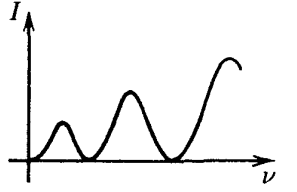
12.1.13. A charged flat capacitor is swung by moving it parallel to the plates. As the oscillation frequency
Solution
We can represent the capacitor plates as two planes with surface charges
Since the charges are opposite, the currents are directed in opposite directions. This means the electromagnetic waves emitted by them have an intrinsic initial phase difference of
For a distant observer located on a line perpendicular to the plates, the waves from the two plates travel different distances. The path difference is equal to the distance between the plates,
This path difference creates an additional phase shift
The total intensity of the emitted radiation is determined by the interference of these two waves. Since they start in anti-phase, the total phase difference is
Destructive interference (zero intensity) occurs when the path delay
Constructive interference (intensity maxima) occurs when the path difference corresponds to an odd number of half-wavelengths, reinforcing the anti-phased sources:
For the 1st maximum (
Note: The alternation is explained by the interference of waves from the two plates. The fact that the peaks on the graph get progressively higher is because the radiation intensity of an accelerating charge itself grows proportionally to the square of the frequency (
Answer
Does not emit at
maxima at