Statement
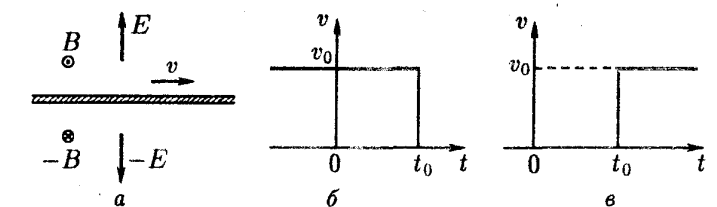
12.1.14∗. A charged plate, the electric field strength of which is
The index
Prove the validity of the formula
Solution
Let's prove the formula using the basic laws of electrodynamics.
The static electric field of an infinite charged plate is directed along the normal to it (along the x-axis) and is equal to
. When the plate begins to move parallel to itself with a velocity
, it creates a surface current . According to Ampere's law, this surface current generates a magnetic field near the plate (as
) equal to:
By multiplying the numerator and denominator byand considering that , and , we obtain the boundary condition for the magnetic field at the plate surface: Any change in this magnetic field (caused by a change in velocity) detaches from the plate and propagates through space as a plane electromagnetic wave at the speed of light
. Consequently, the field at a distance at time exactly repeats the field at the plate, but delayed by a time : In a traveling plane electromagnetic wave, the transverse electric field strength
(which is directed parallel to the plate) and the magnetic induction are strictly related by . Substituting the derived expression for
into this relation, we arrive at the required formula:
Application to graphs (b) and (c):
The derived formula is universal because the wave equation is linear, and the boundary condition
- For graph (b): the velocity drops abruptly from
to at time . In space, this will look like a wavefront behind which (closer to the plate) the transverse field is zero, and ahead of which it is . This termination front moves away from the plate at speed . - For graph (c): the velocity increases abruptly from
to at time . This generates a wavefront behind which a uniform transverse field is established, propagating behind the front at speed .
In both cases, the formulaprovides the exact instantaneous value of the radiated field at any point in space.