New solution

en/14.1.4.md
+37 −0
| @@ -0,0 +1,37 @@ | |||
| + | ### Statement | ||
| + | |||
| + | $14.1.4.$ [Insert the problem statement] | ||
| + | |||
| + | ### Solution | ||
| + | |||
| + |  | ||
| + | |||
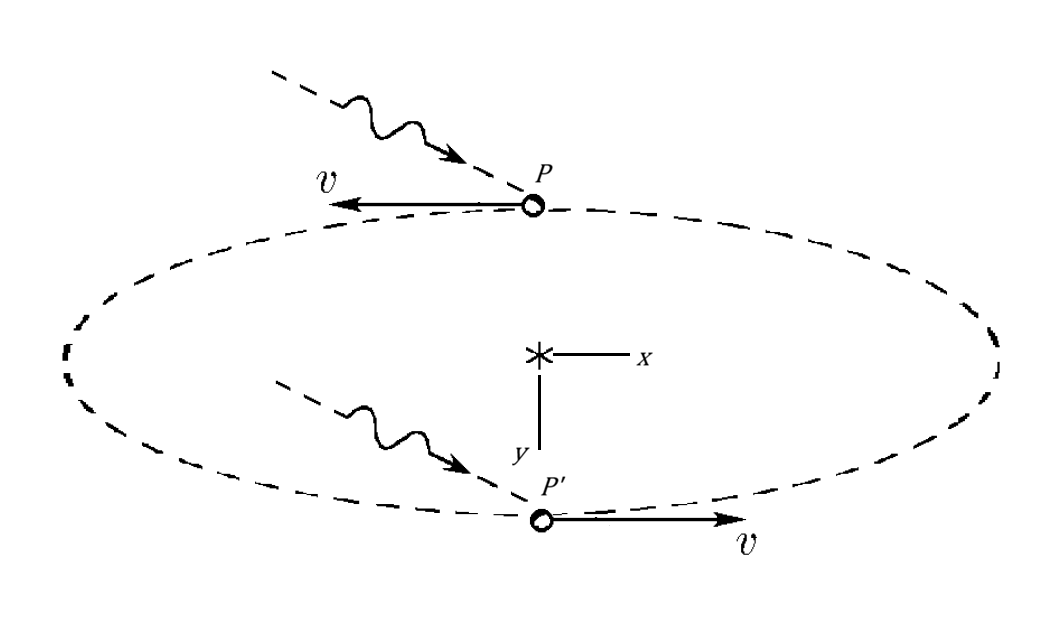
| + | The radius of the Earth's orbit around the Sun is around $500$ light-seconds making its circumference roughly $52$ light-minutes (while the Earth takes around $365$ days to complete one orbit). Thus, the speed $v=\beta c$ of the Earth relative to the Sun is much smaller than the speed of light, i.e. $\beta\approx10^{-4}\ll1$. Although nonrelativistic analysis is sufficient, we will use relativistic consideration until the algebra involved becomes too cumbersome, at which point appropriate estimates will be made. | ||
| + | |||
| + | Relative to the Sun, the velocities of the Earth at $P$ and $P'$ are $-v$ and $v$ along the $x$-axis, respectively. Consequently, the velocity of the Earth at $P'$ relative to the Earth at $P$ is | ||
| + | |||
| + | \[\frac{\beta c-(-\beta c)}{1-\beta(-\beta)}=\frac{2\beta c}{1+\beta^2}=kc,\] | ||
| + | |||
| + | where $k=2\beta/(1+\beta^2)$. Relative to the Earth at $P$, the $x$ and $y$ components of the velocity of light are $u_x=c\cos\alpha$ and $u_y=c\sin\alpha$, respectively. Relative to the Earth at $P'$, the $x$ and $y$ components of the velocity of light are | ||
| + | |||
| + | \[u_x'=\frac{u_x-kc}{1-u_x\cdot kc/c^2}=\frac{c(\cos\alpha-k)}{1-k\cos\alpha}\] | ||
| + | |||
| + | and | ||
| + | |||
| + | \[u_y'=\frac{u_y}{\gamma(1-u_x\cdot kc/c^2)}=\frac{c\sin\alpha}{\gamma(1-k\cos\alpha)},\] | ||
| + | |||
| + | respectively, where $\gamma=1/\sqrt{1-k^2}$. Let the angle that light makes with the direction of motion of the Earth at $P'$ be $\alpha+\Delta\alpha$. Then, | ||
| + | |||
| + | \[\tan(\alpha+\Delta\alpha)=\frac{u_y'}{u_x'}=\frac{\sin\alpha}{\gamma(\cos\alpha-k)}.\] | ||
| + | |||
| + | Since $\beta^2\approx0$, we have $k\approx2\beta$ and $\gamma\approx1$. If $k\ll\cos\alpha$, which is true unless $\alpha$ is close to $90^\circ$, then $\Delta\alpha$ is small, and | ||
| + | |||
| + | \[\tan(\alpha+\Delta\alpha)\approx\tan\alpha+(\sec\alpha)^2\Delta\alpha.\] | ||
| + | |||
| + | Thus, | ||
| + | |||
| + | \[\Delta\alpha\approx(\cos\alpha)^2\left(\frac{\sin\alpha}{(\cos\alpha-2\beta)}-\tan\alpha\right)\approx2\beta\sin\alpha.\] | ||
| + | |||
| + | #### Answer | ||
| + | |||
| + | [Insert a concise answer or boxed result] | ||
| @@ -0,0 +1,37 @@ | |||
| ### Statement | |||
| $14.1.4.$ [Insert the problem statement] | |||
| ### Solution | |||
|  | |||
| The radius of the Earth's orbit around the Sun is around $500$ light-seconds making its circumference roughly $52$ light-minutes (while the Earth takes around $365$ days to complete one orbit). Thus, the speed $v=\beta c$ of the Earth relative to the Sun is much smaller than the speed of light, i.e. $\beta\approx10^{-4}\ll1$. Although nonrelativistic analysis is sufficient, we will use relativistic consideration until the algebra involved becomes too cumbersome, at which point appropriate estimates will be made. | |||
| Relative to the Sun, the velocities of the Earth at $P$ and $P'$ are $-v$ and $v$ along the $x$-axis, respectively. Consequently, the velocity of the Earth at $P'$ relative to the Earth at $P$ is | |||
| \[\frac{\beta c-(-\beta c)}{1-\beta(-\beta)}=\frac{2\beta c}{1+\beta^2}=kc,\] | |||
| where $k=2\beta/(1+\beta^2)$. Relative to the Earth at $P$, the $x$ and $y$ components of the velocity of light are $u_x=c\cos\alpha$ and $u_y=c\sin\alpha$, respectively. Relative to the Earth at $P'$, the $x$ and $y$ components of the velocity of light are | |||
| \[u_x'=\frac{u_x-kc}{1-u_x\cdot kc/c^2}=\frac{c(\cos\alpha-k)}{1-k\cos\alpha}\] | |||
| and | |||
| \[u_y'=\frac{u_y}{\gamma(1-u_x\cdot kc/c^2)}=\frac{c\sin\alpha}{\gamma(1-k\cos\alpha)},\] | |||
| respectively, where $\gamma=1/\sqrt{1-k^2}$. Let the angle that light makes with the direction of motion of the Earth at $P'$ be $\alpha+\Delta\alpha$. Then, | |||
| \[\tan(\alpha+\Delta\alpha)=\frac{u_y'}{u_x'}=\frac{\sin\alpha}{\gamma(\cos\alpha-k)}.\] | |||
| Since $\beta^2\approx0$, we have $k\approx2\beta$ and $\gamma\approx1$. If $k\ll\cos\alpha$, which is true unless $\alpha$ is close to $90^\circ$, then $\Delta\alpha$ is small, and | |||
| \[\tan(\alpha+\Delta\alpha)\approx\tan\alpha+(\sec\alpha)^2\Delta\alpha.\] | |||
| Thus, | |||
| \[\Delta\alpha\approx(\cos\alpha)^2\left(\frac{\sin\alpha}{(\cos\alpha-2\beta)}-\tan\alpha\right)\approx2\beta\sin\alpha.\] | |||
| #### Answer | |||
| [Insert a concise answer or boxed result] | |||