14.1.4∗. According to observations from Earth, the light of a distant star falls on the Earth at an angle $\alpha$ to the direction of its motion when the Earth is approaching the star with the greatest speed. How much will this angle change when the Earth's speed reverses its direction?
Solution
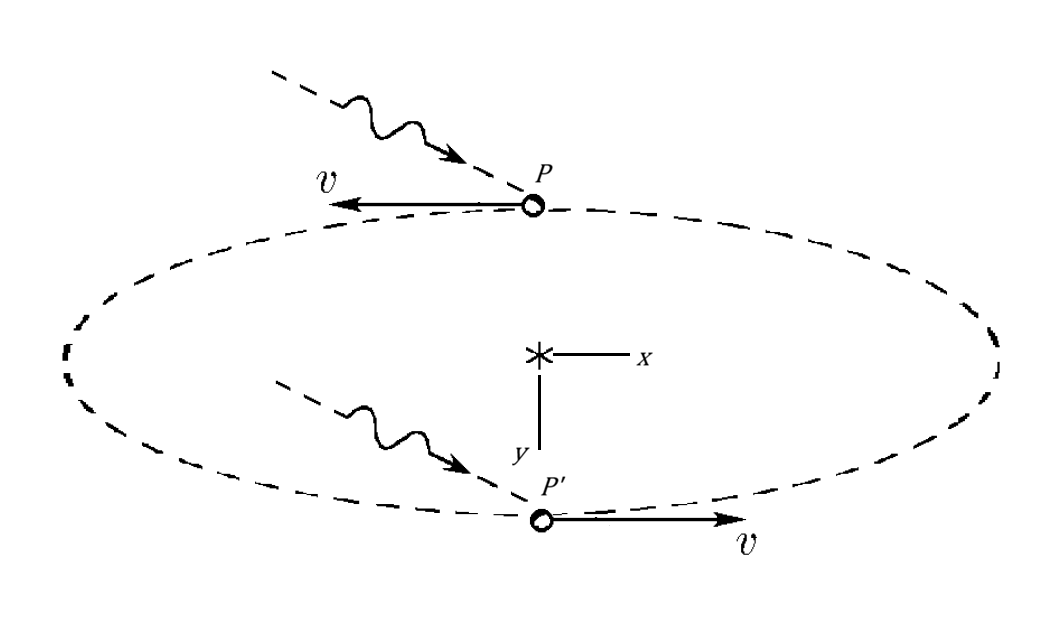
For problem $14.1.4$
The radius of the Earth's orbit around the Sun is around $500$ light-seconds making its circumference roughly $52$ light-minutes (while the Earth takes around $365$ days to complete one orbit). Thus, the speed $v=\beta c$ of the Earth relative to the Sun is much smaller than the speed of light, i.e. $\beta\approx10^{-4}\ll1$. Although nonrelativistic analysis is sufficient, we will use relativistic consideration until the algebra involved becomes too cumbersome, at which point appropriate estimates will be made.
Relative to the Sun, the velocities of the Earth at $P$ and $P'$ are $-v$ and $v$ along the $x$-axis, respectively. Consequently, the velocity of the Earth at $P'$ relative to the Earth at $P$ is
where $k=2\beta/(1+\beta^2)$. Relative to the Earth at $P$, the $x$ and $y$ components of the velocity of light are $u_x=c\cos\alpha$ and $u_y=c\sin\alpha$, respectively. Relative to the Earth at $P'$, the $x$ and $y$ components of the velocity of light are
respectively, where $\gamma=1/\sqrt{1-k^2}$. Let the angle that light makes with the direction of motion of the Earth at $P'$ be $\alpha+\Delta\alpha$. Then,
Since $\beta^2\approx0$, we have $k\approx2\beta$ and $\gamma\approx1$. If $k\ll\cos\alpha$, which is true unless $\alpha$ is close to $90^\circ$, then $\Delta\alpha$ is small, and