Statement
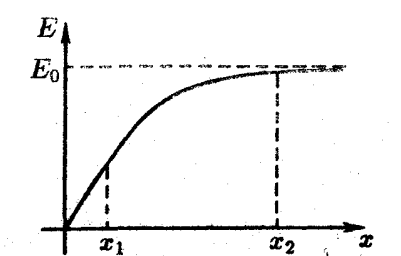
12.1.17. The thicker the film, the greater the amplitude of the electric field strength of an electromagnetic wave reflected from a conductive film. The figure shows a typical dependence of the reflected wave amplitude on the film thickness. Initially (in the region
Solution
This behavior is explained by the interaction of the electromagnetic wave with the free electrons of the material.
- For very small thicknesses (
), the film is semi-transparent. The incident wave penetrates completely and sets all the free electrons of the film into motion. The induced current, and therefore the re-emitted field (reflected wave), is proportional to the number of electrons and, consequently, to the thickness . Hence, the reflected amplitude grows linearly with . - As the thickness increases (
), it reaches a dimension comparable to the penetration depth (skin depth) of the material at that frequency. The incident wave no longer passes completely through the film without attenuation; the deeper layers are shielded and contribute less and less to the induced current. The growth of the reflected amplitude slows down, and the dependence is no longer linear. - When the thickness greatly exceeds the penetration depth (
), the film behaves like a bulk conductor. The incident wave is almost completely attenuated before reaching the back face. All the non-dissipated energy is re-emitted backward, and the amplitude of the reflected wave asymptotically approaches the incident amplitude . Beyond this point, increasing the thickness practically does not change the reflection.