Edits to “Statement”, “Solution”, “Answer”

en/2.2.18.md
+3 −3
| @@ -1,13 +1,13 @@ | |||
| ### Statement | |||
| − | $2.2.18.$ [Insert the problem statement] | ||
| + | $2.2.18.$ Two charged particles of mass $m$ and $2m$, having equal momenta in modulus, simultaneously fly towards each other from points A and B. The particles only interact with each other. Use the trajectory of a particle of mass $2m$ shown in the figure to reconstruct the trajectory of the other particle. | ||
| ### Solution | |||
| − | 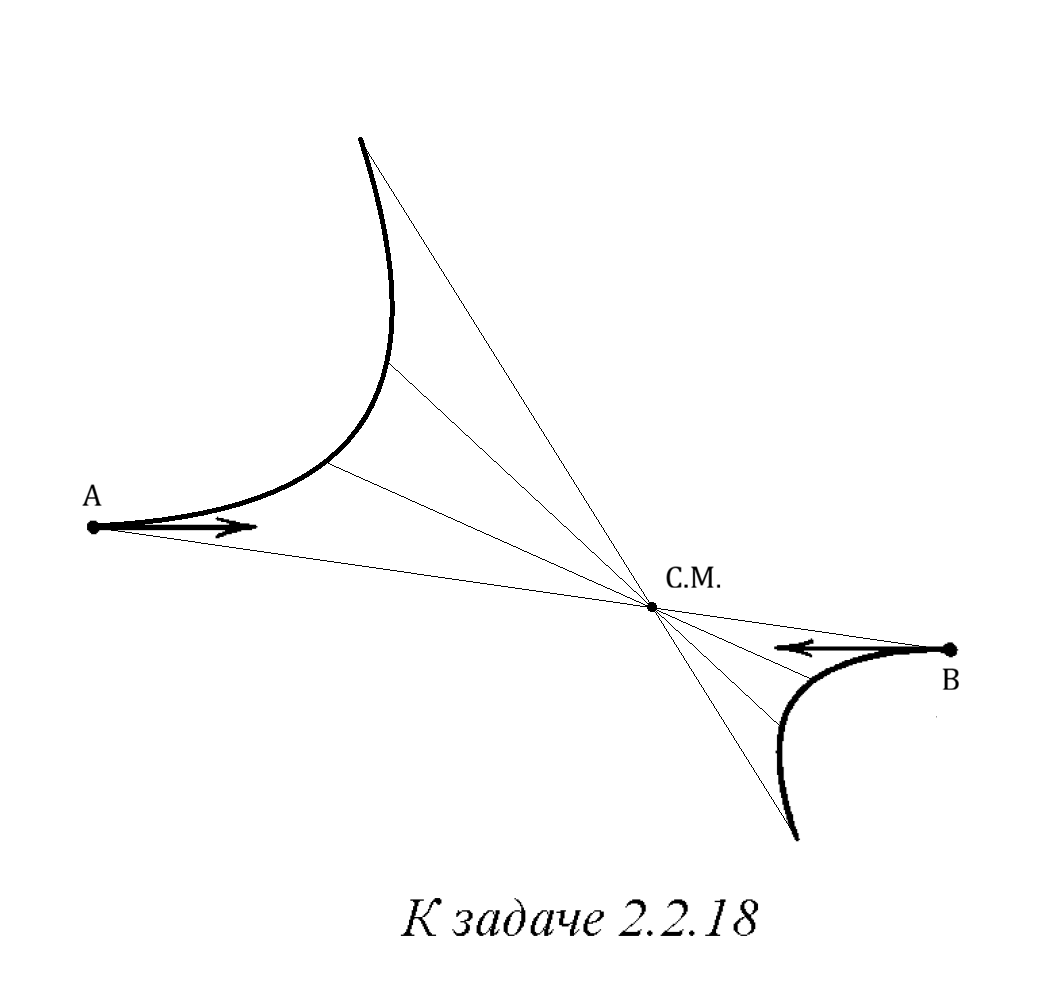 | ||
| Since total momentum of the system is zero, the center of mass (C.M.) remains stationary. The C.M. is on the line segment joining the two particles so that it is twice as far from the particle with mass $m$ as it is from the particle with mass $2m$. Thus, the trajectory of the particle with mass $m$ is obtained by reflecting the trajectory of the particle with mass $2m$ across the C.M. and enlarging it by a factor of 2. | |||
| #### Answer | |||
| − | [Insert a concise answer or boxed result] | ||
| + | See the figure. | ||
| @@ -1,13 +1,13 @@ | |||
| ### Statement | ### Statement | ||
| $2.2.18.$ [Insert the problem statement] | $2.2.18.$ Two charged particles of mass $m$ and $2m$, having equal momenta in modulus, simultaneously fly towards each other from points A and B. The particles only interact with each other. Use the trajectory of a particle of mass $2m$ shown in the figure to reconstruct the trajectory of the other particle. | ||
| ### Solution | ### Solution | ||
|  | ||
| Since total momentum of the system is zero, the center of mass (C.M.) remains stationary. The C.M. is on the line segment joining the two particles so that it is twice as far from the particle with mass $m$ as it is from the particle with mass $2m$. Thus, the trajectory of the particle with mass $m$ is obtained by reflecting the trajectory of the particle with mass $2m$ across the C.M. and enlarging it by a factor of 2. | Since total momentum of the system is zero, the center of mass (C.M.) remains stationary. The C.M. is on the line segment joining the two particles so that it is twice as far from the particle with mass $m$ as it is from the particle with mass $2m$. Thus, the trajectory of the particle with mass $m$ is obtained by reflecting the trajectory of the particle with mass $2m$ across the C.M. and enlarging it by a factor of 2. | ||
| #### Answer | #### Answer | ||
| [Insert a concise answer or boxed result] | See the figure. | ||