Edits to “Statement”, “Solution”, “Answer”

en/8.2.28.md
+8 −4
| @@ -1,13 +1,17 @@ | |||
| ### Statement | |||
| − | $8.2.28.$ [Insert the problem statement] | ||
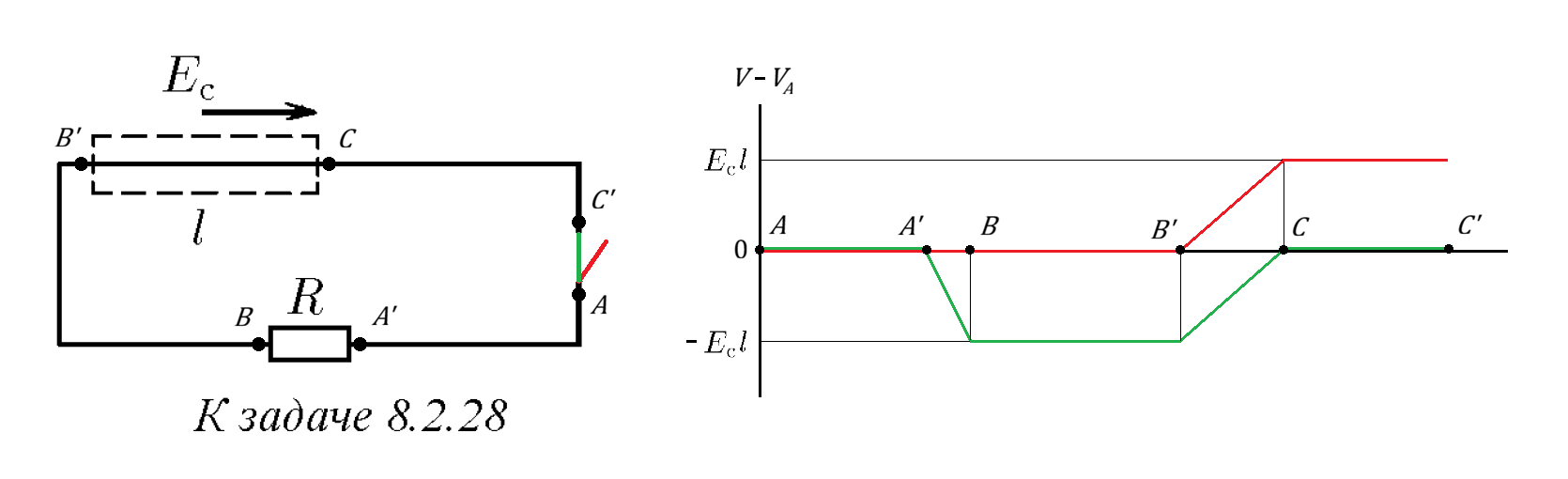
| + | $8.2.28.$ Without delving into the question of the origin of external forces, plot the potential of an open and closed circuit with resistance $R$. On a section of the circuit of length $l$, the force assigned to the unit of charge is equal to $E_c$, and outside this section it is zero. What energy per unit charge is transmitted by the source of external forces in the section $l$? | ||
| + | |||
| + | |||
| ### Solution | |||
| − |  | ||
| − | The force per unit charge $E_c$ is equivalent to the electric field strength. Thus, the work done per unit charge by the force on a section $l$ of the circuit is $W=E_cl$, which is the same as the potential difference between | ||
| + | The force per unit charge $E_c$ is equivalent to the electric field strength. Thus, the work done per unit charge by the force on a section $l$ of the circuit is $W=E_c\,l$, which is the same as the potential difference between points $C$ and $B'$. The graphs show potential difference between each point in the circuit and point $A$. When the circuit is open (shown in red), the only change in potential is across the section of length $l$. When the circuit is closed (shown in green), there is also potential drop of $-E_c\,l$ across the resistor. (Note the discontinuity in the potential between points $C'$ and $A$ in the open circuit.) | ||
| #### Answer | |||
| − | [Insert a concise answer or boxed result] | ||
| + | See the figure. | ||
| + | |||
| + | $W=E_c\,l$ | ||
| @@ -1,13 +1,17 @@ | |||
| ### Statement | ### Statement | ||
| $8.2.28.$ [Insert the problem statement] | $8.2.28.$ Without delving into the question of the origin of external forces, plot the potential of an open and closed circuit with resistance $R$. On a section of the circuit of length $l$, the force assigned to the unit of charge is equal to $E_c$, and outside this section it is zero. What energy per unit charge is transmitted by the source of external forces in the section $l$? | ||
| ### Solution | ### Solution | ||
|  | ||
| The force per unit charge $E_c$ is equivalent to the electric field strength. Thus, the work done per unit charge by the force on a section $l$ of the circuit is $W=E_cl$, which is the same as the potential difference between |
The force per unit charge $E_c$ is equivalent to the electric field strength. Thus, the work done per unit charge by the force on a section $l$ of the circuit is $W=E_c\,l$, which is the same as the potential difference between points $C$ and $B'$. The graphs show potential difference between each point in the circuit and point $A$. When the circuit is open (shown in red), the only change in potential is across the section of length $l$. When the circuit is closed (shown in green), there is also potential drop of $-E_c\,l$ across the resistor. (Note the discontinuity in the potential between points $C'$ and $A$ in the open circuit.) | ||
| #### Answer | #### Answer | ||
| [Insert a concise answer or boxed result] | See the figure. | ||
| $W=E_c\,l$ | |||