| @@ -1,23 +1,23 @@ |
| ### Statement |
| ### Statement |
| |
| |
| $2.7.28.$ [Insert the problem statement] |
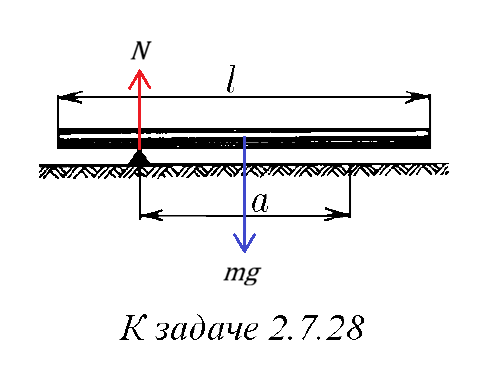
| $2.7.28.$ A thin homogeneous stick of length $l$ and mass $m$ lies symmetrically on supports whose distance is equal to $a$. One of the supports is quickly removed. What is the reaction force of the remaining support immediately afterwards? |
| |
| |
| ### Solution |
| ### Solution |
| |
| |
|  |
|  |
| |
| |
| Since the moment of inertia and the clockwise moment with respect to the center of mass are $ml^2/12$ and $Na/2$, respectivly, the angular acceleration is |
| Since the moment of inertia and the clockwise moment with respect to the center of mass are $ml^2/12$ and $Na/2$, respectivly, the angular acceleration is |
| |
| |
| \[\frac{Na/2}{ml^2/12}=\frac{6Na}{ml^2}.\] |
| \[\frac{Na/2}{ml^2/12}=\frac{6Na}{ml^2}.\] |
| |
| |
| Similarly, since the moment of inertia and the clockwise moment with respect to the remaining support are $ml^2/12+m(a/2)^2$ and $mga/2$, respectively, the angular acceleration is |
| Similarly, since the moment of inertia and the clockwise moment with respect to the remaining support are $ml^2/12+m(a/2)^2$ and $mga/2$, respectively, the angular acceleration is |
| |
| |
| \[\frac{mga/2}{ml^2/12+m(a/2)^2}=\frac{6ga}{l^2+3a^)}.\] |
| \[\frac{mga/2}{ml^2/12+m(a/2)^2}=\frac{6ga}{l^2+3a^2}.\] |
| |
| |
| Equating the two expressions for the angular acceleration, we have |
| Equating the two expressions for the angular acceleration, we have |
| |
| |
| \[\frac{6Na}{ml^2}=\frac{6ga}{l^2+3a^2}\qquad\Rightarrow\qquad N=\frac{mgl^2}{l^2+3a^2}.\] |
| \[\frac{6Na}{ml^2}=\frac{6ga}{l^2+3a^2}\qquad\Rightarrow\qquad N=\frac{mgl^2}{l^2+3a^2}.\] |
| |
| |
| #### Answer |
| #### Answer |
| |
| |
| [Insert a concise answer or boxed result] |
| $N=\frac{mgl^2}{l^2+3a^2}$ |
