New solution

en/4.1.18.md
+13 −0
| @@ -0,0 +1,13 @@ | |||
| + | ### Statement | ||
| + | |||
| + | $4.1.18.$ [Insert the problem statement] | ||
| + | |||
| + | ### Solution | ||
| + | |||
| + |  | ||
| + | |||
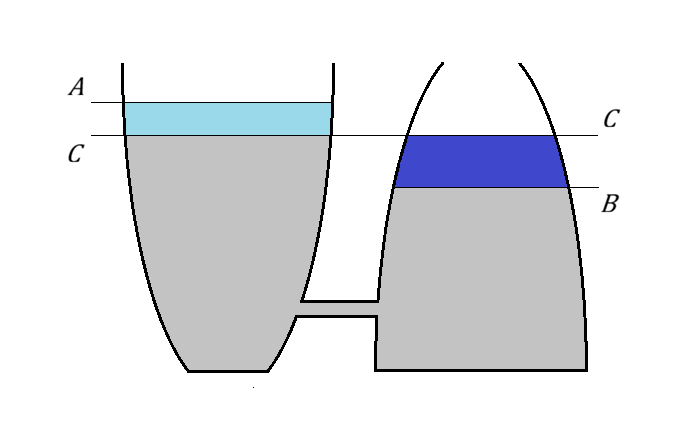
| + | Comparing the moment when the levels ($A$ and $B$) of liquid in both vessels are different to the moment when they are the same ($C$), we see that the decrease in gravitational potential energy of the system is that of the liquid in light blue dropping to where the liquid in dark blue (with the same volume and mass) is. Thus, the total gravitational potential energy of the system is lowest when the levels of liquid in both vessels are the same. | ||
| + | |||
| + | #### Answer | ||
| + | |||
| + | [Insert a concise answer or boxed result] | ||
| @@ -0,0 +1,13 @@ | |||
| ### Statement | |||
| $4.1.18.$ [Insert the problem statement] | |||
| ### Solution | |||
|  | |||
| Comparing the moment when the levels ($A$ and $B$) of liquid in both vessels are different to the moment when they are the same ($C$), we see that the decrease in gravitational potential energy of the system is that of the liquid in light blue dropping to where the liquid in dark blue (with the same volume and mass) is. Thus, the total gravitational potential energy of the system is lowest when the levels of liquid in both vessels are the same. | |||
| #### Answer | |||
| [Insert a concise answer or boxed result] | |||