13.4.25∗. In an optical communication system, a laser beam transmitting information has the shape of a cone with a vertex angle of $10^{-4}$ rad (divergence angle). At the receiving device, the light energy is focused on a photocell using a $1$ m lens. It turned out that when the distance between the transmitter and receiver changed from $5$ to $10$ km, the signal received from the photocell decreased by a factor of two (due to light absorption in the atmosphere). By what factor will the signal change when the distance increases from $10$ to $20$ km?
Solution
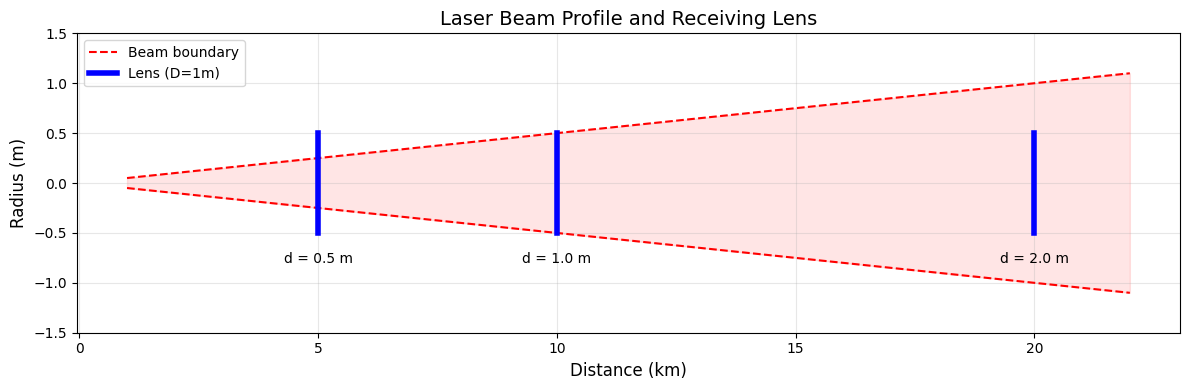
Let's determine the diameter of the laser beam at different distances.
At a distance $r_1 = 5$ km, the diameter is $d_1 = \alpha r_1 = 10^{-4} \cdot 5000 = 0.5$ m.
At a distance $r_2 = 10$ km, the diameter is $d_2 = \alpha r_2 = 10^{-4} \cdot 10000 = 1.0$ m.
At a distance $r_3 = 20$ km, the diameter is $d_3 = \alpha r_3 = 10^{-4} \cdot 20000 = 2.0$ m.
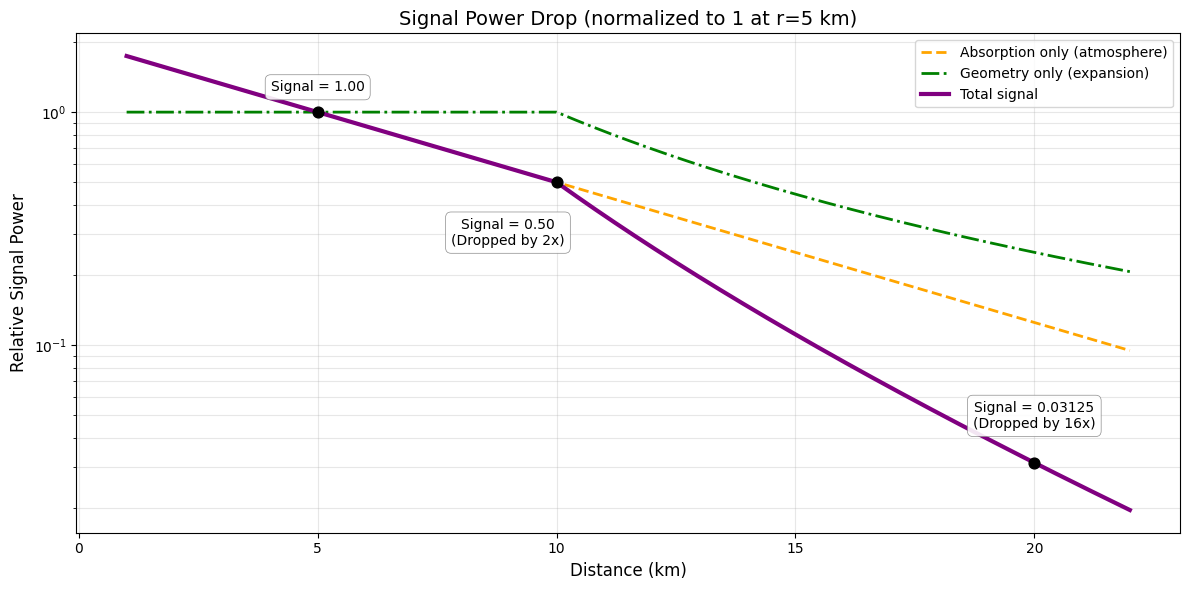
Since the lens diameter is $D = 1$ m, at distances of $5$ km and $10$ km, the entire laser beam enters the lens ($d_1 < D$ and $d_2 = D$). The signal reduction by a factor of $2$ between $5$ km and $10$ km is solely due to absorption in the $5$ km thick atmospheric layer.
According to the Beer-Lambert-Bouguer law, absorption is exponential. Therefore, passing through every $5$ km of the atmosphere attenuates the signal by half.
When the distance increases from $10$ to $20$ km, the light travels an additional $10$ km (two $5$ km layers). Thus, due to absorption in the atmosphere, the signal will decrease by a factor of $2^2 = 4$.
Furthermore, at $20$ km, the beam diameter $d_3 = 2$ m exceeds the lens diameter $D = 1$ m. The fraction of energy captured by the lens is proportional to the ratio of their areas: $$\frac{S_{\text{lens}}}{S_{\text{beam}}} = \frac{D^2}{d_3^2} = \left(\frac{1}{2}\right)^2 = \frac{1}{4}$$
This means the signal decreases by another factor of $4$ due to the geometric expansion of the beam.
The total signal reduction factor is the product of both effects: $$N = 4 \cdot 4 = 16$$
Answer
$N = 16$
Note: there is a typo in the official answer in the problem book.