Edits to “Statement”, “Solution”, “Answer”

en/11.1.13.md
+4 −4
| @@ -1,13 +1,13 @@ | |||
| ### Statement | |||
| − | $11.1.13.$ [Insert the problem statement] | ||
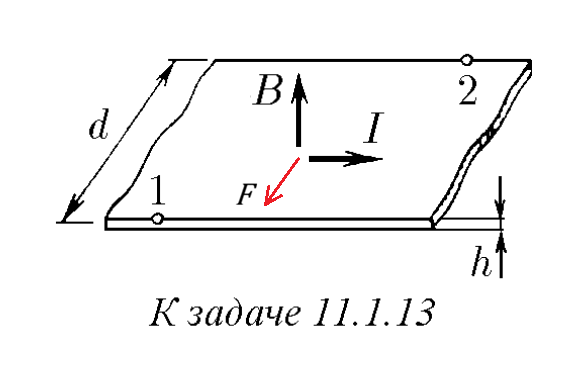
| + | $11.1.13.$ A current flows through a conducting tape of width $d$. The tape is in a magnetic field of induction $B$. The field direction is perpendicular to its plane. Find the potential difference between points $1$ and $2$ of the tape if its thickness is $h$ and the bulk charge density of current carriers on it is $\rho$. | ||
| ### Solution | |||
| − |  | ||
| − | Consider a section of the tape of length $l$. The magnetic force on the charge in the tape is $F=IlB$. In this section of the tape, the total charge is $ | ||
| + | Consider a section of the tape of length $l$. The magnetic force on the charge in the tape is $F=IlB$. In this section of the tape, the total charge is $q=\rho dlh$. Consequently, the force per unit charge $F/q=IB/(\rho dh)$ is equivalent to an electric field $E$. Thus, the potential difference between the near edge and the far edge of the tape is $V=Ed=IB/(\rho h)$. | ||
| #### Answer | |||
| − | [Insert a concise answer or boxed result] | ||
| + | $\frac{IB}{\rho h}$ | ||
| @@ -1,13 +1,13 @@ | |||
| ### Statement | ### Statement | ||
| $11.1.13.$ [Insert the problem statement] | $11.1.13.$ A current flows through a conducting tape of width $d$. The tape is in a magnetic field of induction $B$. The field direction is perpendicular to its plane. Find the potential difference between points $1$ and $2$ of the tape if its thickness is $h$ and the bulk charge density of current carriers on it is $\rho$. | ||
| ### Solution | ### Solution | ||
|  | ||
| Consider a section of the tape of length $l$. The magnetic force on the charge in the tape is $F=IlB$. In this section of the tape, the total charge is $ |
Consider a section of the tape of length $l$. The magnetic force on the charge in the tape is $F=IlB$. In this section of the tape, the total charge is $q=\rho dlh$. Consequently, the force per unit charge $F/q=IB/(\rho dh)$ is equivalent to an electric field $E$. Thus, the potential difference between the near edge and the far edge of the tape is $V=Ed=IB/(\rho h)$. | ||
| #### Answer | #### Answer | ||
| [Insert a concise answer or boxed result] | $\frac{IB}{\rho h}$ | ||