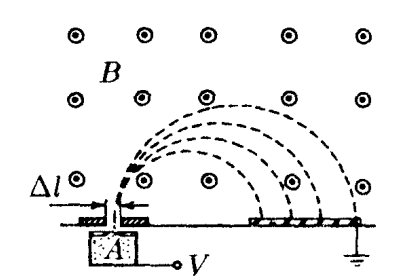
10.1.8. The figure shows a simple mass spectrometer in which the magnetic field induction is 0.1 T. Ions are formed in the ionizer A and are accelerated by a voltage of 10 kV. After turning in the magnetic field, the ions hit a photographic plate and cause it to blacken. At what distance from the slit will the bands of $^1H^+$,$^2H^+$,$^3H^+$, and $^4He^+$ ions be located on the photographic plate? What should be the slit width for the bands of $^{16}O^+$ and $^{15}N^+$ ions to separate?
For problem $10.1.8$
Solution
Let us use the solution to problem 10.1.1. There, the radius of the circle along which a charged particle moves in a magnetic field was found: $$R = \sqrt{\frac{2mU}{qB^2}}$$ where $m$ is the mass of the particle, $q$ is the charge of the particle, $U$ is the accelerating voltage, and $B$ is the magnetic field induction.
The trajectory of the particle is a semicircle, so the distance from the slit to the point of impact on the photographic plate is: $$x = 2R = 2 \cdot \sqrt{\frac{2mU}{qB^2}} = \sqrt{\frac{8mU}{qB^2}}$$
In our problem, all particles are ions, which means their charge is the same and is equal to the electron charge with a plus sign.
For $^1H^+$, the mass is $m = 1.67 \cdot 10^{-27}$ kg. Substituting the numerical data, we obtain: $x_1 = 0.29$ m.
For $^2H^+$, the mass is $m = 3.34 \cdot 10^{-27}$ kg. Substituting the numerical data, we obtain: $x_2 = 0.41$ m.
For $^3H^+$, the mass is $m = 5.01 \cdot 10^{-27}$ kg. Substituting the numerical data, we obtain: $x_3 = 0.5$ m.
For $^4He^+$, the mass is $m = 6.68 \cdot 10^{-27}$ kg. Substituting the numerical data, we obtain: $x_4 = 0.58$ m.
For the bands of $^{16}O^+$ and $^{15}N^+$ ions to separate, the distance between them, $x_O - x_N$, must be greater than the slit width: $$\Delta l < x_O - x_N$$
For $^{15}N^+$, the mass is $m = 2.505 \cdot 10^{-26}$ kg; for $^{16}O^+$, the mass is $m = 2.672 \cdot 10^{-26}$ kg. Substituting the numerical values, we obtain: $$\Delta l < 3.7 \text{ cm}$$