New solution

en/13.1.8.md
+13 −0
| @@ -0,0 +1,13 @@ | |||
| + | ### Statement | ||
| + | |||
| + | $13.1.8.$ [Insert the problem statement] | ||
| + | |||
| + | ### Solution | ||
| + | |||
| + |  | ||
| + | |||
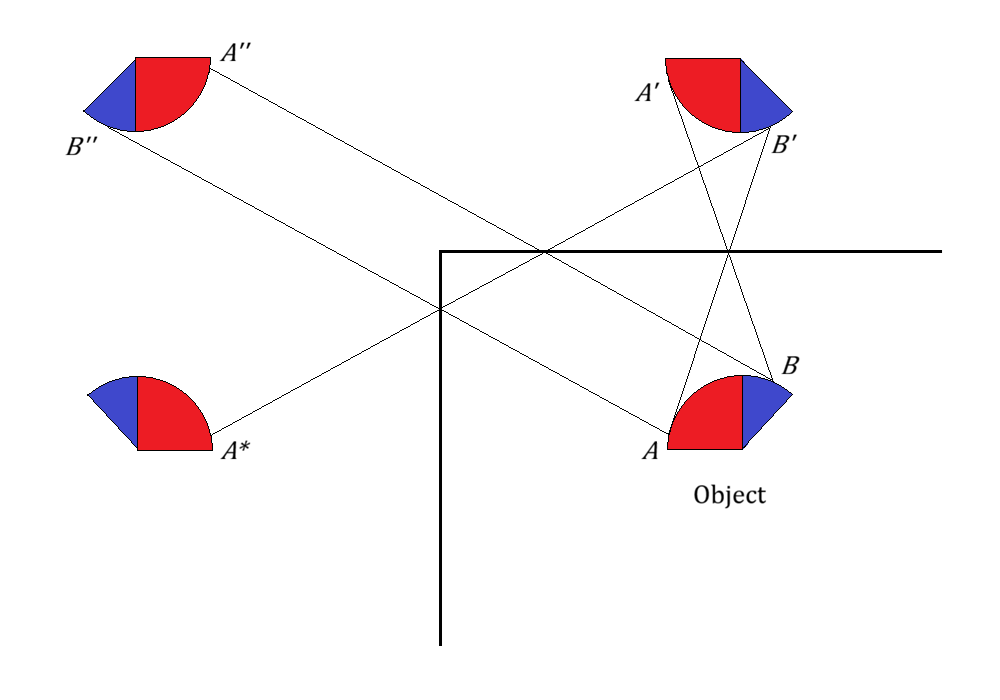
| + | While there are images created by a single reflection at each mirror, we are interested in the image created by two consecutive reflections at both mirrors. An observer at $A$ can see such image of point $B$ at $B''$, while an observer at $B$ can see such image of point $A$ at $A''$. (Needless to say, an observer can see an image when facing it.) Unlike the images created by a single reflection (such as those at $A'$ and $B'$, the image created by two consecutive reflections are not inverted (or doubly inverted). Note that the image of point $A$ at $A*$ is not observable by the observer at $B$, but may be observed from other positions. | ||
| + | |||
| + | #### Answer | ||
| + | |||
| + | [Insert a concise answer or boxed result] | ||
| @@ -0,0 +1,13 @@ | |||
| ### Statement | |||
| $13.1.8.$ [Insert the problem statement] | |||
| ### Solution | |||
|  | |||
| While there are images created by a single reflection at each mirror, we are interested in the image created by two consecutive reflections at both mirrors. An observer at $A$ can see such image of point $B$ at $B''$, while an observer at $B$ can see such image of point $A$ at $A''$. (Needless to say, an observer can see an image when facing it.) Unlike the images created by a single reflection (such as those at $A'$ and $B'$, the image created by two consecutive reflections are not inverted (or doubly inverted). Note that the image of point $A$ at $A*$ is not observable by the observer at $B$, but may be observed from other positions. | |||
| #### Answer | |||
| [Insert a concise answer or boxed result] | |||