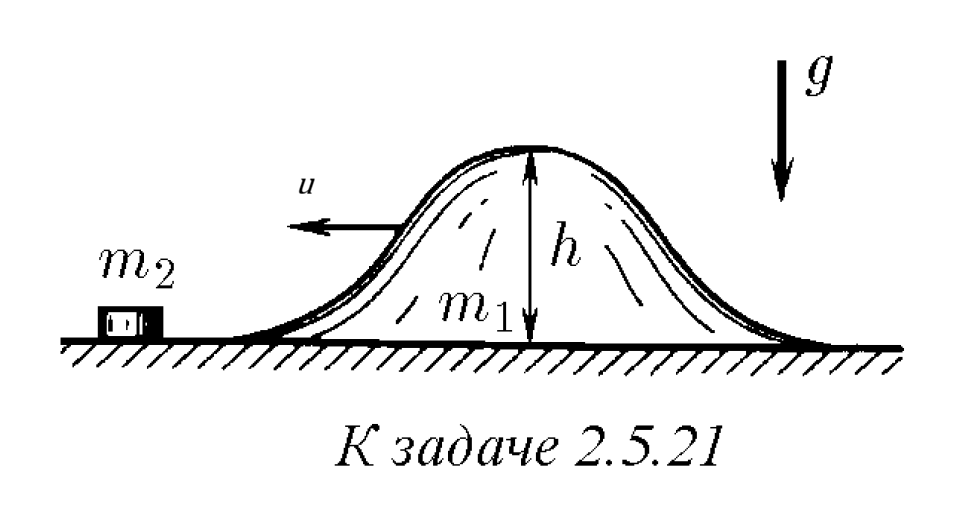
2.5.21∗. A smooth "slide" of height $h$ and mass $m_1$ can slide along a horizontal plane without friction. The slide smoothly turns into a plane. What is the lowest speed of the slide, a small body of mass $m_2$, initially lying motionless on its path, will pass over the top?
Solution
For problem $2.5.21$
Suppose the slide has minimum initial speed $u$. In the frame of reference of the slide, the mass $m_2$ must have barely any kinetic energy left when it reaches the top of the slide. In other words, the slide and the mass must have the same speed $v$ in the original frame of reference when the mass reaches the top. From conservation of momentum,