Statement
2.6.49∗. [Insert the problem statement]
Solution
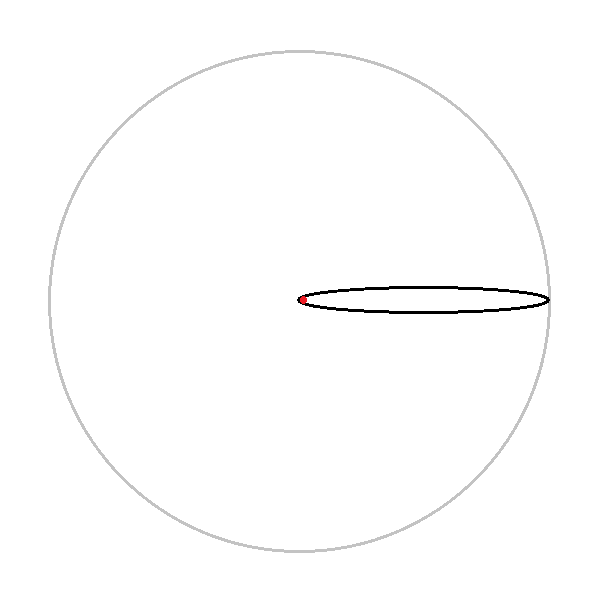
Instead of considering direct falling of the Earth toward the Sun, we can obtain a good estimate for the falling time by assuming that the Earth still has small residual speed and that its orbit changes from an almost circular one to an elliptical one with high eccentricity and its perihelion very close to the Sun, which is at a focal point of the ellipse. (Note that the average distance of the Earth from the Sun is more than
Answer
[Insert a concise answer or boxed result]