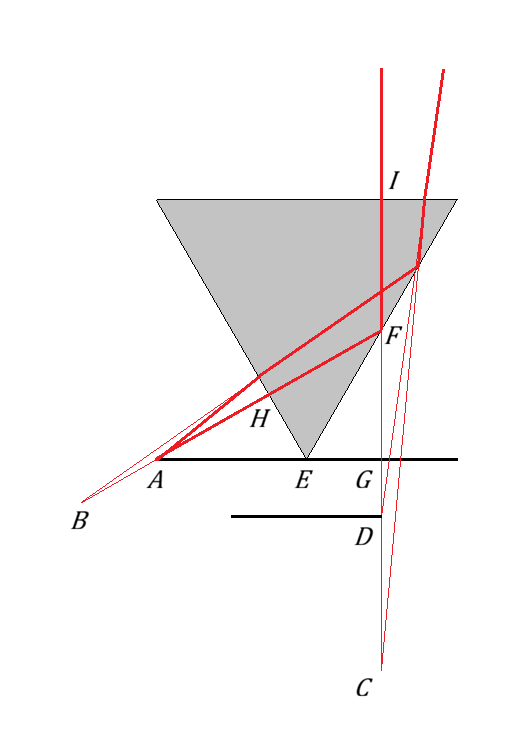
13.2.9. A circle of radius $R$ is blackened on the horizontal plane. In the center of the circle, a glass cone stands vertically, resting its vertex on its center. The refractive index of glass is $n>1.5$. The angle of the cone vertex is $60^\circ$, and the base radius is $R$. The circle is viewed from a great distance along the axis of the cone. What is its visible radius?
Solution
For problem $13.2.9$
After finding the radius of the image, we will also find the location of the image plane. The light ray from the object at point $A$ falling perpendicularly on the left side of the cone at point $H$ will reach point $F$ on the right side of the cone without refraction. At this interface, the critical angle for total internal reflection is $\arcsin(1/n)<\arcsin(2/3)\approx42^\circ$. Since the incident angle is $90^\circ-\angle HFE=60^\circ$, there is total internal reflection. Furthermore, the reflected ray makes a $30^\circ$ angle with the right side of the cone, so it travels vertically upward and does not refract at the base of the cone. As the final image of $A$ must be on this line, the radius of the image equals $EG=EF/2=AE/2=R/2$, because $\triangle AEF$ is isosceles.
To find the location of the image plane, first we see that the image of point $A$ due to refraction at the left side of the cone is at point $B$ so that $BH=n\cdot AH=\sqrt3nR/2$. Then, the image of point $B$ due to reflection at the right side of the cone is at point $C$ so that $CF=BF=\sqrt3(n+1)R/2$, because $AH=HF$. Finally, the image of point $C$ due to refraction at the base of the cone is at point $D$ so that $DI=CI/n=\sqrt3(n+2)R/(2n)$. (Note that since $EF=AE=R$,$F$ is the midpoint of the right side of the cone, and $FI=\sqrt3R/2$.)