Edits to “Statement”, “Solution”, “Answer”

en/11.4.13.md
+7 −7
| @@ -1,21 +1,21 @@ | |||
| ### Statement | |||
| − | $11.4.13.$ [Insert the problem statement] | ||
| + | $11.4.13.$ The values of voltage, current, and phase shift between voltage and current in the load circuit are shown in a vector diagram. Determine the source EMF amplitude if $R=10$ ohms. | ||
| ### Solution | |||
| − | 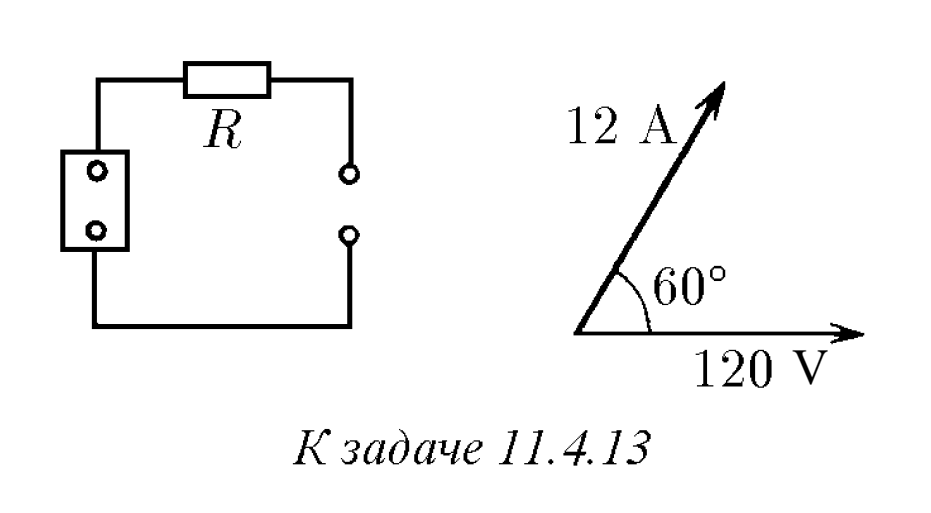 | ||
| − | Let the current through the load (and the resistor $R$) be $I=(12\mbox{ A})e^{i\omega t}$, where $\omega$ is the angular frequency of the source. Then, the voltage drops across the load and the resistor are $V_L=(120\mbox{ V})e^{i(\omega t-\pi/3)}$ and | ||
| + | Let the current through the load (and the resistor $R$) be $I=(12\mbox{ A})\cdot e^{i\omega t}$, where $\omega$ is the angular frequency of the source. Then, the voltage drops across the load and the resistor are $V_L=(120\mbox{ V})\cdot e^{i(\omega t-\pi/3)}$ and | ||
| − | \[V_R=IR=(120\mbox{ V})e^{i\omega t},\] | ||
| + | \[V_R=IR=(120\mbox{ V})\cdot e^{i\omega t},\] | ||
| respectively. Consequently, the EMF of the source is $\mathcal{E}=V_L+V_R$, which becomes | |||
| − | \[\mathcal{E}=(120\mbox{ V})(e^{i\pi/6}+e^{-i\pi/6})e^{i(\omega t-\pi/6)}=(120\mbox{ V})\cdot2\cos\frac{\pi}{6}\cdot e^{i(\omega t-\pi/6).\] | ||
| + | \[\mathcal{E}=(120\mbox{ V})\cdot(e^{i\pi/6}+e^{-i\pi/6})\cdot e^{i(\omega t-\pi/6)}=(120\mbox{ V})\cdot2\cos\frac{\pi}{6}\cdot e^{i(\omega t-\pi/6)}.\] | ||
| − | Thus, the amplitude of the | ||
| + | Thus, the amplitude of the EMF is $120\sqrt3\approx208$ V. | ||
| #### Answer | |||
| − | [Insert a concise answer or boxed result] | ||
| + | $120\sqrt3\approx208$ V | ||
| @@ -1,21 +1,21 @@ | |||
| ### Statement | ### Statement | ||
| $11.4.13.$ [Insert the problem statement] | $11.4.13.$ The values of voltage, current, and phase shift between voltage and current in the load circuit are shown in a vector diagram. Determine the source EMF amplitude if $R=10$ ohms. | ||
| ### Solution | ### Solution | ||
|  | ||
| Let the current through the load (and the resistor $R$) be $I=(12\mbox{ A})e^{i\omega t}$, where $\omega$ is the angular frequency of the source. Then, the voltage drops across the load and the resistor are $V_L=(120\mbox{ V})e^{i(\omega t-\pi/3)}$ and | Let the current through the load (and the resistor $R$) be $I=(12\mbox{ A})\cdot e^{i\omega t}$, where $\omega$ is the angular frequency of the source. Then, the voltage drops across the load and the resistor are $V_L=(120\mbox{ V})\cdot e^{i(\omega t-\pi/3)}$ and | ||
| \[V_R=IR=(120\mbox{ V})e^{i\omega t},\] | \[V_R=IR=(120\mbox{ V})\cdot e^{i\omega t},\] | ||
| respectively. Consequently, the EMF of the source is $\mathcal{E}=V_L+V_R$, which becomes | respectively. Consequently, the EMF of the source is $\mathcal{E}=V_L+V_R$, which becomes | ||
| \[\mathcal{E}=(120\mbox{ V})(e^{i\pi/6}+e^{-i\pi/6})e^{i(\omega t-\pi/6)}=(120\mbox{ V})\cdot2\cos\frac{\pi}{6}\cdot e^{i(\omega t-\pi/6).\] | \[\mathcal{E}=(120\mbox{ V})\cdot(e^{i\pi/6}+e^{-i\pi/6})\cdot e^{i(\omega t-\pi/6)}=(120\mbox{ V})\cdot2\cos\frac{\pi}{6}\cdot e^{i(\omega t-\pi/6)}.\] | ||
| Thus, the amplitude of the |
Thus, the amplitude of the EMF is $120\sqrt3\approx208$ V. | ||
| #### Answer | #### Answer | ||
| [Insert a concise answer or boxed result] | $120\sqrt3\approx208$ V | ||