Edits to “Problem”, “Solution”, “Answer”

en/7.2.6.md
+102 −4
| @@ -1,11 +1,109 @@ | |||
| − | ### | ||
| + | ### Problem | ||
| − | $7.2.6.$ [Insert the problem statement] | ||
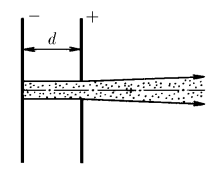
| + | $7.2.6.$ For electrons emitted by one plate of a capacitor, a circular hole in the second plate acts as a single lens if the radius of the hole is much smaller than the distance $d$ between the plates. | ||
| + | $\textbf{a.}$ Does the focal length of this lens depend on the potential difference between the plates? | ||
| + | |||
| + | $\textbf{b*.}$ Determine the focal length of this lens using the formula given in problem $7.1.27a$. Neglect the initial velocity of the electrons. | ||
| + | |||
| + |  | ||
| + | |||
| ### Solution | |||
| − | Studio Ciborg Squad presents | ||
| + | $\textbf{b*.}$ Let us first solve subproblem (b), as its solution will automatically answer the question of subproblem (a). | ||
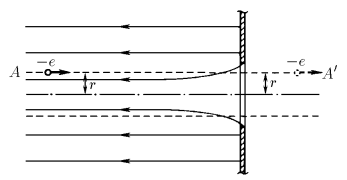
| + | At the edge of the hole, the electric field lines curve. Electrons flying in the beam will experience a transverse force from this "curved field". The figure shows the field lines: | ||
| + | |||
| + |  | ||
| + | |||
| + | Let us place a cylindrical coordinate system at the center of the hole. We direct the $z$-axis along the axis of the capacitor. Before the electron beam passes through, there are no free electric charges inside the capacitor and in the region of the hole itself. Then Gauss's law in differential form is written as follows: | ||
| + | |||
| + | $$\nabla\cdot\vec E=0$$ | ||
| + | |||
| + | In cylindrical coordinates with axial symmetry, when $\frac{\partial }{\partial \varphi}=0$: | ||
| + | |||
| + | $$\frac{1}{r}\frac{\partial (rE_{r}) }{\partial r}+\frac{\partial E_{z}}{\partial z}=0$$ | ||
| + | |||
| + | Consider the region where $r\ll R$, with $R$ being the radius of the hole. In this region, $E_{r}$ is small and grows with $r$; on the axis, the radial component is 0: $E_{r}(0,z)=0$. Under these assumptions, $E_{r}$ can be expanded with respect to $r$: | ||
| + | |||
| + | $$E_{r}(r,z)=\alpha(z)\cdot r+O(r^{2})\Longrightarrow E_{r}(r,z)\approx \alpha(z)\cdot r$$ | ||
| + | |||
| + | Multiplying by $r$: | ||
| + | |||
| + | $$rE_{r}= \alpha(z)\cdot r^{2}$$ | ||
| + | |||
| + | Differentiating: | ||
| + | |||
| + | $$\frac{\partial (rE_{r})}{\partial r}=2\alpha(z)\cdot r$$ | ||
| + | |||
| + | Hence: | ||
| + | |||
| + | $$\frac{1}{r}\frac{\partial (rE_{r})}{\partial r}=2\alpha(z)$$ | ||
| + | |||
| + | Substituting into Gauss's equation: | ||
| + | |||
| + | $$2\alpha(z)+\frac{\partial E_{z}}{\partial z}=0\Longrightarrow \alpha(z)=-\frac{1}{2}\frac{\partial E_{z}}{\partial z}$$ | ||
| + | |||
| + | Substituting back into the radial component expansion: | ||
| + | |||
| + | $$E_{r}(r,z)=-\frac{r}{2}\frac{\partial E_{z}}{\partial z}$$ | ||
| + | |||
| + | This radial component of the field creates a force that changes the radial momentum of the electron: | ||
| + | |||
| + | $$F_{r}=-eE_{r}=\frac{er}{2}\frac{\partial E_{z}}{\partial z}$$ | ||
| + | |||
| + | The change in radial momentum $\Delta p_{r}$ during the flight through the hole is: | ||
| + | |||
| + | $$\Delta p_{r}=\int F_{r}dt=\int F_{r}\frac{dz}{\upsilon_{z}}=\int \frac{er}{2\upsilon_{z}}\frac{\partial E_{z}}{\partial z}dz$$ | ||
| + | |||
| + | Since we consider the hole to be thin, the quantities $r$ and $\upsilon_{z}$ are practically constant during the flight: | ||
| + | |||
| + | $$\Delta p_{r}\approx \frac{er}{2\upsilon_{z}}\int_{E_{1}}^{E_{2}} dE_{z}=\frac{er}{2\upsilon_{z}}\left( E_{2}-E_{1} \right) \tag{1}$$ | ||
| + | |||
| + | Here $E_{1}$ is the electric field strength before the hole (inside the capacitor), and $E_{2}$ is the electric field strength after the hole (outside the capacitor). At the moment of passing through the hole, $r$ represents the radius of the electron beam. | ||
| + | |||
| + | By the definition of focal length, the tangent of the deflection angle is: | ||
| + | |||
| + | $$\tan\beta\approx \beta=\frac{r}{f}\Longrightarrow f=\frac{r}{\beta}$$ | ||
| + | |||
| + | We assume the deflection angle is small due to the small radius of the beam. On the other hand: | ||
| + | |||
| + | $$\tan\beta\approx \beta=\frac{\upsilon_{r}}{\upsilon_{z}}=\frac{\Delta p_{r}}{p_{z}}$$ | ||
| + | |||
| + | Then: | ||
| + | |||
| + | $$f=\frac{rp_{z}}{\Delta p_{r}} \tag{2}$$ | ||
| + | |||
| + | Substituting (1) into (2) and noting that $p_{z}=m\upsilon_{z}$: | ||
| + | |||
| + | $$f=\frac{2\upsilon_{z}\cdot r\cdot m\upsilon_{z}}{er(E_{2}-E_{1})}=\frac{2m\upsilon_{z}^{2}}{e(E_{2}-E_{1})} \tag{3}$$ | ||
| + | |||
| + | According to the law of conservation of energy: | ||
| + | |||
| + | $$\frac{m\upsilon_{z}^{2}}{2}=eU\Longrightarrow m\upsilon_{z}^{2}=2eU$$ | ||
| + | |||
| + | Substituting into (3): | ||
| + | |||
| + | $$f=\frac{2\cdot 2eU}{e(E_{2}-E_{1})}=\frac{4U}{E_{2}-E_{1}} \tag{5}$$ | ||
| + | |||
| + | In our case, the field outside the capacitor is 0, meaning $E_{2}=0$, and the field inside the capacitor is $E_{1}=\frac{U}{d}$. Substituting into (5), we finally obtain: | ||
| + | |||
| + | $$f=\frac{4U}{0-\frac{U}{d}}=-4d$$ | ||
| + | |||
| + | The minus sign for $f$ means that the electrons are scattered (diverging lens). | ||
| + | |||
| + | $\textbf{a.}$ Based on the answer to subproblem (b), we see that the focal length of this lens does not depend on the potential difference between the plates. But this conclusion can also be reached qualitatively. | ||
| + | |||
| + | According to the conservation law, the electron velocity along the $z$-axis is $\upsilon_{z}\sim \sqrt{U}$, meaning the time of flight through the hole, which is the duration the deflecting force acts, is inversely proportional to this velocity: $\Delta t\sim \frac{1}{\upsilon_{z}}\sim \frac{1}{\sqrt{U}}$. | ||
| + | |||
| + | The force deflecting the electrons is $F_{r}\sim E_{r}\sim U$, so the change in velocity in the direction of the force is $\Delta\upsilon_{r}\sim F_{r}\cdot \Delta t\sim U\cdot \frac{1}{\sqrt{U}}=\sqrt{U}$. | ||
| + | |||
| + | The focal length is: | ||
| + | |||
| + | $$f\sim \frac{\Delta\upsilon_{r}}{\upsilon_{z}}=\frac{\sqrt{U}}{\sqrt{U}}=const$$ | ||
| + | |||
| #### Answer | |||
| − | |||
| + | $\textbf{a.}$ Does not depend. | ||
| + | |||
| + | $\textbf{b.}$ $f=-4d$ | ||
| @@ -1,11 +1,109 @@ | |||
| ### |
### Problem | ||
| $7.2.6.$ [Insert the problem statement] | $7.2.6.$ For electrons emitted by one plate of a capacitor, a circular hole in the second plate acts as a single lens if the radius of the hole is much smaller than the distance $d$ between the plates. | ||
| $\textbf{a.}$ Does the focal length of this lens depend on the potential difference between the plates? | |||
| $\textbf{b*.}$ Determine the focal length of this lens using the formula given in problem $7.1.27a$. Neglect the initial velocity of the electrons. | |||
|  | |||
| ### Solution | ### Solution | ||
| Studio Ciborg Squad presents | $\textbf{b*.}$ Let us first solve subproblem (b), as its solution will automatically answer the question of subproblem (a). | ||
| At the edge of the hole, the electric field lines curve. Electrons flying in the beam will experience a transverse force from this "curved field". The figure shows the field lines: | |||
|  | |||
| Let us place a cylindrical coordinate system at the center of the hole. We direct the $z$-axis along the axis of the capacitor. Before the electron beam passes through, there are no free electric charges inside the capacitor and in the region of the hole itself. Then Gauss's law in differential form is written as follows: | |||
| $$\nabla\cdot\vec E=0$$ | |||
| In cylindrical coordinates with axial symmetry, when $\frac{\partial }{\partial \varphi}=0$: | |||
| $$\frac{1}{r}\frac{\partial (rE_{r}) }{\partial r}+\frac{\partial E_{z}}{\partial z}=0$$ | |||
| Consider the region where $r\ll R$, with $R$ being the radius of the hole. In this region, $E_{r}$ is small and grows with $r$; on the axis, the radial component is 0: $E_{r}(0,z)=0$. Under these assumptions, $E_{r}$ can be expanded with respect to $r$: | |||
| $$E_{r}(r,z)=\alpha(z)\cdot r+O(r^{2})\Longrightarrow E_{r}(r,z)\approx \alpha(z)\cdot r$$ | |||
| Multiplying by $r$: | |||
| $$rE_{r}= \alpha(z)\cdot r^{2}$$ | |||
| Differentiating: | |||
| $$\frac{\partial (rE_{r})}{\partial r}=2\alpha(z)\cdot r$$ | |||
| Hence: | |||
| $$\frac{1}{r}\frac{\partial (rE_{r})}{\partial r}=2\alpha(z)$$ | |||
| Substituting into Gauss's equation: | |||
| $$2\alpha(z)+\frac{\partial E_{z}}{\partial z}=0\Longrightarrow \alpha(z)=-\frac{1}{2}\frac{\partial E_{z}}{\partial z}$$ | |||
| Substituting back into the radial component expansion: | |||
| $$E_{r}(r,z)=-\frac{r}{2}\frac{\partial E_{z}}{\partial z}$$ | |||
| This radial component of the field creates a force that changes the radial momentum of the electron: | |||
| $$F_{r}=-eE_{r}=\frac{er}{2}\frac{\partial E_{z}}{\partial z}$$ | |||
| The change in radial momentum $\Delta p_{r}$ during the flight through the hole is: | |||
| $$\Delta p_{r}=\int F_{r}dt=\int F_{r}\frac{dz}{\upsilon_{z}}=\int \frac{er}{2\upsilon_{z}}\frac{\partial E_{z}}{\partial z}dz$$ | |||
| Since we consider the hole to be thin, the quantities $r$ and $\upsilon_{z}$ are practically constant during the flight: | |||
| $$\Delta p_{r}\approx \frac{er}{2\upsilon_{z}}\int_{E_{1}}^{E_{2}} dE_{z}=\frac{er}{2\upsilon_{z}}\left( E_{2}-E_{1} \right) \tag{1}$$ | |||
| Here $E_{1}$ is the electric field strength before the hole (inside the capacitor), and $E_{2}$ is the electric field strength after the hole (outside the capacitor). At the moment of passing through the hole, $r$ represents the radius of the electron beam. | |||
| By the definition of focal length, the tangent of the deflection angle is: | |||
| $$\tan\beta\approx \beta=\frac{r}{f}\Longrightarrow f=\frac{r}{\beta}$$ | |||
| We assume the deflection angle is small due to the small radius of the beam. On the other hand: | |||
| $$\tan\beta\approx \beta=\frac{\upsilon_{r}}{\upsilon_{z}}=\frac{\Delta p_{r}}{p_{z}}$$ | |||
| Then: | |||
| $$f=\frac{rp_{z}}{\Delta p_{r}} \tag{2}$$ | |||
| Substituting (1) into (2) and noting that $p_{z}=m\upsilon_{z}$: | |||
| $$f=\frac{2\upsilon_{z}\cdot r\cdot m\upsilon_{z}}{er(E_{2}-E_{1})}=\frac{2m\upsilon_{z}^{2}}{e(E_{2}-E_{1})} \tag{3}$$ | |||
| According to the law of conservation of energy: | |||
| $$\frac{m\upsilon_{z}^{2}}{2}=eU\Longrightarrow m\upsilon_{z}^{2}=2eU$$ | |||
| Substituting into (3): | |||
| $$f=\frac{2\cdot 2eU}{e(E_{2}-E_{1})}=\frac{4U}{E_{2}-E_{1}} \tag{5}$$ | |||
| In our case, the field outside the capacitor is 0, meaning $E_{2}=0$, and the field inside the capacitor is $E_{1}=\frac{U}{d}$. Substituting into (5), we finally obtain: | |||
| $$f=\frac{4U}{0-\frac{U}{d}}=-4d$$ | |||
| The minus sign for $f$ means that the electrons are scattered (diverging lens). | |||
| $\textbf{a.}$ Based on the answer to subproblem (b), we see that the focal length of this lens does not depend on the potential difference between the plates. But this conclusion can also be reached qualitatively. | |||
| According to the conservation law, the electron velocity along the $z$-axis is $\upsilon_{z}\sim \sqrt{U}$, meaning the time of flight through the hole, which is the duration the deflecting force acts, is inversely proportional to this velocity: $\Delta t\sim \frac{1}{\upsilon_{z}}\sim \frac{1}{\sqrt{U}}$. | |||
| The force deflecting the electrons is $F_{r}\sim E_{r}\sim U$, so the change in velocity in the direction of the force is $\Delta\upsilon_{r}\sim F_{r}\cdot \Delta t\sim U\cdot \frac{1}{\sqrt{U}}=\sqrt{U}$. | |||
| The focal length is: | |||
| $$f\sim \frac{\Delta\upsilon_{r}}{\upsilon_{z}}=\frac{\sqrt{U}}{\sqrt{U}}=const$$ | |||
| #### Answer | #### Answer | ||
| $\textbf{a.}$ Does not depend. | |||
| $\textbf{b.}$ $f=-4d$ | |||