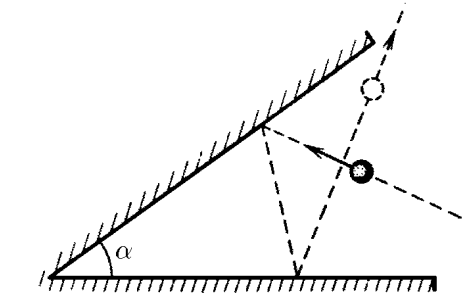
1.1.19. By what angle will the direction of velocity of the ball change after two elastic impacts on the walls, the angle between which is equal to $\alpha$? How will the ball fly if the angle $\alpha = \pi /2$? The motion occurs in a plane perpendicular to the walls. In an elastic collision with a smooth stationary wall, the angle of incidence of the ball is equal to the angle of reflection.
For problem $1.1.19$
Solution
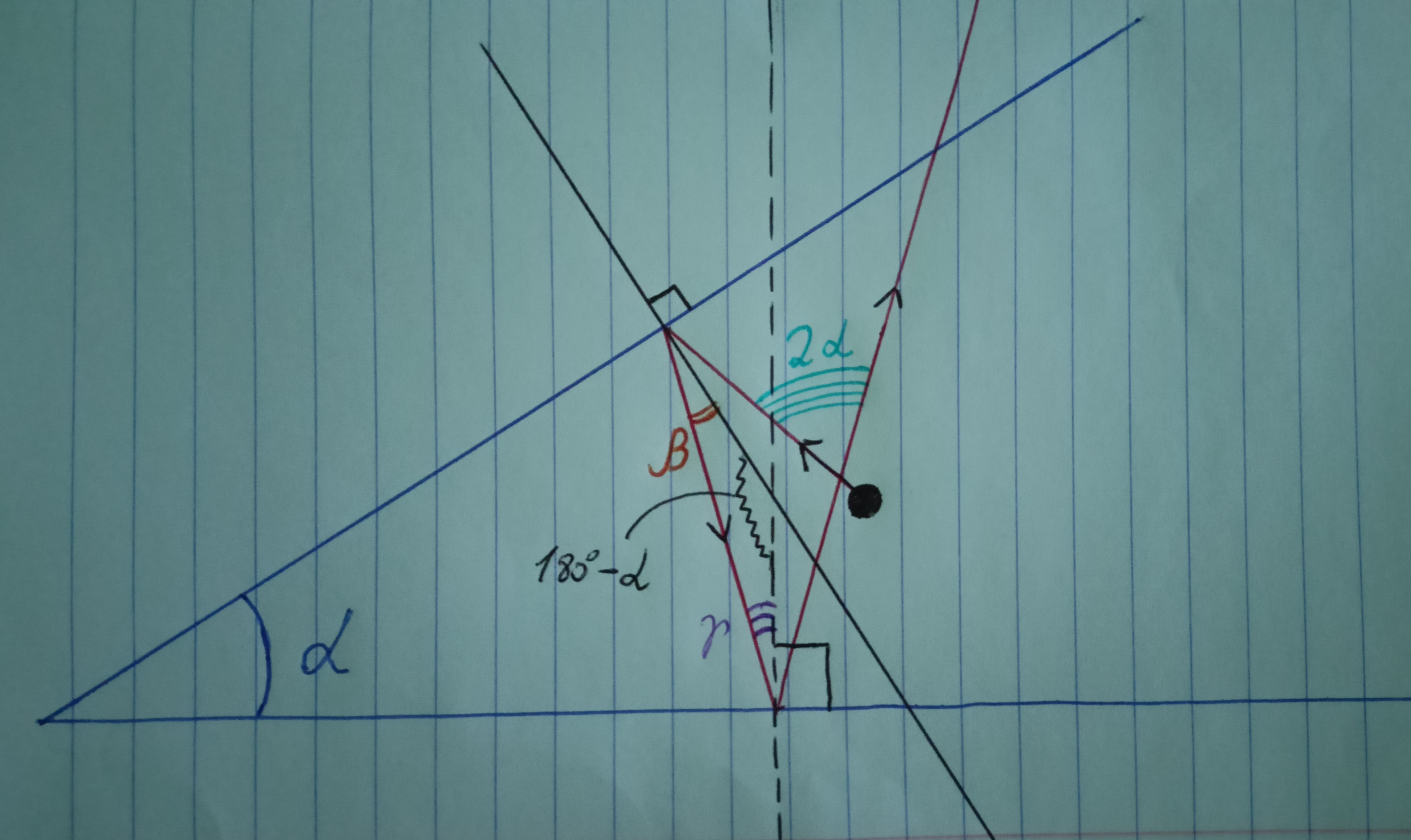
1. Angle between the normals
Consider the quadrilateral formed by the wedge's vertex (with angle $\alpha$), the two points of the ball's impact on the walls, and the intersection point of the perpendiculars (normals) drawn to them. Since the perpendiculars form 90° angles with the walls, the sum of the remaining two angles of this quadrilateral is 180°. Therefore, the angle between the normals at their intersection is $180^\circ - \alpha$.
2. Relationship between the angles of incidence and the wedge angle
Let us examine the triangle formed by the ball's trajectory (the red line) between the two collisions and the two normals. The internal angles of this triangle adjacent to the normals are the angles of incidence $\beta$ and $\gamma$. The third angle is the previously found intersection angle of the normals, $180^\circ - \alpha$. Since the sum of the angles in any triangle is 180°, we can write the equation: $$\beta + \gamma + (180^\circ - \alpha) = 180^\circ$$ This directly leads to the key equality: $$\beta + \gamma = \alpha$$
3. Change in velocity direction
With each elastic reflection, the velocity vector rotates by an angle of $180^\circ - 2\theta$, where $\theta$ is the angle of incidence relative to the normal. Since the ball undergoes two consecutive impacts, the total rotation angle of the velocity vector $\Delta$ will be: $$\Delta = (180^\circ - 2\beta) + (180^\circ - 2\gamma) = 360^\circ - 2(\beta + \gamma)$$ Substituting our equality $\beta + \gamma = \alpha$ into this, we get: $$\Delta = 360^\circ - 2\alpha$$ Geometrically, the rotation of a vector by an angle of $360^\circ - 2\alpha$ means that the final angle between the initial and final directions is exactly $2\alpha$ (marked with a triple blue arc on the drawing).
For $\alpha = \pi/2$:
The direction will change by $2 \cdot (\pi/2) = \pi$, meaning the ball will move in the strictly opposite direction.
Answer
By an angle of $2\alpha$. In the direction opposite to the initial one.