Edits to “Statement”, “Solution”, “Answer”

en/7.3.1.md
+3 −3
| @@ -1,10 +1,10 @@ | |||
| ### Statement | |||
| − | $7.3.1.$ [Insert the problem statement] | ||
| + | $7.3.1.$ One of the plates of a flat capacitor (cathode) is an electron source. The electric field of strength $E$ between the plates changes sign at equal short intervals $\tau$. How long will it take for an electron to reach the opposite plate (anode)? Distance between cathode and anode $l$. | ||
| ### Solution | |||
| − | 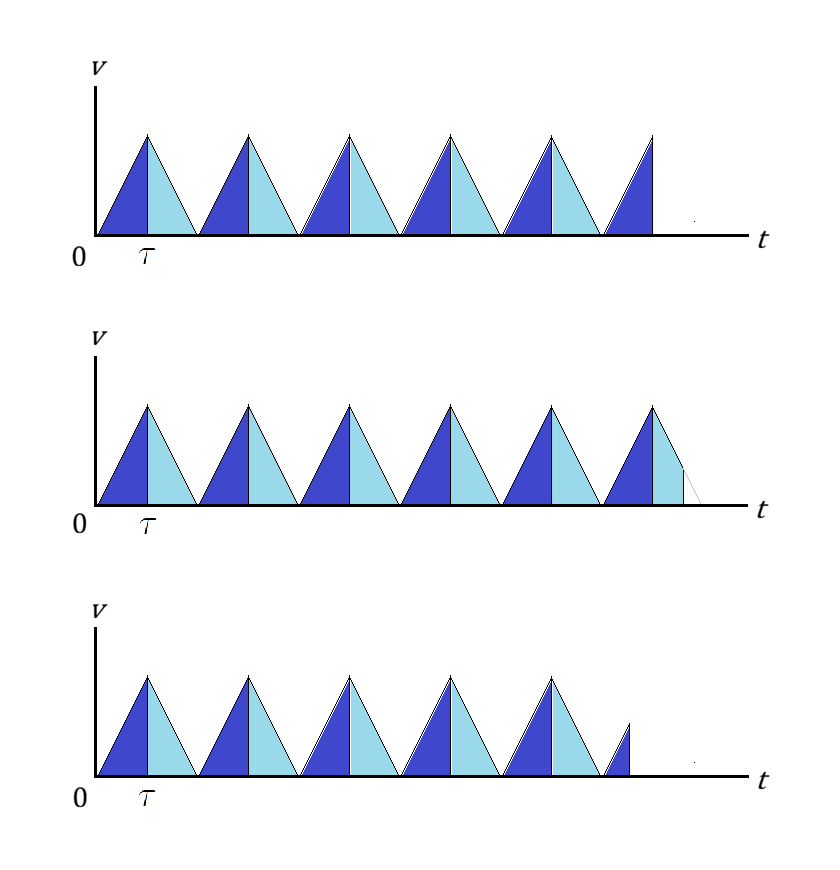 | ||
| Suppose that the electric field toward the cathode is turned on precisely when an electron leaves the cathode (with negligible initial speed). Then, the graph of the velocity of the electron with time is as shown in the figures, where the slopes of the graph are the accelerations $\pm a=\pm eE/m$. Consequently, the area of each light or dark blue region under the graph is the displacement $d=a\tau^2/2=eE\tau^2/(2m)$ during each time interval $\tau$. If $l$ is an integer multiple of $d$ (as in the top figure), then the time that it takes the electron to reach the anode is $\tau l/d=2ml/(eE\tau)$. Indeed, if $l\gg d$, then this answer is a good estimate even if $l/d$ is not an integer. | |||
| For fun, we will find the answers in the general case when $l/d$ is not an integer without the assumption that $l\gg d$. Let $n=\lfloor l/d\rfloor$ be the largest integer not larger than $l/d$. If $n$ is odd (as in the middle figure), then we subtract from the time $(n+1)\tau$ the time $\Delta\tau$ so that $a(\Delta\tau)^2/2=(n+1)d-l$. Then, the total travel time is | |||
| \[(n+1)\tau-\sqrt{\frac{2[(n+1)d-l]}{a}}=\left(n+1-\sqrt{n+1-\frac{l}{d}}\right)\tau.\] | |||
| If $n$ is even (as in the bottom figure), then we add to the time $n\tau$ the time $\Delta\tau$ so that $a(\Delta\tau)^2/2=l-nd$. Then, the total travel time is | |||
| \[n\tau+\sqrt{\frac{2(l-nd)}{a}}=\left(n+\sqrt{\frac{l}{d}-n}\right)\tau.\] | |||
| @@ -18,4 +18,4 @@Solution | |||
| #### Answer | |||
| − | [Insert a concise answer or boxed result] | ||
| + | $\frac{2ml}{eE\tau}$ | ||
| @@ -1,10 +1,10 @@ | |||
| ### Statement | ### Statement | ||
| $7.3.1.$ [Insert the problem statement] | $7.3.1.$ One of the plates of a flat capacitor (cathode) is an electron source. The electric field of strength $E$ between the plates changes sign at equal short intervals $\tau$. How long will it take for an electron to reach the opposite plate (anode)? Distance between cathode and anode $l$. | ||
| ### Solution | ### Solution | ||
|  | ||
| Suppose that the electric field toward the cathode is turned on precisely when an electron leaves the cathode (with negligible initial speed). Then, the graph of the velocity of the electron with time is as shown in the figures, where the slopes of the graph are the accelerations $\pm a=\pm eE/m$. Consequently, the area of each light or dark blue region under the graph is the displacement $d=a\tau^2/2=eE\tau^2/(2m)$ during each time interval $\tau$. If $l$ is an integer multiple of $d$ (as in the top figure), then the time that it takes the electron to reach the anode is $\tau l/d=2ml/(eE\tau)$. Indeed, if $l\gg d$, then this answer is a good estimate even if $l/d$ is not an integer. | Suppose that the electric field toward the cathode is turned on precisely when an electron leaves the cathode (with negligible initial speed). Then, the graph of the velocity of the electron with time is as shown in the figures, where the slopes of the graph are the accelerations $\pm a=\pm eE/m$. Consequently, the area of each light or dark blue region under the graph is the displacement $d=a\tau^2/2=eE\tau^2/(2m)$ during each time interval $\tau$. If $l$ is an integer multiple of $d$ (as in the top figure), then the time that it takes the electron to reach the anode is $\tau l/d=2ml/(eE\tau)$. Indeed, if $l\gg d$, then this answer is a good estimate even if $l/d$ is not an integer. | ||
| For fun, we will find the answers in the general case when $l/d$ is not an integer without the assumption that $l\gg d$. Let $n=\lfloor l/d\rfloor$ be the largest integer not larger than $l/d$. If $n$ is odd (as in the middle figure), then we subtract from the time $(n+1)\tau$ the time $\Delta\tau$ so that $a(\Delta\tau)^2/2=(n+1)d-l$. Then, the total travel time is | For fun, we will find the answers in the general case when $l/d$ is not an integer without the assumption that $l\gg d$. Let $n=\lfloor l/d\rfloor$ be the largest integer not larger than $l/d$. If $n$ is odd (as in the middle figure), then we subtract from the time $(n+1)\tau$ the time $\Delta\tau$ so that $a(\Delta\tau)^2/2=(n+1)d-l$. Then, the total travel time is | ||
| \[(n+1)\tau-\sqrt{\frac{2[(n+1)d-l]}{a}}=\left(n+1-\sqrt{n+1-\frac{l}{d}}\right)\tau.\] | \[(n+1)\tau-\sqrt{\frac{2[(n+1)d-l]}{a}}=\left(n+1-\sqrt{n+1-\frac{l}{d}}\right)\tau.\] | ||
| If $n$ is even (as in the bottom figure), then we add to the time $n\tau$ the time $\Delta\tau$ so that $a(\Delta\tau)^2/2=l-nd$. Then, the total travel time is | If $n$ is even (as in the bottom figure), then we add to the time $n\tau$ the time $\Delta\tau$ so that $a(\Delta\tau)^2/2=l-nd$. Then, the total travel time is | ||
| \[n\tau+\sqrt{\frac{2(l-nd)}{a}}=\left(n+\sqrt{\frac{l}{d}-n}\right)\tau.\] | \[n\tau+\sqrt{\frac{2(l-nd)}{a}}=\left(n+\sqrt{\frac{l}{d}-n}\right)\tau.\] | ||
| @@ -18,4 +18,4 @@Solution | |||
| #### Answer | #### Answer | ||
| [Insert a concise answer or boxed result] | $\frac{2ml}{eE\tau}$ | ||