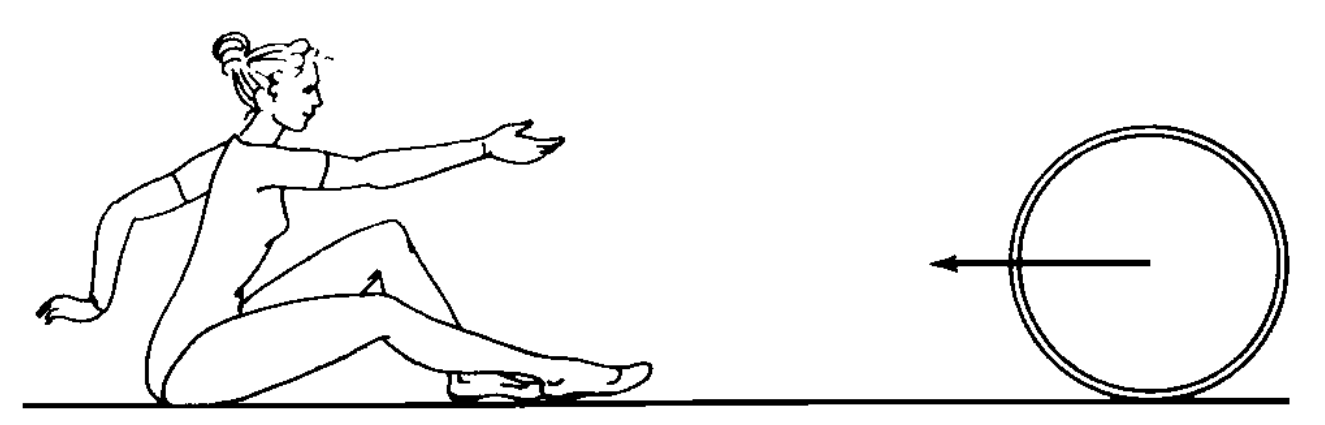
2.4.18. A hoop, spun in a vertical plane and thrown along the floor by a gymnast, returns to her after a few seconds. Explain this phenomenon. Determine the coefficient of friction between the hoop and the floor if the initial speed of the center of the hoop is $v$, and the distance the hoop travels before stopping and returning is $l$.
For problem $2.4.18$
Solution
Physical Explanation of the Phenomenon
The gymnast imparts both a forward translational velocity $v$ and a backward angular velocity $\omega_0$ (backspin) to the hoop.
1. Direction of Kinetic Friction:
The velocity of the contact point relative to the floor is the sum of linear and rotational velocities:
$$v_{\text{rel}} = v + \omega_0 R > 0$$
Because the bottom of the hoop slides forward across the surface, kinetic friction $F_{\text{fr}} = \mu m g$ acts in the backward direction (toward the gymnast).
2. Deceleration of Linear and Angular Motion:
Translational motion:
Friction decelerates the center of mass at a constant rate:
$$a = \mu g$$
Rotational motion:
The torque of friction $M = F_{\text{fr}} R$ decreases the backspin with angular deceleration:
$$\alpha = \frac{M}{J_C} = \frac{\mu m g R}{m R^2} = \frac{\mu g}{R}$$
Note: The moment of inertia of a thin hoop about its center of mass is $J_C = m R^2$.
3. Mechanism of Return:
The forward linear velocity drops to zero at time $t_0$:$$t_0 = \frac{v}{\mu g}$$At this instant, the remaining backspin angular velocity is:$$\omega(t_0) = \omega_0 - \alpha t_0 = \omega_0 - \frac{v}{R}$$If the initial backspin is sufficiently strong ($\omega_0 R > v$), then $\omega(t_0) > 0$, meaning the hoop is still spinning backward when $v = 0$. Since the contact point continues to slide forward due to this rotation, kinetic friction does not vanish or change direction—it continues acting backward, accelerating the hoop's center of mass toward the gymnast until pure rolling is established.
Determination of the Coefficient of Friction $\mu$
The center of mass moves with constant deceleration $a = \mu g$ over the distance $l$ until its forward velocity drops to zero.
Using the kinematic relation for uniformly decelerated motion ($v^2 = 2 a l$):$$v^2 = 2 \mu g l$$Solving for the coefficient of friction $\mu$: