7.1.10∗. An electron moving with velocity $v_1$ passes from a region of potential $\varphi_1$ into a region of potential $\varphi_2$. For what potential difference between the regions will the electron move along their boundary if it approaches the boundary at an angle $\alpha$?
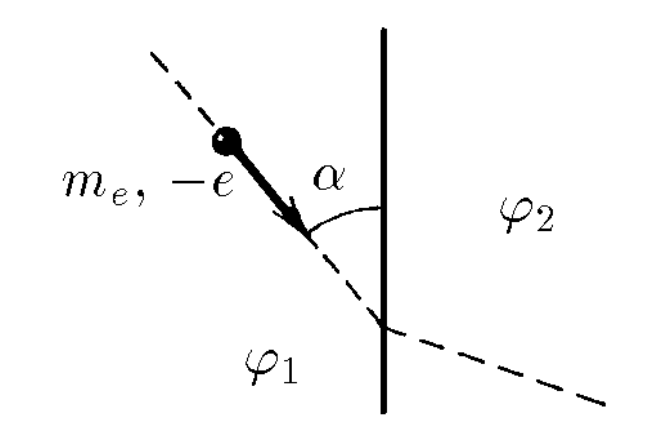
For problem $7.1.10$
Solution
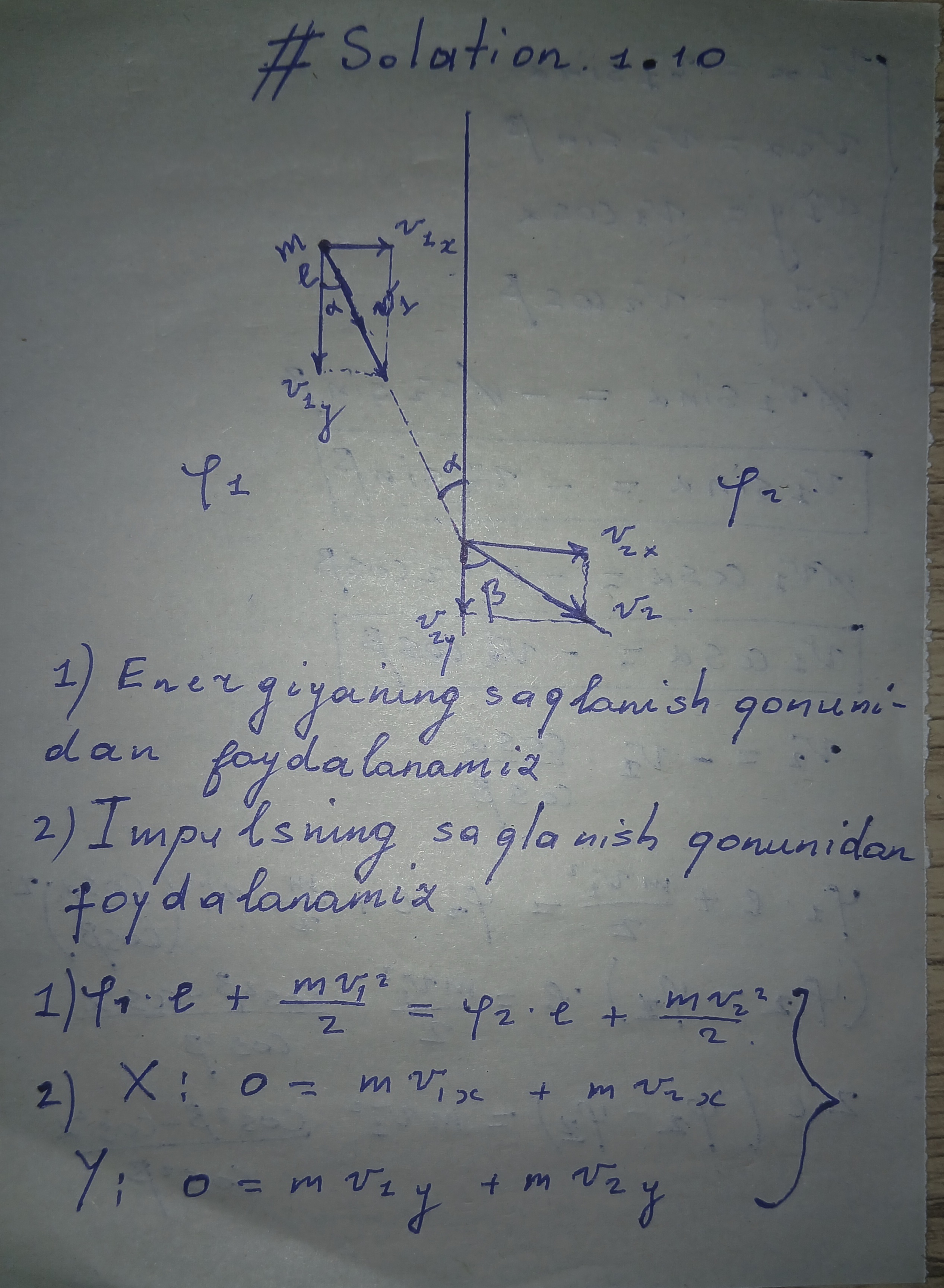
When an electron crosses the interface between two regions with different potentials, the electric field does work and acts on it only along the normal to this boundary. Since there is no force parallel to the interface, the tangential (parallel to the boundary) component of the electron's velocity remains unchanged: $$v_{1\tau} = v_{2\tau}$$
The angles $\alpha$ and $\beta$ are defined between the velocity vectors and the interface itself. Let's write the tangential and normal components of the initial velocity: $$v_{1\tau} = v_1 \cos\alpha$$ $$v_{1n} = v_1 \sin\alpha$$
Then for the final velocity, the tangential component is: $$v_{2\tau} = v_1 \cos\alpha$$
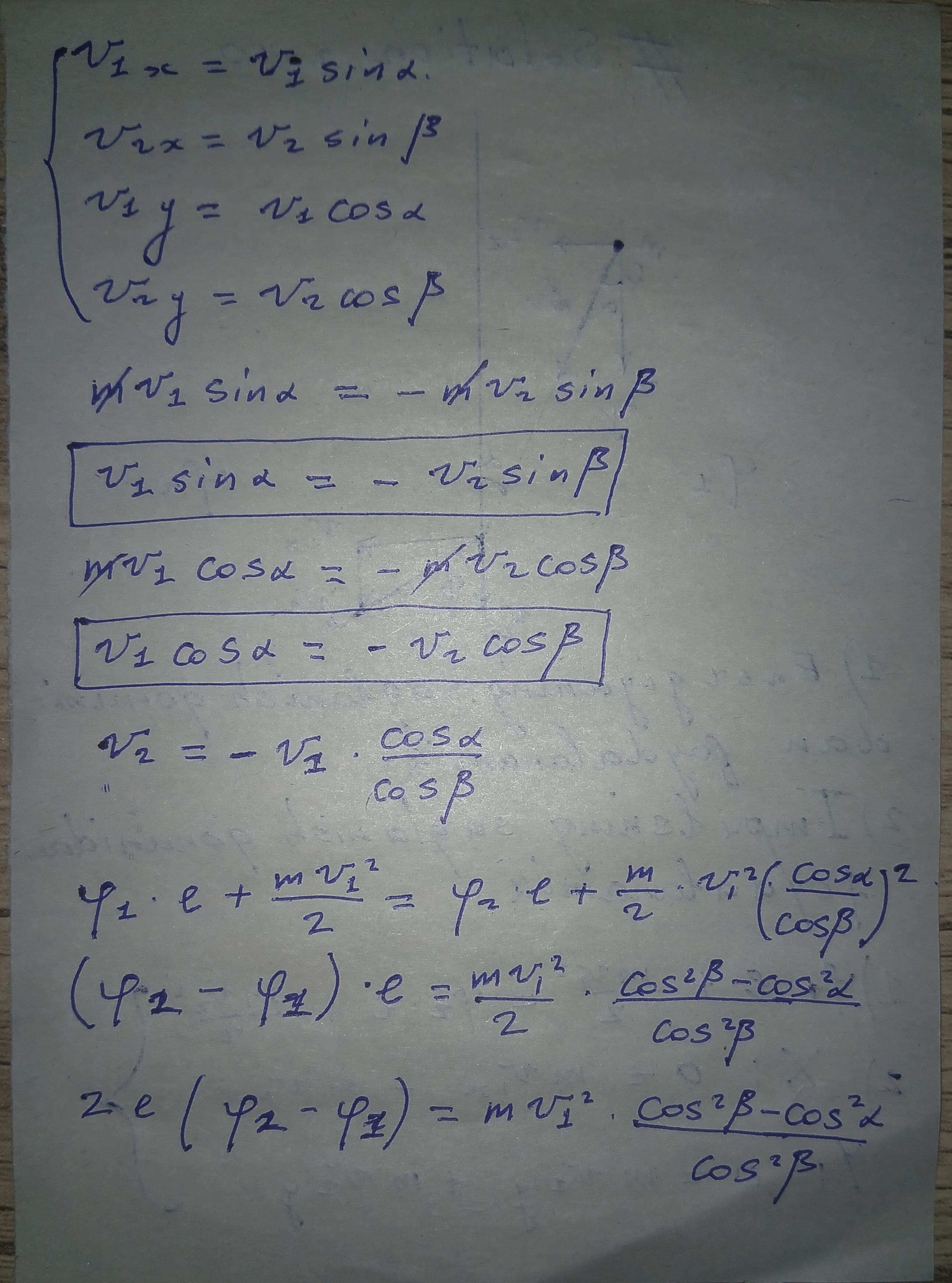
Let's find the normal component of the electron's velocity $v_{2n}$ in the second region by applying the law of conservation of energy. Considering the negative charge of the electron ($-e$): $$\frac{m_e v_{1n}^2}{2} - e\varphi_1 = \frac{m_e v_{2n}^2}{2} - e\varphi_2$$
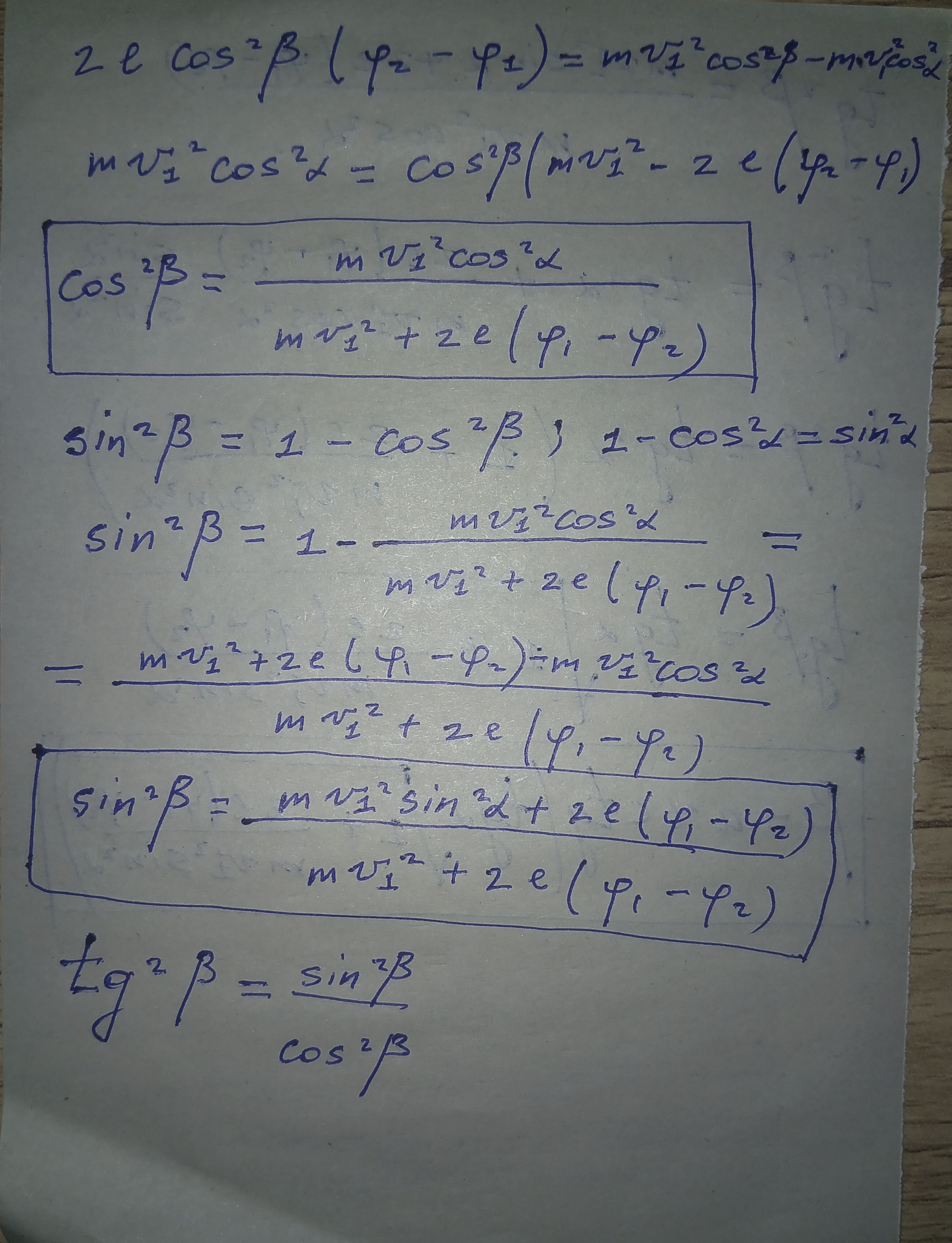
From this, we express the square of the final normal velocity: $$v_{2n}^2 = v_{1n}^2 + \frac{2e}{m_e}(\varphi_2 - \varphi_1) = v_1^2 \sin^2\alpha + \frac{2e}{m_e}(\varphi_2 - \varphi_1)$$
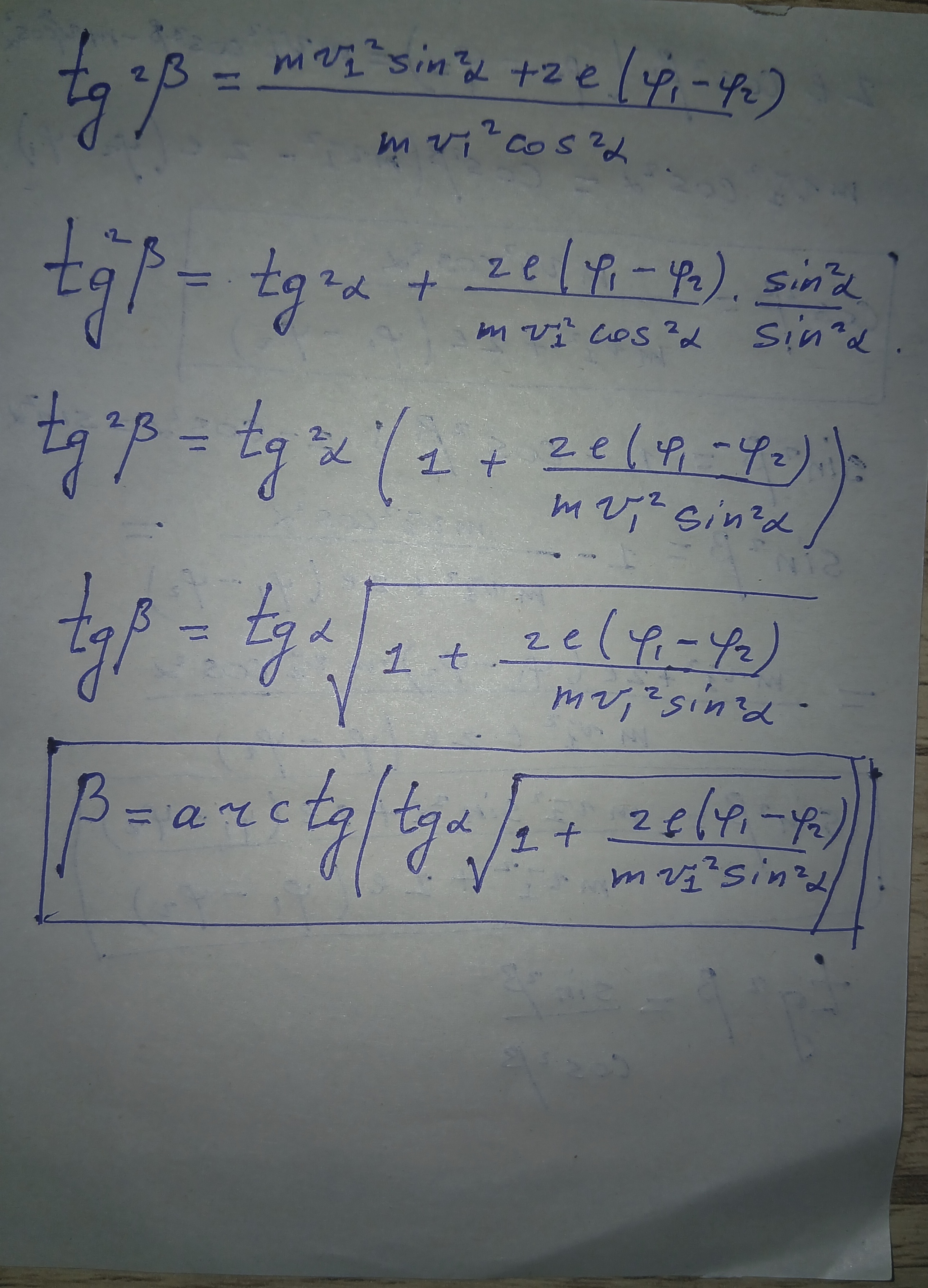
The tangent of the required angle of departure $\beta$ is determined by the ratio of the normal component of the final velocity to the tangential one: $$\tan\beta = \frac{v_{2n}}{v_{2\tau}} = \frac{\sqrt{v_1^2 \sin^2\alpha + \frac{2e}{m_e}(\varphi_2 - \varphi_1)}}{v_1 \cos\alpha}$$
Let's factor out the multiplier $v_1 \sin\alpha$ from under the square root in the numerator: $$\tan\beta = \frac{v_1 \sin\alpha \sqrt{1 + \frac{2e(\varphi_2 - \varphi_1)}{m_e v_1^2 \sin^2\alpha}}}{v_1 \cos\alpha}$$
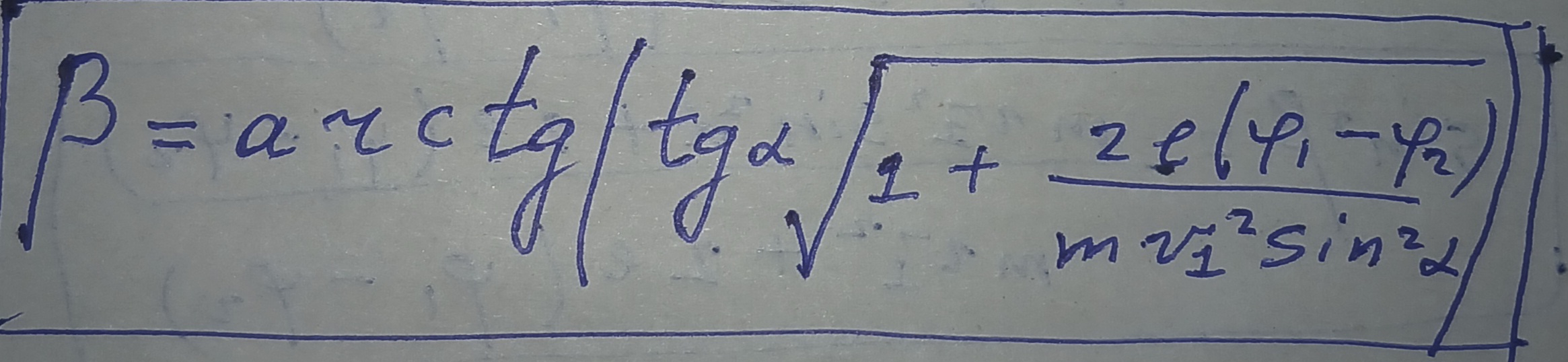
Canceling $v_1$ and considering that $\frac{\sin\alpha}{\cos\alpha} = \tan\alpha$, we obtain the final answer: $$\tan\beta = \tan\alpha \sqrt{1 + \frac{2e(\varphi_2 - \varphi_1)}{m_e v_1^2 \sin^2\alpha}}$$