New solution

en/7.4.23.md
+33 −0
| @@ -0,0 +1,33 @@ | |||
| + | ### Statement | ||
| + | |||
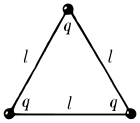
| + | $7.4.23.$ Three identical similarly charged balls with charge $q$ and mass $m$ are connected by weightless, non-stretchable and non-conducting threads of length $l$. One of the threads is burned out. Determine the maximum speed of the balls. | ||
| + | |||
| + |  | ||
| + | |||
| + | ### Solution | ||
| + | |||
| + |  | ||
| + | |||
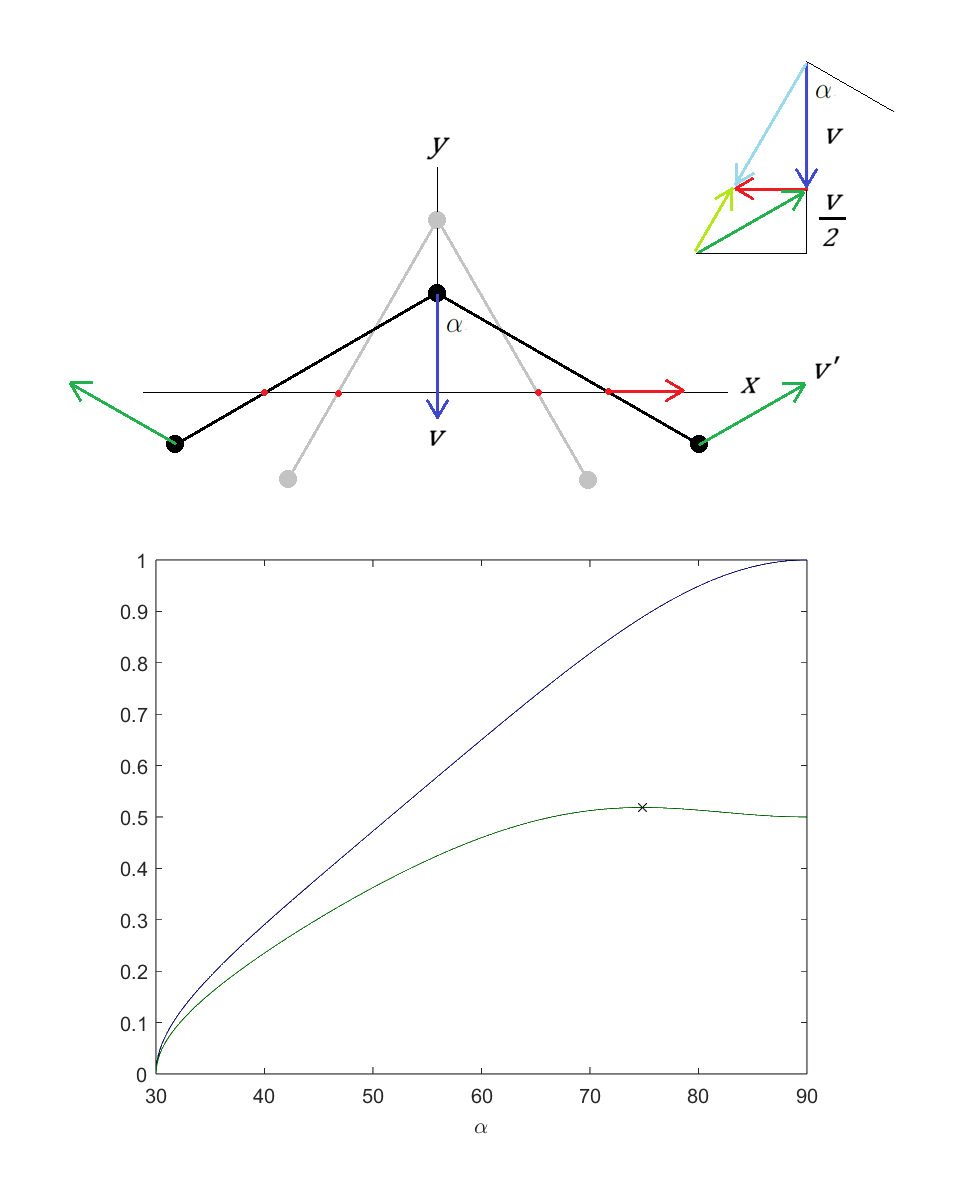
| + | While it is true that the total kinetic energy of the three balls is maximum when the right and the left balls are as far apart as possible (i.e. when the three balls are collinear), it is not true that the speed of the right and the left balls is maximum in that configuration, because they lack lateral speed. We consider a general configuration in which the center of mass of the system is (stationary) at the origin and the angle between the two remaining threads is $2\alpha$. Since the middle ball must be twice as far from the $x$-axis as the other two balls are, the red point on the right thread which is twice as far from the middle ball as it is from the right ball must move along the $x$-axis. In addition, the speed $v$ of the middle ball must be twice the $y$-component of the velocity of the right and the left balls. The speed of the red point on the right thread must be so that the velocities of the middle ball and the right ball relative to the red point (shown in light blue and light green) are perpendicular to the thread. If $v'$ is the speed of the right ball, then | ||
| + | |||
| + | \[v'^2=\left(\frac{v}{2}\right)^2+\left(\frac{3v}{2}\cot\alpha\right)^2=\frac{v^2}{4}[1+9(\cot\alpha)^2].\] | ||
| + | |||
| + | The kinetic energy of the system equals the change in electrical potential energy between the right and the left balls, and so | ||
| + | |||
| + | \[\frac{1}{2}mv^2+2\cdot\frac{1}{2}mv'^2=\frac{kq^2}{l}-\frac{kq^2}{2l\sin\alpha}.\] | ||
| + | |||
| + | Consequently, | ||
| + | |||
| + | \[v=\sqrt{\frac{2kq^2}{3ml}\cdot\frac{2-\csc\alpha}{1+3(\cot\alpha)^2}},\] | ||
| + | |||
| + | which is increasing as $\alpha$ increases from $30^\circ$ to $90^\circ$. Thus, $v_{\mbox{max}}=\sqrt{2kq^2/(3ml)}$ when $\alpha=90^\circ$. Now, | ||
| + | |||
| + | \[v'=\frac{1}{2}\cdot\sqrt{\frac{2kq^2}{3ml}\cdot\frac{(2-\csc\alpha)[1+9(\cot\alpha)^2]}{1+3(\cot\alpha)^2}},\] | ||
| + | |||
| + | and its behavior is not as straightforward. From the graph of $v'/v_{\mbox{max}}$ as a function of $\alpha$ (shown in green) as well as the graph of $v/v_{\mbox{max}}$ as a function of $\alpha$ (shown in blue), we see that $v'/v_{\mbox{max}}$ has maximum value of roughly $0.52$ at $\alpha\approx75^\circ$. | ||
| + | |||
| + | #### Answer | ||
| + | |||
| + | For the middle ball, $v_{\mbox{max}}=\sqrt{\frac{2kq^2}{3ml}}$ at $\alpha=90^\circ.$ | ||
| + | |||
| + | For the right and the left balls, $v'_{\mbox{max}}\approx0.52\cdot v_{\mbox{max}}$ at $\alpha\approx75^\circ$. | ||
| @@ -0,0 +1,33 @@ | |||
| ### Statement | |||
| $7.4.23.$ Three identical similarly charged balls with charge $q$ and mass $m$ are connected by weightless, non-stretchable and non-conducting threads of length $l$. One of the threads is burned out. Determine the maximum speed of the balls. | |||
|  | |||
| ### Solution | |||
|  | |||
| While it is true that the total kinetic energy of the three balls is maximum when the right and the left balls are as far apart as possible (i.e. when the three balls are collinear), it is not true that the speed of the right and the left balls is maximum in that configuration, because they lack lateral speed. We consider a general configuration in which the center of mass of the system is (stationary) at the origin and the angle between the two remaining threads is $2\alpha$. Since the middle ball must be twice as far from the $x$-axis as the other two balls are, the red point on the right thread which is twice as far from the middle ball as it is from the right ball must move along the $x$-axis. In addition, the speed $v$ of the middle ball must be twice the $y$-component of the velocity of the right and the left balls. The speed of the red point on the right thread must be so that the velocities of the middle ball and the right ball relative to the red point (shown in light blue and light green) are perpendicular to the thread. If $v'$ is the speed of the right ball, then | |||
| \[v'^2=\left(\frac{v}{2}\right)^2+\left(\frac{3v}{2}\cot\alpha\right)^2=\frac{v^2}{4}[1+9(\cot\alpha)^2].\] | |||
| The kinetic energy of the system equals the change in electrical potential energy between the right and the left balls, and so | |||
| \[\frac{1}{2}mv^2+2\cdot\frac{1}{2}mv'^2=\frac{kq^2}{l}-\frac{kq^2}{2l\sin\alpha}.\] | |||
| Consequently, | |||
| \[v=\sqrt{\frac{2kq^2}{3ml}\cdot\frac{2-\csc\alpha}{1+3(\cot\alpha)^2}},\] | |||
| which is increasing as $\alpha$ increases from $30^\circ$ to $90^\circ$. Thus, $v_{\mbox{max}}=\sqrt{2kq^2/(3ml)}$ when $\alpha=90^\circ$. Now, | |||
| \[v'=\frac{1}{2}\cdot\sqrt{\frac{2kq^2}{3ml}\cdot\frac{(2-\csc\alpha)[1+9(\cot\alpha)^2]}{1+3(\cot\alpha)^2}},\] | |||
| and its behavior is not as straightforward. From the graph of $v'/v_{\mbox{max}}$ as a function of $\alpha$ (shown in green) as well as the graph of $v/v_{\mbox{max}}$ as a function of $\alpha$ (shown in blue), we see that $v'/v_{\mbox{max}}$ has maximum value of roughly $0.52$ at $\alpha\approx75^\circ$. | |||
| #### Answer | |||
| For the middle ball, $v_{\mbox{max}}=\sqrt{\frac{2kq^2}{3ml}}$ at $\alpha=90^\circ.$ | |||
| For the right and the left balls, $v'_{\mbox{max}}\approx0.52\cdot v_{\mbox{max}}$ at $\alpha\approx75^\circ$. | |||