Edits to “Statement”, “Solution”

en/14.3.26.md
+2 −2
| @@ -1,10 +1,10 @@ | |||
| ### Statement | |||
| − | $14.3.26.$ "... For a moving electron, the electric field $E$ is equivalent to an additional magnetic field $ \overrightarrow{B} = -[\overrightarrow{\beta} \times \overrightarrow{E} ]$" (H. Bethe, E. Salpeter. Quantum mechanics with one and two electrons, Moscow: Fizmatgiz, 1960). Determine, using this statement, the force acting on the magnetic moment of an electron in a hydrogen atom, if the electron | ||
| + | $14.3.26.$ "... For a moving electron, the electric field $E$ is equivalent to an additional magnetic field $ \overrightarrow{B} = -[\overrightarrow{\beta} \times \overrightarrow{E} ]$" (H. Bethe, E. Salpeter. Quantum mechanics with one and two electrons, Moscow: Fizmatgiz, 1960). Determine, using this statement, the force acting on the magnetic moment of an electron in a hydrogen atom, if the electron is moving by circular orbit. | ||
| ### Solution | |||
| − | 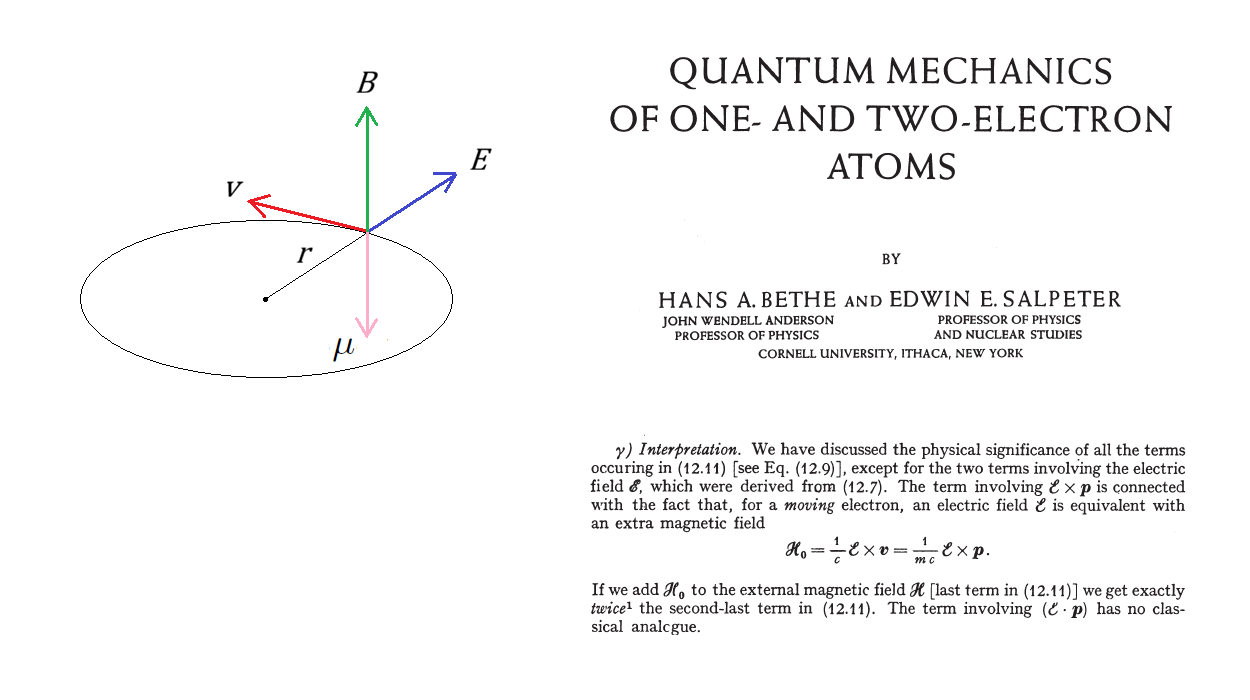 | ||
| Using cylindrical coordinates, we find the additional magnetic field experienced by the electron as | |||
| \[\vec B=-\frac{1}{c^2}(\vec v\times\vec E)=-\frac{1}{c^2}\left[v\hat\theta\times\left(\frac{ke}{r^2}\right)\hat r\right]=\left(\frac{kev}{c^2r^2}\right)\hat z.\] | |||
| The orbital magnetic moment of the electron is | |||
| \[\vec\mu=-\left(\frac{e}{2m}\right)\vec L=-\left(\frac{evr}{2}\right)\hat z.\] | |||
| Consequently, the potential energy of the magnetic moment in the magnetic field is | |||
| \[U=-\vec\mu\cdot\vec B=\frac{ke^2v^2}{2c^2r}=\frac{k^2e^4}{2mc^2r^2},\] | |||
| where the last step is a result of considering electrical attraction between the nucleus and the electron as centripetal force, i.e. | |||
| \[\frac{mv^2}{r}=\frac{ke^2}{r^2}.\] | |||
| Thus, the force on the magnetic moment is | |||
| \[F=-\frac{\partial U}{\partial r}=\frac{k^2e^4}{mc^2r^3}=\frac{2\mu kev}{c^2r^3}.\] | |||
| #### Answer | |||
| $\frac{2\mu kev}{c^2r^3}$ | |||
| unchanged lines 22 | |||
| @@ -1,10 +1,10 @@ | |||
| ### Statement | ### Statement | ||
| $14.3.26.$ "... For a moving electron, the electric field $E$ is equivalent to an additional magnetic field $ \overrightarrow{B} = -[\overrightarrow{\beta} \times \overrightarrow{E} ]$" (H. Bethe, E. Salpeter. Quantum mechanics with one and two electrons, Moscow: Fizmatgiz, 1960). Determine, using this statement, the force acting on the magnetic moment of an electron in a hydrogen atom, if the electron |
$14.3.26.$ "... For a moving electron, the electric field $E$ is equivalent to an additional magnetic field $ \overrightarrow{B} = -[\overrightarrow{\beta} \times \overrightarrow{E} ]$" (H. Bethe, E. Salpeter. Quantum mechanics with one and two electrons, Moscow: Fizmatgiz, 1960). Determine, using this statement, the force acting on the magnetic moment of an electron in a hydrogen atom, if the electron is moving by circular orbit. | ||
| ### Solution | ### Solution | ||
|  | ||
| Using cylindrical coordinates, we find the additional magnetic field experienced by the electron as | Using cylindrical coordinates, we find the additional magnetic field experienced by the electron as | ||
| \[\vec B=-\frac{1}{c^2}(\vec v\times\vec E)=-\frac{1}{c^2}\left[v\hat\theta\times\left(\frac{ke}{r^2}\right)\hat r\right]=\left(\frac{kev}{c^2r^2}\right)\hat z.\] | \[\vec B=-\frac{1}{c^2}(\vec v\times\vec E)=-\frac{1}{c^2}\left[v\hat\theta\times\left(\frac{ke}{r^2}\right)\hat r\right]=\left(\frac{kev}{c^2r^2}\right)\hat z.\] | ||
| The orbital magnetic moment of the electron is | The orbital magnetic moment of the electron is | ||
| \[\vec\mu=-\left(\frac{e}{2m}\right)\vec L=-\left(\frac{evr}{2}\right)\hat z.\] | \[\vec\mu=-\left(\frac{e}{2m}\right)\vec L=-\left(\frac{evr}{2}\right)\hat z.\] | ||
| Consequently, the potential energy of the magnetic moment in the magnetic field is | Consequently, the potential energy of the magnetic moment in the magnetic field is | ||
| \[U=-\vec\mu\cdot\vec B=\frac{ke^2v^2}{2c^2r}=\frac{k^2e^4}{2mc^2r^2},\] | \[U=-\vec\mu\cdot\vec B=\frac{ke^2v^2}{2c^2r}=\frac{k^2e^4}{2mc^2r^2},\] | ||
| where the last step is a result of considering electrical attraction between the nucleus and the electron as centripetal force, i.e. | where the last step is a result of considering electrical attraction between the nucleus and the electron as centripetal force, i.e. | ||
| \[\frac{mv^2}{r}=\frac{ke^2}{r^2}.\] | \[\frac{mv^2}{r}=\frac{ke^2}{r^2}.\] | ||
| Thus, the force on the magnetic moment is | Thus, the force on the magnetic moment is | ||
| \[F=-\frac{\partial U}{\partial r}=\frac{k^2e^4}{mc^2r^3}=\frac{2\mu kev}{c^2r^3}.\] | \[F=-\frac{\partial U}{\partial r}=\frac{k^2e^4}{mc^2r^3}=\frac{2\mu kev}{c^2r^3}.\] | ||
| #### Answer | #### Answer | ||
| $\frac{2\mu kev}{c^2r^3}$ | $\frac{2\mu kev}{c^2r^3}$ | ||
| unchanged lines 22 | |||