Edits to “Solution”, “1. Potential of a point current source i”, “2. Effect of the sea surface”

en/8.2.18.md
+341 −2
| ### Statement | |||
| $8.2.18.$ Two electrodes—metal spheres of diameter $30$ cm—hang in the sea on insulated cables at a depth of $60$ m. The distance between the spheres is $300$ m. The electrical conductivity of seawater is $4$ S/m. Estimate the resistance of the water between the spheres. | |||
| @@ -4,8 +4,347 @@Statement | |||
| ### Solution | |||
| − | 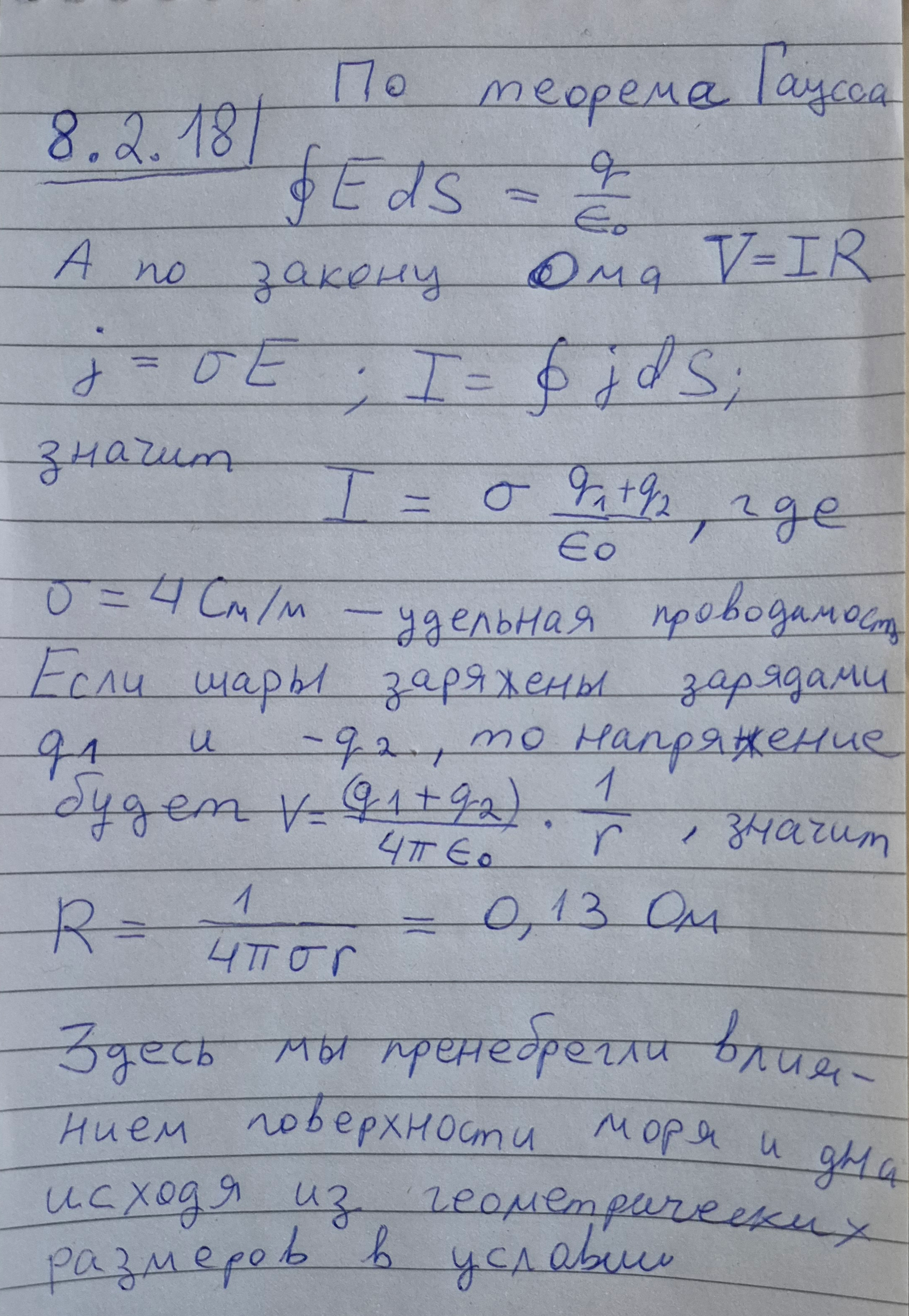 | ||
| + | Let the radius of each metallic sphere be denoted by $a$: | ||
| + | $$ | ||
| + | a=\frac{30\,\text{cm}}{2}=0.15\,\text{m}. | ||
| + | $$ | ||
| + | |||
| + | The electrodes are located at a depth | ||
| + | |||
| + | $$ | ||
| + | h=60\,\text{m}, | ||
| + | $$ | ||
| + | |||
| + | their center-to-center separation is | ||
| + | |||
| + | $$ | ||
| + | L=300\,\text{m}, | ||
| + | $$ | ||
| + | |||
| + | and the electrical conductivity of seawater is | ||
| + | |||
| + | $$ | ||
| + | \sigma=4\,\text{S/m}. | ||
| + | $$ | ||
| + | |||
| + | We need to determine the electrical resistance of the seawater between the two spherical electrodes. | ||
| + | |||
| + | Since the size of each electrode is much smaller than both the depth and the separation between the electrodes, | ||
| + | |||
| + | $$ | ||
| + | a\ll h,\qquad a\ll L, | ||
| + | $$ | ||
| + | |||
| + | each electrode may be treated, to a good approximation, as a point current source or sink, while its finite radius $a$ is retained when calculating its self-potential. | ||
| + | |||
| + | --- | ||
| + | |||
| + | #### 1. Potential of a point current source in a conducting medium | ||
| + | |||
| + | Suppose a current $I$ flows out of a small spherical electrode into an infinite homogeneous conducting medium. | ||
| + | |||
| + | At a distance $r$ from the center, the current is distributed approximately spherically. Therefore, the current density is | ||
| + | |||
| + | $$ | ||
| + | j(r)=\frac{I}{4\pi r^2}. | ||
| + | $$ | ||
| + | |||
| + | The differential form of Ohm's law is | ||
| + | |||
| + | $$ | ||
| + | \mathbf j=\sigma\mathbf E. | ||
| + | $$ | ||
| + | |||
| + | Hence, | ||
| + | |||
| + | $$ | ||
| + | E(r)=\frac{j(r)}{\sigma}. | ||
| + | $$ | ||
| + | |||
| + | Substituting the expression for the current density, | ||
| + | |||
| + | $$ | ||
| + | E(r)=\frac{I}{4\pi\sigma r^2}. | ||
| + | $$ | ||
| + | |||
| + | The electric potential relative to infinity is | ||
| + | |||
| + | $$ | ||
| + | \varphi(r)=\int_r^\infty E(r')\,dr'. | ||
| + | $$ | ||
| + | |||
| + | Therefore, | ||
| + | |||
| + | $$ | ||
| + | \varphi(r)=\frac{I}{4\pi\sigma}\int_r^\infty\frac{dr'}{r'^2}. | ||
| + | $$ | ||
| + | |||
| + | Thus, | ||
| + | |||
| + | $$ | ||
| + | \boxed{\varphi(r)=\frac{I}{4\pi\sigma r}}. | ||
| + | $$ | ||
| + | |||
| + | For a spherical electrode of radius $a$, its self-contribution to the potential is | ||
| + | |||
| + | $$ | ||
| + | \boxed{\varphi_{\text{self}}=\frac{I}{4\pi\sigma a}}. | ||
| + | $$ | ||
| + | |||
| + | --- | ||
| + | |||
| + | #### 2. Effect of the sea surface | ||
| + | |||
| + | Seawater occupies only the lower half-space, while the air above it has negligible conductivity compared with seawater. | ||
| + | |||
| + | Therefore, electric current cannot flow through the water-air boundary. The normal component of the current density at the surface must vanish: | ||
| + | |||
| + | $$ | ||
| + | j_n=0. | ||
| + | $$ | ||
| + | |||
| + | Since | ||
| + | |||
| + | $$ | ||
| + | \mathbf j=\sigma\mathbf E=-\sigma\nabla\varphi, | ||
| + | $$ | ||
| + | |||
| + | this boundary condition is equivalent to | ||
| + | |||
| + | $$ | ||
| + | \frac{\partial\varphi}{\partial n}=0. | ||
| + | $$ | ||
| + | |||
| + | This condition can be satisfied using the method of images. | ||
| + | |||
| + | For a point current source located at depth $h$, one introduces a mirror source of the <b>same sign</b> at the symmetric point a distance $h$ above the surface. | ||
| + | |||
| + | Thus, each real electrode has an image electrode of the same sign. | ||
| + | |||
| + | --- | ||
| + | |||
| + | #### 3. Potential of the first electrode | ||
| + | |||
| + | Let the first electrode act as a current source $+I$, while the second electrode acts as a current sink $-I$. | ||
| + | |||
| + | The potential of the first electrode is the sum of four contributions: | ||
| + | |||
| + | 1. its own field; | ||
| + | 2. the field of its own image; | ||
| + | 3. the field of the second electrode; | ||
| + | 4. the field of the image of the second electrode. | ||
| + | |||
| + | The self-potential contribution is | ||
| + | |||
| + | $$ | ||
| + | \varphi_{11}=\frac{I}{4\pi\sigma a}. | ||
| + | $$ | ||
| + | |||
| + | The distance from the first electrode to its own image is | ||
| + | |||
| + | $$ | ||
| + | 2h, | ||
| + | $$ | ||
| + | |||
| + | so the corresponding contribution is | ||
| + | |||
| + | $$ | ||
| + | \varphi_{1\,\text{im1}}=\frac{I}{4\pi\sigma\,2h}. | ||
| + | $$ | ||
| + | |||
| + | The second electrode is at distance $L$ and has opposite current sign, therefore | ||
| + | |||
| + | $$ | ||
| + | \varphi_{12}=-\frac{I}{4\pi\sigma L}. | ||
| + | $$ | ||
| + | |||
| + | The distance from the first electrode to the image of the second electrode is | ||
| + | |||
| + | $$ | ||
| + | \sqrt{L^2+(2h)^2}. | ||
| + | $$ | ||
| + | |||
| + | Hence, | ||
| + | |||
| + | $$ | ||
| + | \varphi_{1\,\text{im2}}=-\frac{I}{4\pi\sigma\sqrt{L^2+4h^2}}. | ||
| + | $$ | ||
| + | |||
| + | Therefore, the total potential of the first electrode is | ||
| + | |||
| + | $$ | ||
| + | \varphi_1=\frac{I}{4\pi\sigma}\left(\frac1a+\frac1{2h}-\frac1L-\frac1{\sqrt{L^2+4h^2}}\right). | ||
| + | $$ | ||
| + | |||
| + | --- | ||
| + | |||
| + | #### 4. Potential of the second electrode | ||
| + | |||
| + | By symmetry, the second electrode has the same potential magnitude but opposite sign: | ||
| + | |||
| + | $$ | ||
| + | \varphi_2=-\varphi_1. | ||
| + | $$ | ||
| + | |||
| + | Therefore, the potential difference between the two electrodes is | ||
| + | |||
| + | $$ | ||
| + | U=\varphi_1-\varphi_2=2\varphi_1. | ||
| + | $$ | ||
| + | |||
| + | Thus, | ||
| + | |||
| + | $$ | ||
| + | U=\frac{I}{2\pi\sigma}\left(\frac1a+\frac1{2h}-\frac1L-\frac1{\sqrt{L^2+4h^2}}\right). | ||
| + | $$ | ||
| + | |||
| + | By definition, | ||
| + | |||
| + | $$ | ||
| + | R=\frac{U}{I}. | ||
| + | $$ | ||
| + | |||
| + | Hence, | ||
| + | |||
| + | $$ | ||
| + | \boxed{R=\frac{1}{2\pi\sigma}\left(\frac1a+\frac1{2h}-\frac1L-\frac1{\sqrt{L^2+4h^2}}\right)}. | ||
| + | $$ | ||
| + | |||
| + | This expression takes into account both the finite separation between the electrodes and the presence of the sea surface. | ||
| + | |||
| + | --- | ||
| + | |||
| + | #### 5. Numerical evaluation | ||
| + | |||
| + | Substitute | ||
| + | |||
| + | $$ | ||
| + | a=0.15\,\text{m}, | ||
| + | $$ | ||
| + | |||
| + | $$ | ||
| + | h=60\,\text{m}, | ||
| + | $$ | ||
| + | |||
| + | $$ | ||
| + | L=300\,\text{m}, | ||
| + | $$ | ||
| + | |||
| + | $$ | ||
| + | \sigma=4\,\text{S/m}. | ||
| + | $$ | ||
| + | |||
| + | Then | ||
| + | |||
| + | $$ | ||
| + | R=\frac{1}{2\pi\cdot4}\left(\frac1{0.15}+\frac1{120}-\frac1{300}-\frac1{\sqrt{300^2+120^2}}\right). | ||
| + | $$ | ||
| + | |||
| + | The individual terms are | ||
| + | |||
| + | $$ | ||
| + | \frac1{0.15}\approx6.6667\,\text{m}^{-1}, | ||
| + | $$ | ||
| + | |||
| + | $$ | ||
| + | \frac1{120}\approx0.00833\,\text{m}^{-1}, | ||
| + | $$ | ||
| + | |||
| + | $$ | ||
| + | \frac1{300}\approx0.00333\,\text{m}^{-1}, | ||
| + | $$ | ||
| + | |||
| + | $$ | ||
| + | \frac1{\sqrt{300^2+120^2}}\approx0.00309\,\text{m}^{-1}. | ||
| + | $$ | ||
| + | |||
| + | Therefore, | ||
| + | |||
| + | $$ | ||
| + | R\approx\frac{6.6667+0.00833-0.00333-0.00309}{8\pi}. | ||
| + | $$ | ||
| + | |||
| + | Hence, | ||
| + | |||
| + | $$ | ||
| + | \boxed{R\approx0.265\,\Omega}. | ||
| + | $$ | ||
| + | |||
| + | To the appropriate accuracy, | ||
| + | |||
| + | $$ | ||
| + | \boxed{R\approx0.27\,\Omega}. | ||
| + | $$ | ||
| + | |||
| + | --- | ||
| + | |||
| + | #### 6. Why the depth has only a very small effect | ||
| + | |||
| + | The dominant contribution to the resistance comes from the region close to the surface of each electrode. | ||
| + | |||
| + | Indeed, | ||
| + | |||
| + | $$ | ||
| + | \frac1a\approx6.67\,\text{m}^{-1}, | ||
| + | $$ | ||
| + | |||
| + | whereas the corrections associated with the depth and the finite electrode separation are only of order | ||
| + | |||
| + | $$ | ||
| + | 10^{-3}-10^{-2}\,\text{m}^{-1}. | ||
| + | $$ | ||
| + | |||
| + | Therefore, even the simpler estimate | ||
| + | |||
| + | $$ | ||
| + | R\approx\frac{1}{2\pi\sigma a} | ||
| + | $$ | ||
| + | |||
| + | gives | ||
| + | |||
| + | $$ | ||
| + | R\approx\frac{1}{2\pi\cdot4\cdot0.15}\approx0.265\,\Omega, | ||
| + | $$ | ||
| + | |||
| + | which is practically the same result. | ||
| + | |||
| + | The depth $60\,\text{m}$ is useful for checking that the electrodes are effectively embedded in a nearly infinite conducting medium and for estimating the correction caused by the water-air interface. | ||
| + | |||
| + | --- | ||
| + | |||
| + | #### Note | ||
| + | |||
| + | The spreading resistance of <b>one</b> spherical electrode relative to a distant region of the conducting medium is | ||
| + | |||
| + | $$ | ||
| + | R_1=\frac{1}{4\pi\sigma a}. | ||
| + | $$ | ||
| + | |||
| + | For the present data, | ||
| + | |||
| + | $$ | ||
| + | R_1\approx0.133\,\Omega. | ||
| + | $$ | ||
| + | |||
| + | This is the value obtained if only one electrode is accounted for. | ||
| + | |||
| + | However, the problem asks for the resistance <b>between two</b> widely separated electrodes. To first approximation, the spreading resistances of the two electrodes add: | ||
| + | |||
| + | $$ | ||
| + | R\approx2R_1. | ||
| + | $$ | ||
| + | |||
| + | Therefore, | ||
| + | |||
| + | $$ | ||
| + | R\approx0.265\,\Omega. | ||
| + | $$ | ||
| + | |||
| + | Thus, a value of approximately $0.13$–$0.14\,\Omega$ corresponds to the spreading resistance of a single sphere, rather than to the total resistance of the seawater between the two electrodes. | ||
| + | |||
| #### Answer | |||
| − | R = 0.13 Ω | ||
| + | $$ | ||
| + | \boxed{R\approx0.27\,\Omega} | ||
| + | $$ | ||
| ### Statement | ### Statement | ||
| $8.2.18.$ Two electrodes—metal spheres of diameter $30$ cm—hang in the sea on insulated cables at a depth of $60$ m. The distance between the spheres is $300$ m. The electrical conductivity of seawater is $4$ S/m. Estimate the resistance of the water between the spheres. | $8.2.18.$ Two electrodes—metal spheres of diameter $30$ cm—hang in the sea on insulated cables at a depth of $60$ m. The distance between the spheres is $300$ m. The electrical conductivity of seawater is $4$ S/m. Estimate the resistance of the water between the spheres. | ||
| @@ -4,8 +4,347 @@Statement | |||
| ### Solution | ### Solution | ||
|  | Let the radius of each metallic sphere be denoted by $a$: | ||
| $$ | |||
| a=\frac{30\,\text{cm}}{2}=0.15\,\text{m}. | |||
| $$ | |||
| The electrodes are located at a depth | |||
| $$ | |||
| h=60\,\text{m}, | |||
| $$ | |||
| their center-to-center separation is | |||
| $$ | |||
| L=300\,\text{m}, | |||
| $$ | |||
| and the electrical conductivity of seawater is | |||
| $$ | |||
| \sigma=4\,\text{S/m}. | |||
| $$ | |||
| We need to determine the electrical resistance of the seawater between the two spherical electrodes. | |||
| Since the size of each electrode is much smaller than both the depth and the separation between the electrodes, | |||
| $$ | |||
| a\ll h,\qquad a\ll L, | |||
| $$ | |||
| each electrode may be treated, to a good approximation, as a point current source or sink, while its finite radius $a$ is retained when calculating its self-potential. | |||
| --- | |||
| #### 1. Potential of a point current source in a conducting medium | |||
| Suppose a current $I$ flows out of a small spherical electrode into an infinite homogeneous conducting medium. | |||
| At a distance $r$ from the center, the current is distributed approximately spherically. Therefore, the current density is | |||
| $$ | |||
| j(r)=\frac{I}{4\pi r^2}. | |||
| $$ | |||
| The differential form of Ohm's law is | |||
| $$ | |||
| \mathbf j=\sigma\mathbf E. | |||
| $$ | |||
| Hence, | |||
| $$ | |||
| E(r)=\frac{j(r)}{\sigma}. | |||
| $$ | |||
| Substituting the expression for the current density, | |||
| $$ | |||
| E(r)=\frac{I}{4\pi\sigma r^2}. | |||
| $$ | |||
| The electric potential relative to infinity is | |||
| $$ | |||
| \varphi(r)=\int_r^\infty E(r')\,dr'. | |||
| $$ | |||
| Therefore, | |||
| $$ | |||
| \varphi(r)=\frac{I}{4\pi\sigma}\int_r^\infty\frac{dr'}{r'^2}. | |||
| $$ | |||
| Thus, | |||
| $$ | |||
| \boxed{\varphi(r)=\frac{I}{4\pi\sigma r}}. | |||
| $$ | |||
| For a spherical electrode of radius $a$, its self-contribution to the potential is | |||
| $$ | |||
| \boxed{\varphi_{\text{self}}=\frac{I}{4\pi\sigma a}}. | |||
| $$ | |||
| --- | |||
| #### 2. Effect of the sea surface | |||
| Seawater occupies only the lower half-space, while the air above it has negligible conductivity compared with seawater. | |||
| Therefore, electric current cannot flow through the water-air boundary. The normal component of the current density at the surface must vanish: | |||
| $$ | |||
| j_n=0. | |||
| $$ | |||
| Since | |||
| $$ | |||
| \mathbf j=\sigma\mathbf E=-\sigma\nabla\varphi, | |||
| $$ | |||
| this boundary condition is equivalent to | |||
| $$ | |||
| \frac{\partial\varphi}{\partial n}=0. | |||
| $$ | |||
| This condition can be satisfied using the method of images. | |||
| For a point current source located at depth $h$, one introduces a mirror source of the <b>same sign</b> at the symmetric point a distance $h$ above the surface. | |||
| Thus, each real electrode has an image electrode of the same sign. | |||
| --- | |||
| #### 3. Potential of the first electrode | |||
| Let the first electrode act as a current source $+I$, while the second electrode acts as a current sink $-I$. | |||
| The potential of the first electrode is the sum of four contributions: | |||
| 1. its own field; | |||
| 2. the field of its own image; | |||
| 3. the field of the second electrode; | |||
| 4. the field of the image of the second electrode. | |||
| The self-potential contribution is | |||
| $$ | |||
| \varphi_{11}=\frac{I}{4\pi\sigma a}. | |||
| $$ | |||
| The distance from the first electrode to its own image is | |||
| $$ | |||
| 2h, | |||
| $$ | |||
| so the corresponding contribution is | |||
| $$ | |||
| \varphi_{1\,\text{im1}}=\frac{I}{4\pi\sigma\,2h}. | |||
| $$ | |||
| The second electrode is at distance $L$ and has opposite current sign, therefore | |||
| $$ | |||
| \varphi_{12}=-\frac{I}{4\pi\sigma L}. | |||
| $$ | |||
| The distance from the first electrode to the image of the second electrode is | |||
| $$ | |||
| \sqrt{L^2+(2h)^2}. | |||
| $$ | |||
| Hence, | |||
| $$ | |||
| \varphi_{1\,\text{im2}}=-\frac{I}{4\pi\sigma\sqrt{L^2+4h^2}}. | |||
| $$ | |||
| Therefore, the total potential of the first electrode is | |||
| $$ | |||
| \varphi_1=\frac{I}{4\pi\sigma}\left(\frac1a+\frac1{2h}-\frac1L-\frac1{\sqrt{L^2+4h^2}}\right). | |||
| $$ | |||
| --- | |||
| #### 4. Potential of the second electrode | |||
| By symmetry, the second electrode has the same potential magnitude but opposite sign: | |||
| $$ | |||
| \varphi_2=-\varphi_1. | |||
| $$ | |||
| Therefore, the potential difference between the two electrodes is | |||
| $$ | |||
| U=\varphi_1-\varphi_2=2\varphi_1. | |||
| $$ | |||
| Thus, | |||
| $$ | |||
| U=\frac{I}{2\pi\sigma}\left(\frac1a+\frac1{2h}-\frac1L-\frac1{\sqrt{L^2+4h^2}}\right). | |||
| $$ | |||
| By definition, | |||
| $$ | |||
| R=\frac{U}{I}. | |||
| $$ | |||
| Hence, | |||
| $$ | |||
| \boxed{R=\frac{1}{2\pi\sigma}\left(\frac1a+\frac1{2h}-\frac1L-\frac1{\sqrt{L^2+4h^2}}\right)}. | |||
| $$ | |||
| This expression takes into account both the finite separation between the electrodes and the presence of the sea surface. | |||
| --- | |||
| #### 5. Numerical evaluation | |||
| Substitute | |||
| $$ | |||
| a=0.15\,\text{m}, | |||
| $$ | |||
| $$ | |||
| h=60\,\text{m}, | |||
| $$ | |||
| $$ | |||
| L=300\,\text{m}, | |||
| $$ | |||
| $$ | |||
| \sigma=4\,\text{S/m}. | |||
| $$ | |||
| Then | |||
| $$ | |||
| R=\frac{1}{2\pi\cdot4}\left(\frac1{0.15}+\frac1{120}-\frac1{300}-\frac1{\sqrt{300^2+120^2}}\right). | |||
| $$ | |||
| The individual terms are | |||
| $$ | |||
| \frac1{0.15}\approx6.6667\,\text{m}^{-1}, | |||
| $$ | |||
| $$ | |||
| \frac1{120}\approx0.00833\,\text{m}^{-1}, | |||
| $$ | |||
| $$ | |||
| \frac1{300}\approx0.00333\,\text{m}^{-1}, | |||
| $$ | |||
| $$ | |||
| \frac1{\sqrt{300^2+120^2}}\approx0.00309\,\text{m}^{-1}. | |||
| $$ | |||
| Therefore, | |||
| $$ | |||
| R\approx\frac{6.6667+0.00833-0.00333-0.00309}{8\pi}. | |||
| $$ | |||
| Hence, | |||
| $$ | |||
| \boxed{R\approx0.265\,\Omega}. | |||
| $$ | |||
| To the appropriate accuracy, | |||
| $$ | |||
| \boxed{R\approx0.27\,\Omega}. | |||
| $$ | |||
| --- | |||
| #### 6. Why the depth has only a very small effect | |||
| The dominant contribution to the resistance comes from the region close to the surface of each electrode. | |||
| Indeed, | |||
| $$ | |||
| \frac1a\approx6.67\,\text{m}^{-1}, | |||
| $$ | |||
| whereas the corrections associated with the depth and the finite electrode separation are only of order | |||
| $$ | |||
| 10^{-3}-10^{-2}\,\text{m}^{-1}. | |||
| $$ | |||
| Therefore, even the simpler estimate | |||
| $$ | |||
| R\approx\frac{1}{2\pi\sigma a} | |||
| $$ | |||
| gives | |||
| $$ | |||
| R\approx\frac{1}{2\pi\cdot4\cdot0.15}\approx0.265\,\Omega, | |||
| $$ | |||
| which is practically the same result. | |||
| The depth $60\,\text{m}$ is useful for checking that the electrodes are effectively embedded in a nearly infinite conducting medium and for estimating the correction caused by the water-air interface. | |||
| --- | |||
| #### Note | |||
| The spreading resistance of <b>one</b> spherical electrode relative to a distant region of the conducting medium is | |||
| $$ | |||
| R_1=\frac{1}{4\pi\sigma a}. | |||
| $$ | |||
| For the present data, | |||
| $$ | |||
| R_1\approx0.133\,\Omega. | |||
| $$ | |||
| This is the value obtained if only one electrode is accounted for. | |||
| However, the problem asks for the resistance <b>between two</b> widely separated electrodes. To first approximation, the spreading resistances of the two electrodes add: | |||
| $$ | |||
| R\approx2R_1. | |||
| $$ | |||
| Therefore, | |||
| $$ | |||
| R\approx0.265\,\Omega. | |||
| $$ | |||
| Thus, a value of approximately $0.13$–$0.14\,\Omega$ corresponds to the spreading resistance of a single sphere, rather than to the total resistance of the seawater between the two electrodes. | |||
| #### Answer | #### Answer | ||
| R = 0.13 Ω | $$ | ||
| \boxed{R\approx0.27\,\Omega} | |||
| $$ | |||