Solutions of Savchenko Problems in Physics
    <h3 id="back-link"><a href="/#1.4">$\leftarrow$Back</a></h3>

    <h3> Statement </h3>
    <p>
        $1.4.15^*.$ There is a bundle of identical nuclei moving with velocity $v$. The nuclei in the beam spontaneously divide into pairs of identical fragments. The velocity of the fragments moving in the direction of the beam is $3v$. Find the velocity of the fragments moving in the direction perpendicular to the beam.
    </p>

    <h3>Solution</h3>
    <p>
        <p>Let's move to the beam center of mass frame.</p>
In this frame of reference, the relative velocity is related to the velocity in the NFR by the relation
Where
By the condition, when
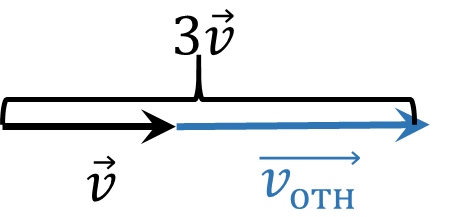
From where
Next, let's consider the fragments that flew with the speed of
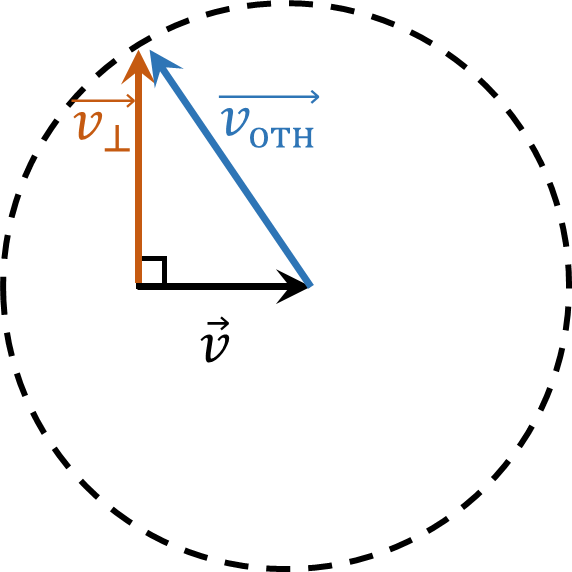
Going back to inertial reference frame, we get that
By the Pythagorean theorem
    <h4>Answer</h4>
    <p>
        $$\sin \alpha = u/v$$
    </p>


<footer class="row container">
  <br>
    <p>
        <small> © <strong>Savchenko Solutions</strong>, 2023-2024 <br></small>
    </p>
    <p>
        <small>All rights belong to the authors. <br> Commercial use of materials - with the written permission of the authors. <br> alex@savchenkosolutions.com <br></small>
    </p>
</footer>