Solutions of Savchenko Problems in Physics
    <h3 id="back-link"><a href="/#1.4">$\leftarrow$Back</a></h3>

    <h3> Statement </h3>
    <p>
        $1.4.14.$ A nucleus traveling at speed $v$ splits into two identical fragments. Determine the maximum possible angle $\alpha$ between the velocities of one of the fragments and the vector $v$, if the fragments have a velocity $u < v$ during the decay of a resting nucleus.
    </p>

    <h3>Solution</h3>
    <p>
        <p>The velocity and one of the accelerations of the nucleus are</p>
where
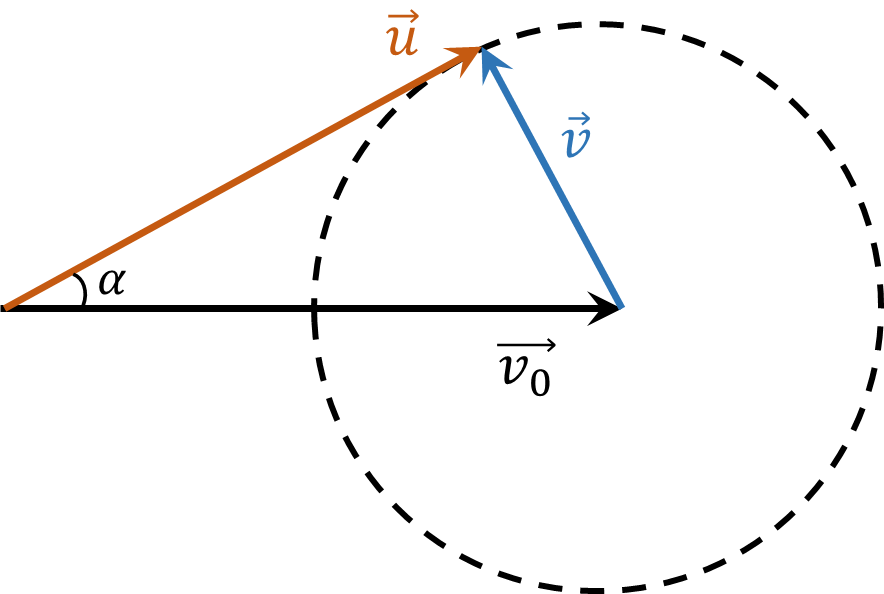
Let's arrange the vector
It is clear from the figure that the vector and forms the maximum angle
    <h4>Answer</h4>
    <p>
        $$\sin \alpha = u/v$$
    </p>


<footer class="row container">
  <br>
    <p>
        <small> © <strong>Savchenko Solutions</strong>, 2023-2024 <br></small>
    </p>
    <p>
        <small>All rights belong to the authors. <br> Commercial use of materials - with the written permission of the authors. <br> alex@savchenkosolutions.com <br></small>
    </p>
</footer>