
Solutions of Savchenko Problems in Physics
    <h3 id="back-link"><a href="/#2.1">$\leftarrow$Back</a></h3>

    <h3> Statement </h3>
    <p>
        $2.1.16.$ The body of mass m is connected by two springs of stiffness $k_1$ and $k_2$ with fixed walls, the springs are not initially deformed. When vibrations occur, the greatest acceleration of the body is $a$. Find the maximum deviation of the body from the equilibrium position and the maximum forces with which the springs act on the walls.
    <h3>Solution</h3>
    <p>
        <center>
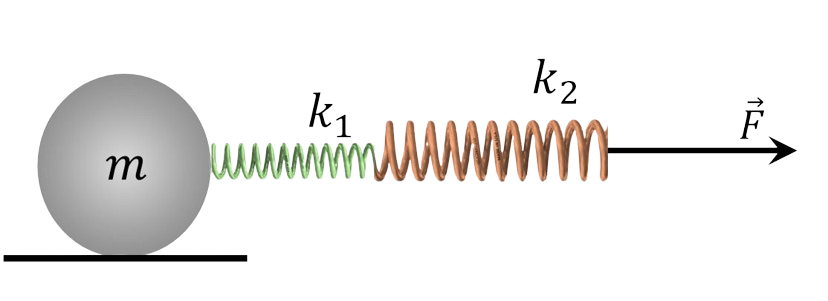
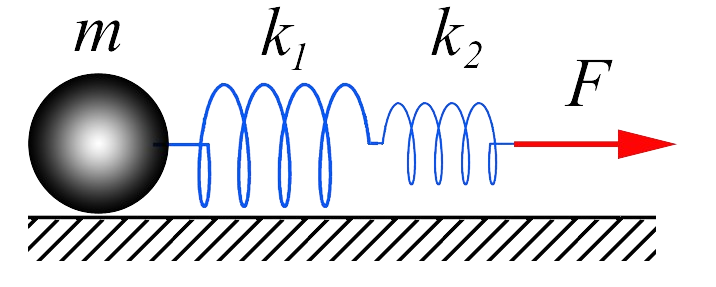
1. When springs are connected in series, their deformation will be different with the same acting force, this circumstance allows us to determine the overall stiffness of the springs as follows
2. The combined effect on the mass of the springs when the mass is at rest will be equal to the applied force
    <h4>Answer</h4>
    <p>
        $$x = F(k_1 + k_2)/(k_1k_2)$$
    </p>


<footer class="row container">
  <br>
    <p>
        <small> © <strong>Savchenko Solutions</strong>, 2023-2024 <br></small>
    </p>
    <p>
        <small>All rights belong to the authors. <br> Commercial use of materials - with the written permission of the authors. <br> alex@savchenkosolutions.com <br></small>
    </p>
</footer>