
Solutions of Savchenko Problems in Physics
    <h3 id="back-link"><a href="/#2.1">$\leftarrow$Back</a></h3>

    <h3> Statement </h3>
    <p>
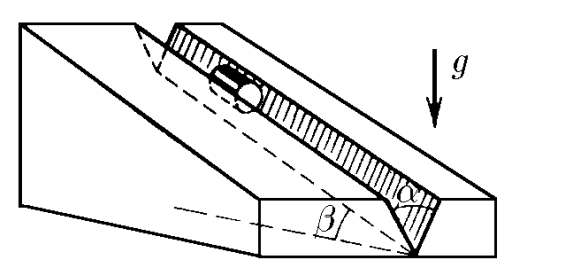
        $2.1.24.$ The cylinder slides along the chute, which has the form of a dihedral angle with the solution $\alpha$. The edge of a dihedral angle is inclined at an angle $\beta$ to the horizon. The planes of a dihedral angle form identical angles with the horizon. Determine the acceleration of the cylinder. Coefficient of friction between the cylinder and the chute surface $\mu$.
    <h3>Solution</h3>
    <p>
        <center>
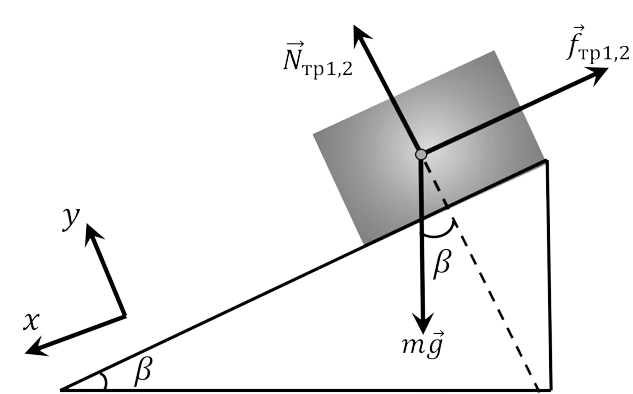
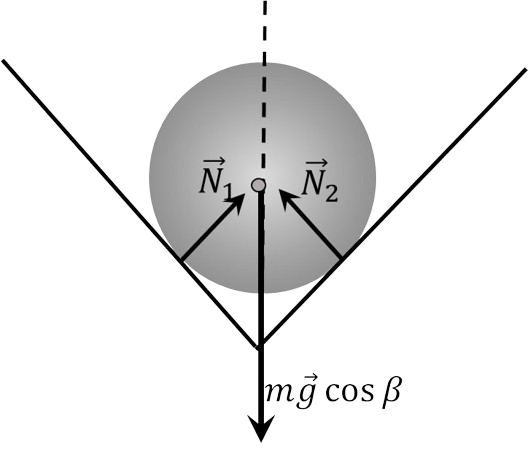
Forces acting on the cylinder: gravity
According to the Coulomb-Amonton law
The fundamental law of dynamics for a cylinder is
Substituting
    <h4>Answer</h4>
    <p>
                  $$a=g\left(\operatorname{sin}\beta-\frac{\mu\operatorname{cos}\beta}{\operatorname{sin}(\alpha/2)}\right)\text{ with }\mu\leqslant\operatorname{tg}\beta\operatorname{sin}\frac{\alpha}{2};$$
      $$a=0\text{ with }\mu\geqslant\operatorname{tg}\beta\operatorname{sin}\frac{\alpha}{2}.$$
    </p>


<footer class="row container">
  <br>
    <p>
        <small> © <strong>Savchenko Solutions</strong>, 2023-2024 <br></small>
    </p>
    <p>
        <small>All rights belong to the authors. <br> Commercial use of materials - with the written permission of the authors. <br> alex@savchenkosolutions.com <br></small>
    </p>
</footer>