
 Savchenko Solutions
    <h3 id="back-link"><a href="/#2.1">$\leftarrow$Back</a></h3>

    <h3> Statement </h3>
    <p>
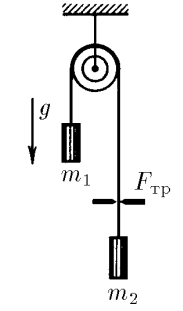
        $2.1.25.$ A thread spanned over a block with a fixed axis is passed through a slot. At the ends of the thread are suspended loads, the mass of which is $m_1$ and $m_2$. Determine the acceleration of loads if a constant frictional force $F_{tr}$ acts on the thread from the side of the slot when it moves.
    <h3>Solution</h3>
    <p>
        <center>
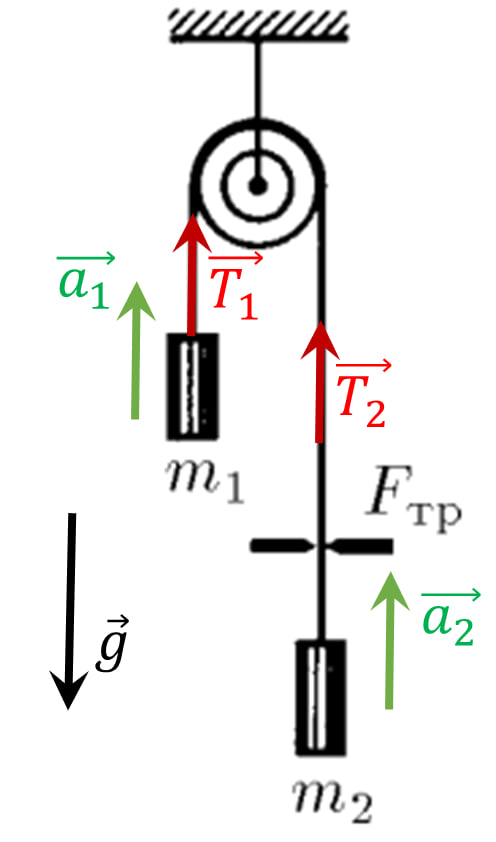
1. Due to the weightlessness and non-stretchability of the thread, as well as the ideal properties of the block (no losses and low weight), the problem can be solved in the following approximation)
2. The equations of motion of loads in projection onto the vertical axis in this case are written as follows:
3. Solving the equations together, we obtain
4. Substituting the acceleration value into the first equation of the system allows us to determine the tension of the thread
    <h4>Answer</h4>
    <p>
        $$T=m_1\frac{2m_2g+F_{fr}}{m_1+m_2}$$
    </p>


<footer class="row container">
  <br>
    <p>
        <small> © <strong>Savchenko Solutions</strong>, 2023-2024 <br></small>
    </p>
    <p>
        <small>All rights belong to the authors. <br> Commercial use of materials - with the written permission of the authors. <br> alex@savchenkosolutions.com <br></small>
    </p>
</footer>