
 Savchenko Solutions
    <h3 id="back-link"><a href="/#1.4">$\leftarrow$Back</a></h3>

    <h3> Statement </h3>
    <p>
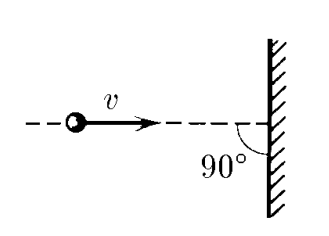
        $1.4.8.$ In case of an elastic impact of a body against a fixed wall, its velocity $v$ changes only in the direction. Determine the change after the impact of the velocity of this body, if the wall is moving: a) at a speed $u$ towards the body; b) at a speed $w < v$ in the direction of movement of the body.
    <h3>Solution</h3>
    <p>
        <p>The whole point of the problem is to move to an inertial system associated with the wall, correctly describing the relative velocity.</p>
In this frame of reference, the relative velocity of the ball before the impact is
After the elastic impact, the velocity projection changes sign: it becomes equal to
If we then return to the original (laboratory) frame of reference, where the wall moves with a velocity of
The change in velocity in this case is
In this frame of reference, the relative velocity of the ball before the impact is
If we then return to the original (laboratory) frame of reference, where the wall moves with the velocity
The change in velocity in this case is
    <h4>Answer</h4>
    <p>
        $\begin{aligned}&{a) }\Delta v = -2(v + u).\quad б) \Delta v = -2(v - w). (\text{Projection on the direction of the initial}\\&\text{speeds are considered positive.)}\end{aligned}$
    </p>


<footer class="row container">
  <br>
    <p>
        <small> © <strong>Savchenko Solutions</strong>, 2023-2024 <br></small>
    </p>
    <p>
        <small>All rights belong to the authors. <br> Commercial use of materials - with the written permission of the authors. <br> alex@savchenkosolutions.com <br></small>
    </p>
</footer>