
 Savchenko Solutions
    <h3 id="back-link"><a href="/#2.1">$\leftarrow$Back</a></h3>

    <h3> Statement </h3>
    <p>
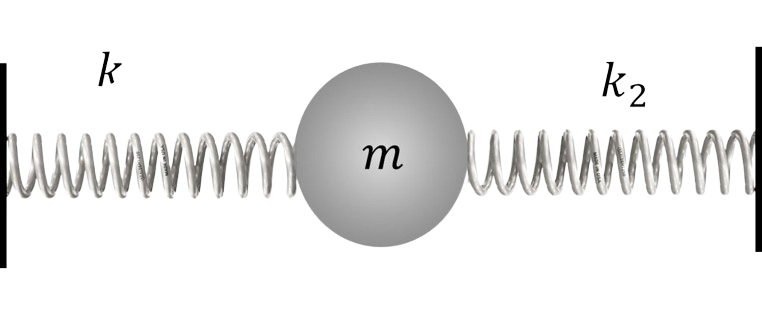
        $2.1.15.$ The body of mass $m$ is connected by two springs of stiffness $k_1$ and $k_2$ with fixed walls, the springs are not initially deformed. When vibrations occur, the greatest acceleration of the body is $a$. Find the maximum deviation of the body from the equilibrium position and the maximum forces with which the springs act on the walls.
    <h3>Solution</h3>
    <p>
        <center>
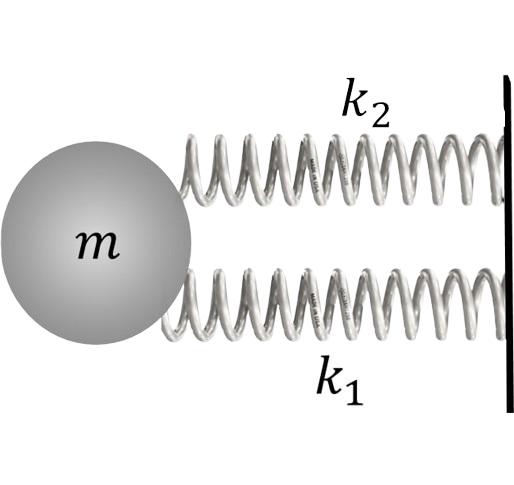
1. The springs in this problem are connected in parallel, their deformation is the same
4. Maximum values of forces acting on the mass
  </p>
    </p>

    <h4>Answer</h4>
    <p>
                <p>
    	$$x_{max} = ma/(k_1 + k_2);$$
    	$${F_1}_{max} = k_1x_{max}$$
    	$${F_2}_{max} = k_2x_{max}$$
    </p>
    </p>


<footer class="row container">
  <br>
    <p>
        <small> © <strong>Savchenko Solutions</strong>, 2023-2024 <br></small>
    </p>
    <p>
        <small>All rights belong to the authors. <br> Commercial use of materials - with the written permission of the authors. <br> alex@savchenkosolutions.com <br></small>
    </p>
</footer>