
 Savchenko Solutions
    <h3 id="back-link"><a href="/#2.1">$\leftarrow$Back</a></h3>

    <h3> Statement </h3>
    <p>
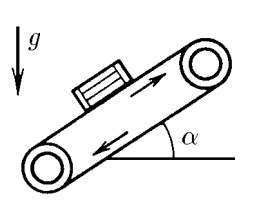
        $2.1.21.$ The belt lift forms an angle $\alpha$ with the horizon. With what maximum acceleration can a box be lifted on such a lift, if the coefficient of friction is equal to $\mu$? The tape doesn't bend.
    <h3>Solution</h3>
    <p>
        <center>
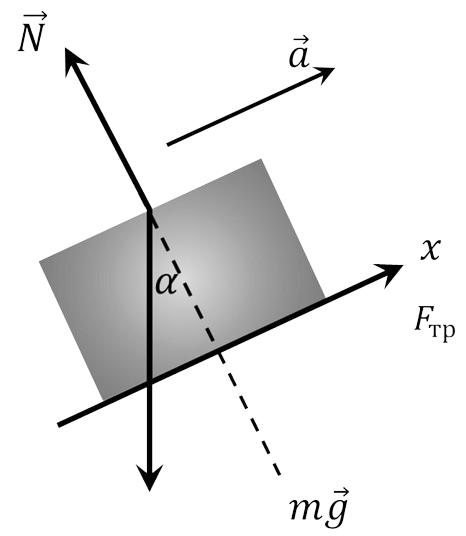
1. By discarding the constraints imposed on the box and replacing them with reactions, we can consider it as a free body capable of moving along the
2. The equation of Newton's second law allows us to determine the maximum value of acceleration
    <h4>Answer</h4>
    <p>
        $$a_{max} = g(\mu \cos \alpha − \sin \alpha)$$
    </p>


<footer class="row container">
  <br>
    <p>
        <small> © <strong>Savchenko Solutions</strong>, 2023-2024 <br></small>
    </p>
    <p>
        <small>All rights belong to the authors. <br> Commercial use of materials - with the written permission of the authors. <br> alex@savchenkosolutions.com <br></small>
    </p>
</footer>