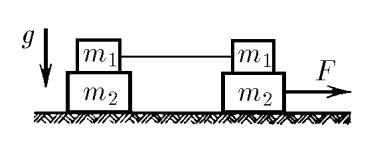
The cargo system shown in the figure is located on a smooth horizontal table. The lower right weight is pulled along the table with a force of F, as indicated in the figure. The coefficient of friction between loads of mass m_1 and m_2 is equal to \mu. Find the acceleration of all loads in the system.
Solutions of Savchenko Problems in Physics knowledge must be free
    <h3 id="back-link"><a href="/#2.1">$\leftarrow$Back</a></h3>

    <h3> Statement </h3>
    <p>
        $2.1.31.$ The cargo system shown in the figure is located on a smooth horizontal table. The lower right weight is pulled along the table with a force of $F$, as indicated in the figure. The coefficient of friction between loads of mass $m_1$ and $m_2$ is equal to $\mu$. Find the acceleration of all loads in the system.
For problem $2.1.31$
    <h3>Solution</h3>
    <p>
        <p>
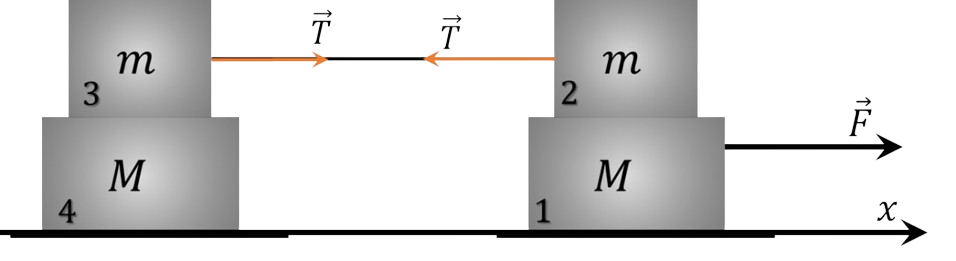
Let's renumber the weights as shown in the figure, and direct the $X$ axis to the right.
Forces acting on the weights
It is clear that then none of the weights can have negative acceleration.
Let's prove that weights $3$ and $4$ move as a single whole. To do this, let's assume the opposite: let weight $3$ slide on weight $4$. Then a friction force arises between them
$$F_{fr}= \mu mg$$
and elastic force arises in the thread
$$T> \mu mg$$
In this case, the acceleration of load $2$ would be directed to the left, which is impossible. Therefore, the accelerations of loads $2$,$3$, and $4$ are the same.
Let us denote the acceleration of these loads as $\bar{a}_{1}=\bar{a}_{2}$, and the acceleration of load $1$ as $\bar{a}_{1}$.
Now consider two cases.
Case 1. Let loads $1$ and $2$ be at relative rest and $\bar{a}_{1}=\bar{a}_{2}$.
Let us denote the modulus of the static friction force between them as $F_1$, the modulus of the friction force between loads $3$ and $4$ as $F_2$, and the modulus of the elastic force of the thread as $T$ .
Then: for cargo $1$$$F-F_{1}=Ma_{1}$$
for cargo $2$$$F_{1}-T=ma_{2}$$
for cargo $3$$$T-F_{2}=ma_{2}$$
for cargo $4$$$F_{2}=Ma_{2}$$
Solving this system of equations, we obtain:
$$F_{1}=\frac{2m+M}{2(M+m)}F,a_{1}=a_{2}=\frac{F}{2(M+m)}$$
The same result can be obtained in another way. Since the friction between all surfaces is static friction, the system of loads moves as one body with mass $M=2(M+m)$.
Therefore
$$\bar{F}=m \bar{a}_{1},\bar{a}_{1}=\bar{a}_{2}= \frac{\bar{F}}{2(M+m)}$$
Case $2$.
Let load $2$ slide on load $1$. Then the friction force acts on load $1$$$F_{fr}^{\prime}= \mu mg$$
and this load receives acceleration $a_{1}=\frac{F- \mu mg}{m}$.
The system of loads $2$,$3$ and $4$ moves as one body, the mass of which is $M_{0}=2m+M$ with acceleration
$$a_{2}=\frac{\mu mg}{2m+M}$$
The first case is realized if
$$F \geq \frac{2 \mu m (m+M)g}{2m+M}$$
    <h4>Answer</h4>
    <p>
        <p>
For $F\leqslant\frac{2\mu m_{1}g(m_{1}+m_{2})}{m_{2}+2m_{1}}\equiv F_{0}$ we get $a_{1\text{sing}}=a_{1\text{right}}=a_{2\text{right}}=\frac{F}{2(m_{1}+m_{2})}$
For $F\geqslant F_{0}$ we get $a_{2\text{right}}=\frac{F-\mu m_{1}g}{m_{2}}$,$a_{1\text{left}}=a_{1\text{right}}=a_{2\text{left}}=\frac{\mu m_{1}g}{m_{2}+2m_{1}}$

 Savchenko Solutions