Problem database

How difficulty is scored
Showing 11 of 11 for «8.2.2» Sort:
8.2.2 2300
Upload a solution

A container filled with air at room temperature and atmospheric pressure is irradiated with X-rays that ionize a small portion of the molecules. Negative ions are molecules that have "captured" an electron. The size of the container is cm; two walls of cm are made of metal, and the rest are made of insulating material. A voltage of V is applied between the conducting walls, causing a current of uA. Assuming the number of positive and negative singly charged ions is the same, estimate the fraction of ionized gas molecules. The free path of ions is m.

8.2.20 1700
RU Solution

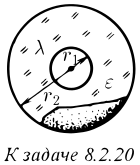
Radii of spherical capacitor plates and , respectively, charge . Find the resistance and leakage current in this capacitor if there is a substance with a dielectric constant and a specific conductivity between the plates.

Figure for problem 8.2.20
8.2.21 1100
RU Solution

After filling the capacitor with a medium with a specific conductivity and a dielectric constant , the resistance between its terminals turned out to be equal to . Find the capacitance of the capacitor. Does the result depend on the design of the capacitor?

8.2.22 900
EN Solution

Where on the lower and upper surfaces of a round conducting plate should electrical contacts be placed so that the resistance between them is minimal?

8.2.23 1100
EN Solution

Why is the kinetic energy of current carriers associated with their ordered motion not taken into account when considering the electric current in a substance? Estimate the kinetic energy of one electron (in electron volts) at a current of A in a sodium wire with a cross-section of . The number of conduction electrons per unit volume of the wire .

8.2.24 3300
EN Solution

The tape consists of narrow conductive strips with even narrower insulating gaps. It is in contact with one plate of the capacitor and with a small contact, between which the resistance is turned on. Before that, the tape was not charged, and the charge of the capacitor plates was . The length of the plates is , and their width coincides with the width of the tape. The tape is pulled out of the condenser with a force of . Find the current through the resistance and the steady-state speed of the tape. The distance from the edge of the capacitor plates to the contact is much greater than the distance between them and much less than their length.
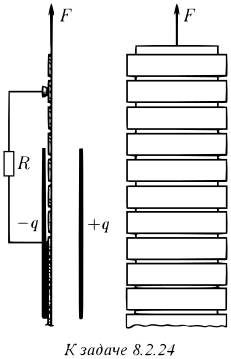
Figure for problem 8.2.24
8.2.25 1400
RU Solution

In a Van de Graaf generator, charge carriers "glued" to a non-conducting tape are transferred against the field. Inside the ball, charges are removed from the tape by a strong field localized on the contact brush. The energy needed to move the belt can be supplied by an electric motor, a gasoline engine, or a human hand. The total charge on the tape is , its length is , and the resistance between the ball and the ground is . Determine the steady state potential of the ball in two cases: a) the tape moves at a constant speed ; b) the tape is moved by applying a constant force .
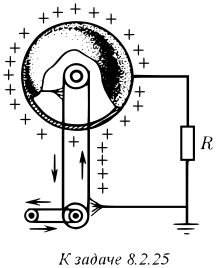
Figure for problem 8.2.25
8.2.26 2400
RU Solution

An electric "atomic" battery is a metal sphere with a piece of -radioactive substance isolated from it. The number of atoms decaying per unit time is equal to . Energy of escaped electrons . Determine the voltage at the open terminals of the battery. What is the highest current output of this battery? At what load resistance can a battery be considered a current generator?
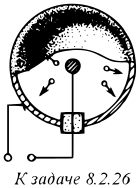
Figure for problem 8.2.26
8.2.27 3300
EN Solution

The current source consists of a thin plate of radioactive material surrounded by a conductive housing. The gap width between the housing and the plate is much smaller than the linear dimensions of the plate. How does the current depend on the voltage between the housing and the radioactive plate, if the current at a positive voltage is ? The energy of electrons escaping from the plates is . Electrons fly out in all directions evenly.
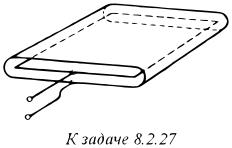
Figure for problem 8.2.27
8.2.28 2400
EN Solution

Without delving into the question of the origin of external forces, plot the potential of an open and closed circuit with resistance . On a section of the chain of length , the side force assigned to the unit of charge is equal to , and outside this section it is zero. What energy per unit charge is transmitted by the source of external forces in the section ?
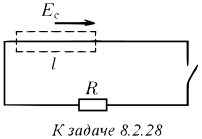
Figure for problem 8.2.28
8.2.29 2100
RU Solution

In a chemical element, the following reactions occur: on the negative silver electrode and on the positive platinum electrode (platinum does not react). At a very low current, cal of heat is released inside the cell for every mole of generated. During the reaction , cal are released for each mole of formed. Find the EMF of the element, i.e. the energy transmitted by the element to the unit of the transmitted charge ( cal eV).
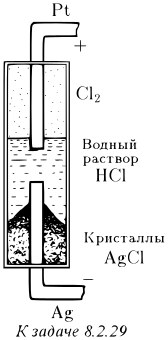
Figure for problem 8.2.29