| ### Statement | | ### Statement |
| | | |
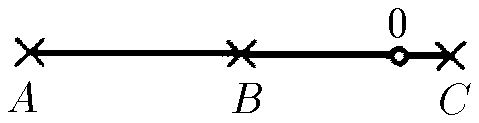
| $1.1.5^*.$ Three microphones located on the same straight line at points $A$, $B$, $C$ recorded successively at the moments $t_A > t_B > t_C$ the sound of an explosion that occurred at point $O$, which lies on the segment $AC$. Find the length of the segment $AO$ if $AB = BC = L$. At what point in time did the explosion occur? | | $1.1.5^*.$ Three microphones located on the same straight line at points $A$, $B$, $C$ recorded successively at the moments $t_A > t_B > t_C$ the sound of an explosion that occurred at point $O$, which lies on the segment $AC$. Find the length of the segment $AO$ if $AB = BC = L$. At what point in time did the explosion occur? |
| | | |
|  | |  |
| | | |
| ### Solution | | ### Solution |
| | | |
| Let the explosion occurred at time $t_0$, then the time of signal registration at point $A$ is equal to: | | Let the explosion occurred at time $t_0$, then the time of signal registration at point $A$ is equal to: |
| | | |
| $$t_A = t_0 + \frac{L + x}{c}, \, (1)$$ | | $$t_A = t_0 + \frac{L + x}{c}, \, (1)$$ |
| | | |
| where $x = BO$. Similar to point $B$ | | where $x = BO$. Similar to point $B$ |
| | | |
| $$t_B = t_0 + \frac{x}{c}, \,(2)$$ | | $$t_B = t_0 + \frac{x}{c}, \,(2)$$ |
| | | |
| For point $C$ | | For point $C$ |
| | | |
| $$t_C = t_0 + \frac{L - x}{c}, \,(3)$$ | | $$t_C = t_0 + \frac{L - x}{c}, \,(3)$$ |
| | | |
| Let's subtract the second equation from the first equation: | | Let's subtract the second equation from the first equation: |
| | | |
| $$t_A – t_B = \frac{L}{c}. \,(4)$$ | | $$t_A – t_B = \frac{L}{c}. \,(4)$$ |
| | | |
| And from the first equation we subtract the third equation | | And from the first equation we subtract the third equation |
| | | |
| $$t_A – t_C = \frac{2x}{c}. \,(5)$$ | | $$t_A – t_C = \frac{2x}{c}. \,(5)$$ |
| | | |
| From equation $(4)$ let's express | | From equation $(4)$ let's express |
| | | |
| $$c = \frac{L}{t_A – t_B},$$ | | $$c = \frac{L}{t_A – t_B},$$ |
| | | |
| and from $(5)$ | | and from $(5)$ |
| After the transformation | | After the transformation |
| | | |
| $$AO = \frac{3t_A – 2t_B – t_C}{2(t_A – t_B)} \cdot L. \, (6)$$ | | $$AO = \frac{3t_A – 2t_B – t_C}{2(t_A – t_B)} \cdot L. \, (6)$$ |
| | | |
| To determine the moment of time at which the explosion occurred, we substitute in the expression | | To determine the moment of time at which the explosion occurred, we substitute in the expression |
| | | |
| $$t_A = t_0 + \frac{L + x}{c}, \; c = \frac{L}{t_A – t_B}$$ $$\frac{t_A – t_C}{2} = \frac{x}{c}$$ | | $$t_A = t_0 + \frac{L + x}{c}, \; c = \frac{L}{t_A – t_B}$$ $$\frac{t_A – t_C}{2} = \frac{x}{c}$$ |
| | | |
| after transformations | | after transformations |
| | | |
| $$t_0 = t_B - \frac{1}{2} \cdot (t_A – t_C)$$ | | $$t_0 = t_B - \frac{1}{2} \cdot (t_A – t_C)$$ |
| | | |
| #### Answer | | #### Answer |
| | | |
| $$AO = \frac{3t_A – 2t_B – t_C}{2(t_A – t_B)} \cdot L, \; t_0 = t_B - \frac{1}{2} \cdot (t_A – t_C)$$ | | $$AO = \frac{3t_A – 2t_B – t_C}{2(t_A – t_B)} \cdot L, \; t_0 = t_B - \frac{1}{2} \cdot (t_A – t_C)$$ |
