Правка раздела «Solution»

en/2.3.38.md
+1 −1
| ### Statement | |||
| $2.3.38.$ Potential energy of electrostatic interaction of point charges $q$ and $Q$ located at a distance $r$ from each other, $U = \frac{kqQ}{r}$. Find the electrostatic force. Which charges have repulsion and which have attraction? | |||
| @@ -4,7 +4,7 @@Statement | |||
| ### Solution | |||
| − | Let us find the derivative of the potential energy of interaction by distance $$\frac{dU}{dr}=\left(\frac{kqQ}{r}\right)'$$ $$dU=-\frac{kqQ}{r^2}dr\quad(1)$$ Also by the law of conservation of energy, the change in that energy is equal to the work to be done $$dU=dA\Rightarrow dU=-Fdr\quad(2)$$ _NO: The larger $r$ is, the smaller $F$ is_ | ||
| + | Let us find the derivative of the potential energy of interaction by distance $$\frac{dU}{dr}=\left(\frac{kqQ}{r}\right)'$$ $$dU=-\frac{kqQ}{r^2}dr\quad(1)$$ Also by the law of conservation of energy, the change in that energy is equal to the work to be done $$dU=dA\Rightarrow dU=-Fdr\quad(2)$$ __NO: The larger $r$ is, the smaller $F$ is__ | ||
| 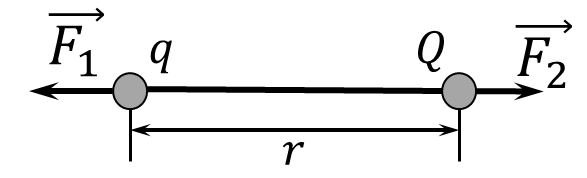 | |||
| According to Newton's third law $$\vec{F}_1=-\vec{F}_2=F$$ Substituting $(2)$ into $(1)$ leads to $$-\frac{kqQ}{r^2}dr=-Fdr$$ $$\boxed{F=\frac{kqQ}{r^2}}$$ When $qQ > 0$ — repulsion, when $qQ < 0$ — attraction. | |||
| #### Answer | |||
| $$F=\frac{kqQ}{r^2}$$ | |||
| ещё строк без изменений 5 | |||
| ### Statement | ### Statement | ||
| $2.3.38.$ Potential energy of electrostatic interaction of point charges $q$ and $Q$ located at a distance $r$ from each other, $U = \frac{kqQ}{r}$. Find the electrostatic force. Which charges have repulsion and which have attraction? | $2.3.38.$ Potential energy of electrostatic interaction of point charges $q$ and $Q$ located at a distance $r$ from each other, $U = \frac{kqQ}{r}$. Find the electrostatic force. Which charges have repulsion and which have attraction? | ||
| @@ -4,7 +4,7 @@Statement | |||
| ### Solution | ### Solution | ||
| Let us find the derivative of the potential energy of interaction by distance $$\frac{dU}{dr}=\left(\frac{kqQ}{r}\right)'$$ $$dU=-\frac{kqQ}{r^2}dr\quad(1)$$ Also by the law of conservation of energy, the change in that energy is equal to the work to be done $$dU=dA\Rightarrow dU=-Fdr\quad(2)$$ _NO: The larger $r$ is, the smaller $F$ is_ | Let us find the derivative of the potential energy of interaction by distance $$\frac{dU}{dr}=\left(\frac{kqQ}{r}\right)'$$ $$dU=-\frac{kqQ}{r^2}dr\quad(1)$$ Also by the law of conservation of energy, the change in that energy is equal to the work to be done $$dU=dA\Rightarrow dU=-Fdr\quad(2)$$ __NO: The larger $r$ is, the smaller $F$ is__ | ||
|  |  | ||
| According to Newton's third law $$\vec{F}_1=-\vec{F}_2=F$$ Substituting $(2)$ into $(1)$ leads to $$-\frac{kqQ}{r^2}dr=-Fdr$$ $$\boxed{F=\frac{kqQ}{r^2}}$$ When $qQ > 0$ — repulsion, when $qQ < 0$ — attraction. | According to Newton's third law $$\vec{F}_1=-\vec{F}_2=F$$ Substituting $(2)$ into $(1)$ leads to $$-\frac{kqQ}{r^2}dr=-Fdr$$ $$\boxed{F=\frac{kqQ}{r^2}}$$ When $qQ > 0$ — repulsion, when $qQ < 0$ — attraction. | ||
| #### Answer | #### Answer | ||
| $$F=\frac{kqQ}{r^2}$$ | $$F=\frac{kqQ}{r^2}$$ | ||
| ещё строк без изменений 5 | |||