2.4.12∗. Two identical uniform cylinders of radius $R$ each are placed on top of each other next to a wall as shown. After a disturbance, the bottom cylinder slightly moves to the right and the system comes into motion. Find the maximum subsequent speed of the bottom cylinder. Neglect friction between all surfaces.
Solution
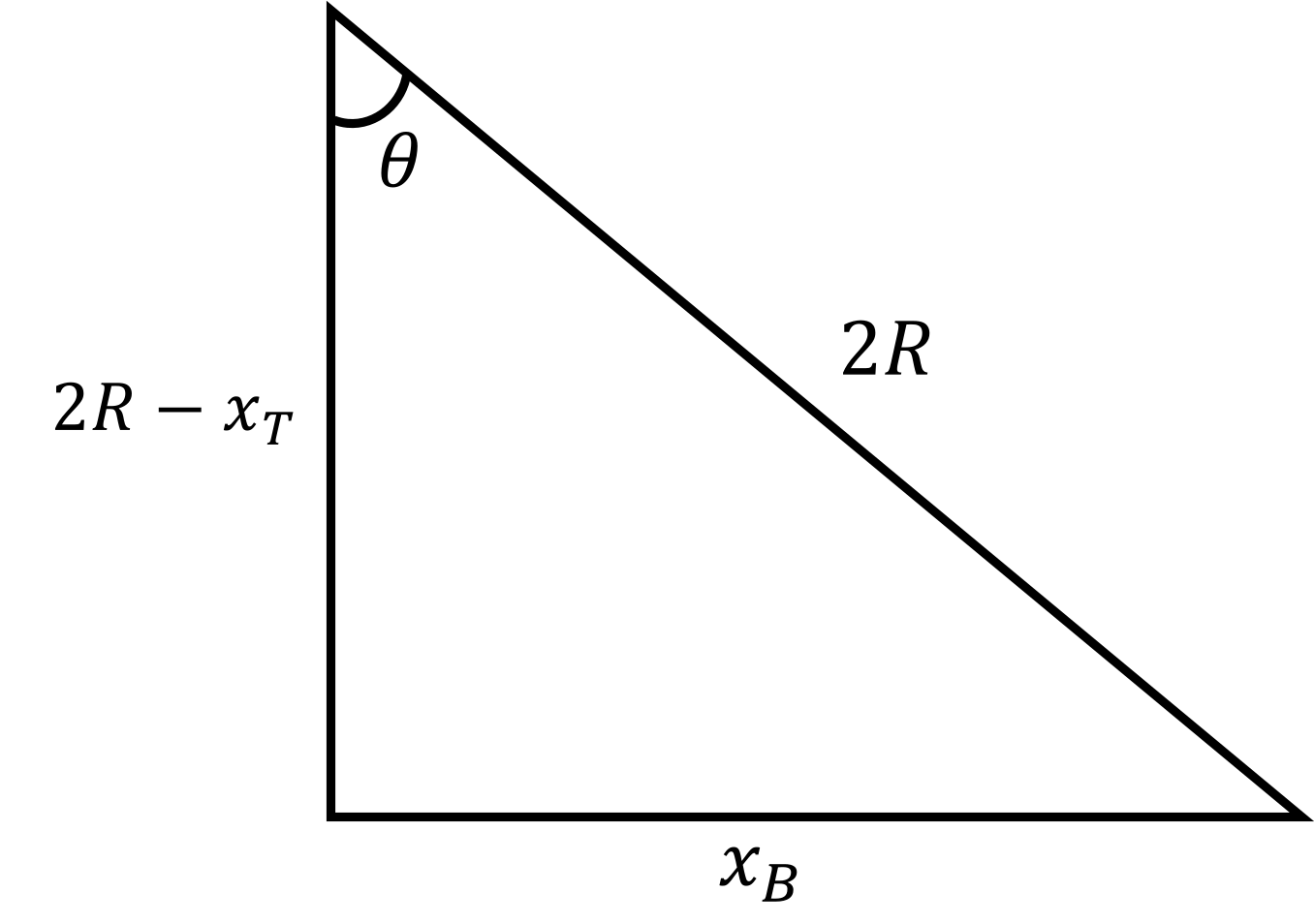
Figure 1
Consider the moment when the center of the top cylinder has moved down a distance $x_T$ and the center of the bottom cylinder has moved to the right a distance $x_B$. At this moment, the cylinders are moving with speeds $v_T$ and $v_B$, respectively. From Fig. 1:
Eliminating $v_T$ from the energy conservation equation gives $$v_B^2 = 4gR(1 – cos \theta)/(1 + \tan^2\theta)$$
Setting the derivative with respect to $\theta$ equal to zero gives
$$\cos \theta_m = \frac{2}{3}.$$
for the angle $\theta_m$ at which $v_B$ is maximum.
At this point, the speed of the bottom cylinder is
$$\boxed{v_B = \sqrt{\frac{16}{27}gR}}.$$
Mathematically, it appears that the speed decreases after $\theta_m$. However, for this to happen, the acceleration and, therefore, the horizontal force must be directed to the left (negative) for angles greater than $\theta_m$. But the contact force on the bottom cylinder by the top cylinder cannot be directed to the left. Therefore, the bottom cylinder loses contact with the top one and moves off at the maximum speed $v_B$