Правка разделов «Statement», «Solution», «Answer»

en/2.8.14.md
+6 −35
| @@ -1,44 +1,15 @@ | |||
| − | ### Statement | ||
| + | ### Statement | ||
| − | $2.8.14.$ [Insert problem description here] | ||
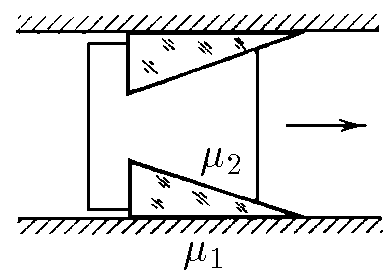
| + | $2.8.14^*.$ The body with wedges installed in its cutouts is located between two parallel walls as shown in the figure. Find the limit angle at the top of the wedges at which the body can move to the right and cannot move to the left. The coefficients of friction of the wedges against the walls and body are equal to $\mu_1$ and $\mu_2$, respectively. | ||
| − | __Example Statement__: | ||
| − | $1.1.1.$ Determine the coordinate $x(t)$ of a body as a function of time $t$, given that its acceleration is defined as $a(t) = bt$, where $b$ is a constant. | ||
| + |  | ||
| − | |||
| ### Solution | |||
| − | [Your solution should be placed here] | ||
| + |  | ||
| − | __Example Solution__: | ||
| − | The acceleration of the body defined by | ||
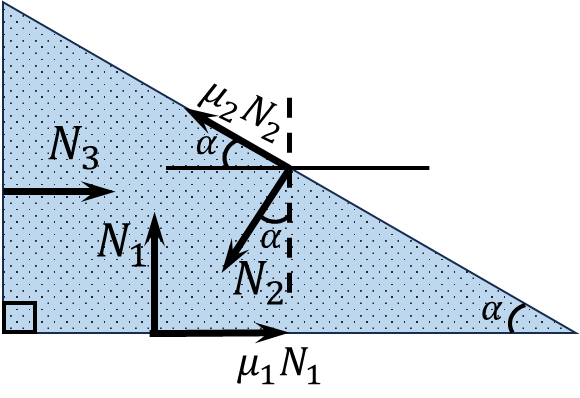
| + | State of forces equilibrium for the wedge for the horizontal axis: $$N_3+\mu_1N_1=\left(\mu_2\cos\alpha +\sin\alpha\right)N_2$$ In the set mode, the force that will act on the left wall will be equal to zero ($N_3=0$) $$\frac{N_1}{N_2}=\frac{\mu_2\cos\alpha +\sin\alpha}{\mu_1}\quad(1)$$ Similarly, for the vertical axis $$N_1+\mu_2N_2\sin\alpha =N_2\cos\alpha$$ $$\frac{N_1}{N_2}=\cos\alpha -\mu_2\sin\alpha\quad(2)$$ Substituing $(2)$ into $(1)$ $$\mu_1\cos\alpha -\mu_1\mu_2\sin\alpha =\mu_2\cos\alpha +\sin\alpha$$ Divide the left and right parts by $\cos\alpha$ $$\left(1+\mu_1\mu_2\right)\tan\alpha =\mu_1-\mu_2$$ Whence the required angle $$\boxed{\tan\alpha =\frac{{\mu}_{1}-\mu_{2}}{1+\mu_{1}\mu_{2}}}$$ | ||
| − | $$a(t) = bt$$ | ||
| − | |||
| − | We know that acceleration is the time derivative of velocity: | ||
| − | |||
| − | $$a(t) = \frac{d v(t)}{d t}$$ | ||
| − | |||
| − | To find the velocity $v(t)$, we integrate $a(t)$ with respect to time: | ||
| − | |||
| − | $$v(t) = \int a(t) \, dt = \int b t \, dt$$ | ||
| − | |||
| − | If the initial velocity is $v(0) = 0$, then the velocity becomes: | ||
| − | |||
| − | $$v(t) = \frac{b t^2}{2}$$ | ||
| − | |||
| − | Likewise, integrate $v(t)$ with respect to time: | ||
| − | |||
| − | $$x(t)= \int v(t) \, dt = \frac{b}{2} \int t^2 \, dt$$ | ||
| − | |||
| − | From where the coordinate from time, considering the initial conditions: | ||
| − | |||
| − | $$\boxed{x(t)=\frac{bt^3}{6}}$$ | ||
| − | |||
| #### Answer | |||
| − | [Insert a concise answer or boxed result, like this:] | ||
| − | |||
| − | |||
| − | __Example Answer__: | ||
| − | $$ x(t)=\frac{bt^3}{6} $$ | ||
| + | $$\operatorname{tg}\alpha =({\mu}_{1}-\mu_{2})/(1+\mu_{1}\mu_{2})$$ | ||
| @@ -1,44 +1,15 @@ | |||
| ### Statement | ### Statement | ||
| $2.8.14.$ [Insert problem description here] | $2.8.14^*.$ The body with wedges installed in its cutouts is located between two parallel walls as shown in the figure. Find the limit angle at the top of the wedges at which the body can move to the right and cannot move to the left. The coefficients of friction of the wedges against the walls and body are equal to $\mu_1$ and $\mu_2$, respectively. | ||
| __Example Statement__: |  | ||
| $1.1.1.$ Determine the coordinate $x(t)$ of a body as a function of time $t$, given that its acceleration is defined as $a(t) = bt$, where $b$ is a constant. | |||
| ### Solution | ### Solution | ||
| [Your solution should be placed here] |  | ||
| __Example Solution__: | State of forces equilibrium for the wedge for the horizontal axis: $$N_3+\mu_1N_1=\left(\mu_2\cos\alpha +\sin\alpha\right)N_2$$ In the set mode, the force that will act on the left wall will be equal to zero ($N_3=0$) $$\frac{N_1}{N_2}=\frac{\mu_2\cos\alpha +\sin\alpha}{\mu_1}\quad(1)$$ Similarly, for the vertical axis $$N_1+\mu_2N_2\sin\alpha =N_2\cos\alpha$$ $$\frac{N_1}{N_2}=\cos\alpha -\mu_2\sin\alpha\quad(2)$$ Substituing $(2)$ into $(1)$ $$\mu_1\cos\alpha -\mu_1\mu_2\sin\alpha =\mu_2\cos\alpha +\sin\alpha$$ Divide the left and right parts by $\cos\alpha$ $$\left(1+\mu_1\mu_2\right)\tan\alpha =\mu_1-\mu_2$$ Whence the required angle $$\boxed{\tan\alpha =\frac{{\mu}_{1}-\mu_{2}}{1+\mu_{1}\mu_{2}}}$$ | ||
| The acceleration of the body defined by | |||
| $$a(t) = bt$$ | |||
| We know that acceleration is the time derivative of velocity: | |||
| $$a(t) = \frac{d v(t)}{d t}$$ | |||
| To find the velocity $v(t)$, we integrate $a(t)$ with respect to time: | |||
| $$v(t) = \int a(t) \, dt = \int b t \, dt$$ | |||
| If the initial velocity is $v(0) = 0$, then the velocity becomes: | |||
| $$v(t) = \frac{b t^2}{2}$$ | |||
| Likewise, integrate $v(t)$ with respect to time: | |||
| $$x(t)= \int v(t) \, dt = \frac{b}{2} \int t^2 \, dt$$ | |||
| From where the coordinate from time, considering the initial conditions: | |||
| $$\boxed{x(t)=\frac{bt^3}{6}}$$ | |||
| #### Answer | #### Answer | ||
| [Insert a concise answer or boxed result, like this:] | $$\operatorname{tg}\alpha =({\mu}_{1}-\mu_{2})/(1+\mu_{1}\mu_{2})$$ | ||
| __Example Answer__: | |||
| $$ x(t)=\frac{bt^3}{6} $$ | |||