Правка раздела «Solution»

en/9.2.17.md
+1 −1
| ### Statement | |||
| $9.2.17^*.$ Determine the magnetic field induction of a rectangular frame $a \times b$ with a current $I$ at a point $A$ located at a distance $r$ much greater than the linear dimensions of the frame. The radius vector $\vec{r}$ forms an angle $\alpha$ with the plane of the frame. | |||
| ### Solution | |||
| 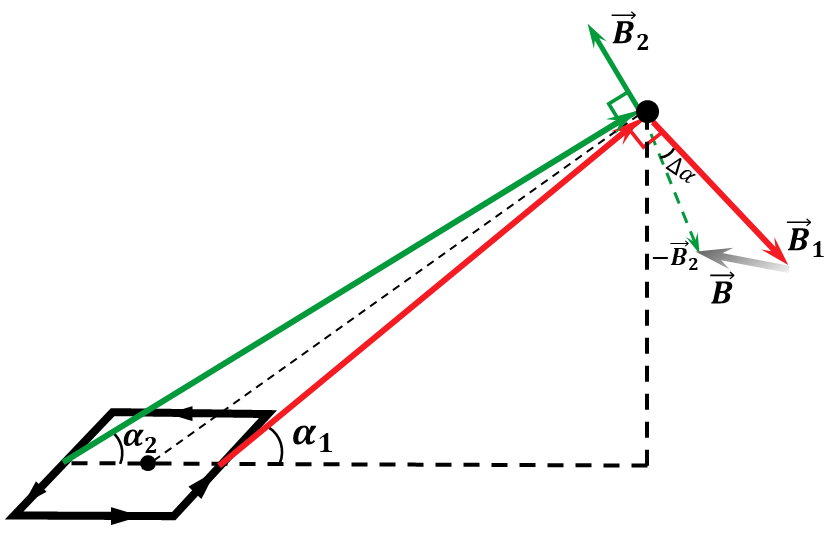 | |||
| From symmetry, it follows that the magnetic field induction will be present only in the plane defined by the angle $\alpha$, since the components of the wire of length $a$ will compensate each other | |||
| Let's write out the cosines of the angles that $\vec{r}$ makes with wires of length $b$ let the angle $\alpha_1$ be for the nearest wire, and the angle $\alpha_2$ be for the farthest one, then | |||
| $$ \cos\alpha_1 = \frac{{2r\cos\alpha} - a}{2r} = \cos\alpha - \frac{a}{2r} $$ $$ \cos\alpha_2 = \frac{{2r\cos\alpha} + a}{2r} = \cos\alpha + \frac{a}{2r} $$ __Theoretical digression__ | |||
|  | |||
| @@ -16,8 +16,8 @@Solution | |||
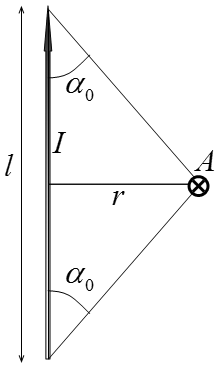
| A magnetic wire of length $l$ creates a magnetic field equal to $$ B=\frac{\mu_0I}{2\pi r}\cos\alpha_0 $$ From the geometry of the problem, we obtain $$ \cos\alpha_0 = \frac{b/2}{\sqrt{r^2+b^2/4}} = \frac{b}{2r}\left(1+\frac{b^2}{4r^2}\right)^{1/2} $$ Using the approximation $(1+x)^\alpha\approx1+\alpha x$, we transform to the first order of smallness $$ \cos\alpha_0 = \frac{b}{2r}\left(1-\frac{b^2}{8r^2}\right)\approx\frac{b}{2r} $$ A more detailed derivation of this formula is on pages 76-78 ["Magnetostatics. Electrodynamics. Theory of Oscillations"](http://belpho.org/books/Magnitostatika.pdf) — A.I. Slobodanyuk From where we get $$ \boxed{B_0=B_1=B_2=\frac{\mu_0Ib}{4\pi r^2}} $$ NO: we used an approximation that will later give us an answer with an accuracy of up to first order | |||
| − | From the drawing it follows that the total magnetic induction of the magnetic field $\vec{B}$ will be equal to the vector sum of the components $\vec{B}_1$ and $\vec{B}_2$ $$ \vec{B}=\vec{B}_1+\vec{B}_2 $$ Then the vector modulus can be found using the cosine law. $$ B = \sqrt{B_1^2+B_2^2-2B_1B_2\cos\Delta\alpha} $$ $$ B = B_0\sqrt{2-2\cos\Delta\alpha} = 2B_0\sin\frac{\Delta\alpha}{2}\tag{1} $$ Considering the smallness of the angle $\Delta \alpha$, $$ \sin\frac{\Delta\alpha}{2} \approx \frac{\Delta\alpha}{2}=\frac{a}{2r} $$ We substitute $(1)$: $$ B = 2B_0\sin\frac{\Delta\alpha}{2} = B_0 \Delta\alpha $$ We obtain in approximation to the first order: $$ \boxed{B = \frac{\mu_0Ib}{4\pi r^2}\frac{a}{r} = \frac{\mu_0M}{4\pi r^3}} $$ If, when solving the problem, you managed to get an answer up to the second order, be the first to send the solution to [al | ||
| + | From the drawing it follows that the total magnetic induction of the magnetic field $\vec{B}$ will be equal to the vector sum of the components $\vec{B}_1$ and $\vec{B}_2$ $$ \vec{B}=\vec{B}_1+\vec{B}_2 $$ Then the vector modulus can be found using the cosine law. $$ B = \sqrt{B_1^2+B_2^2-2B_1B_2\cos\Delta\alpha} $$ $$ B = B_0\sqrt{2-2\cos\Delta\alpha} = 2B_0\sin\frac{\Delta\alpha}{2}\tag{1} $$ Considering the smallness of the angle $\Delta \alpha$, $$ \sin\frac{\Delta\alpha}{2} \approx \frac{\Delta\alpha}{2}=\frac{a}{2r} $$ We substitute $(1)$: $$ B = 2B_0\sin\frac{\Delta\alpha}{2} = B_0 \Delta\alpha $$ We obtain in approximation to the first order: $$ \boxed{B = \frac{\mu_0Ib}{4\pi r^2}\frac{a}{r} = \frac{\mu_0M}{4\pi r^3}} $$ If, when solving the problem, you managed to get an answer up to the second order, be the first to send the solution to [aliaksandr@melnichenka.com](mailto:aliaksandr@melnichenka.com) | ||
| #### Answer | |||
| $$B=\mu_0M\sqrt{1+3\sin^2\alpha} /(4\pi r^3), ~M=Iab$$ | |||
| ### Statement | ### Statement | ||
| $9.2.17^*.$ Determine the magnetic field induction of a rectangular frame $a \times b$ with a current $I$ at a point $A$ located at a distance $r$ much greater than the linear dimensions of the frame. The radius vector $\vec{r}$ forms an angle $\alpha$ with the plane of the frame. | $9.2.17^*.$ Determine the magnetic field induction of a rectangular frame $a \times b$ with a current $I$ at a point $A$ located at a distance $r$ much greater than the linear dimensions of the frame. The radius vector $\vec{r}$ forms an angle $\alpha$ with the plane of the frame. | ||
| ### Solution | ### Solution | ||
|  |  | ||
| From symmetry, it follows that the magnetic field induction will be present only in the plane defined by the angle $\alpha$, since the components of the wire of length $a$ will compensate each other | From symmetry, it follows that the magnetic field induction will be present only in the plane defined by the angle $\alpha$, since the components of the wire of length $a$ will compensate each other | ||
| Let's write out the cosines of the angles that $\vec{r}$ makes with wires of length $b$ let the angle $\alpha_1$ be for the nearest wire, and the angle $\alpha_2$ be for the farthest one, then | Let's write out the cosines of the angles that $\vec{r}$ makes with wires of length $b$ let the angle $\alpha_1$ be for the nearest wire, and the angle $\alpha_2$ be for the farthest one, then | ||
| $$ \cos\alpha_1 = \frac{{2r\cos\alpha} - a}{2r} = \cos\alpha - \frac{a}{2r} $$ $$ \cos\alpha_2 = \frac{{2r\cos\alpha} + a}{2r} = \cos\alpha + \frac{a}{2r} $$ __Theoretical digression__ | $$ \cos\alpha_1 = \frac{{2r\cos\alpha} - a}{2r} = \cos\alpha - \frac{a}{2r} $$ $$ \cos\alpha_2 = \frac{{2r\cos\alpha} + a}{2r} = \cos\alpha + \frac{a}{2r} $$ __Theoretical digression__ | ||
|  |  | ||
| @@ -16,8 +16,8 @@Solution | |||
| A magnetic wire of length $l$ creates a magnetic field equal to $$ B=\frac{\mu_0I}{2\pi r}\cos\alpha_0 $$ From the geometry of the problem, we obtain $$ \cos\alpha_0 = \frac{b/2}{\sqrt{r^2+b^2/4}} = \frac{b}{2r}\left(1+\frac{b^2}{4r^2}\right)^{1/2} $$ Using the approximation $(1+x)^\alpha\approx1+\alpha x$, we transform to the first order of smallness $$ \cos\alpha_0 = \frac{b}{2r}\left(1-\frac{b^2}{8r^2}\right)\approx\frac{b}{2r} $$ A more detailed derivation of this formula is on pages 76-78 ["Magnetostatics. Electrodynamics. Theory of Oscillations"](http://belpho.org/books/Magnitostatika.pdf) — A.I. Slobodanyuk From where we get $$ \boxed{B_0=B_1=B_2=\frac{\mu_0Ib}{4\pi r^2}} $$ NO: we used an approximation that will later give us an answer with an accuracy of up to first order | A magnetic wire of length $l$ creates a magnetic field equal to $$ B=\frac{\mu_0I}{2\pi r}\cos\alpha_0 $$ From the geometry of the problem, we obtain $$ \cos\alpha_0 = \frac{b/2}{\sqrt{r^2+b^2/4}} = \frac{b}{2r}\left(1+\frac{b^2}{4r^2}\right)^{1/2} $$ Using the approximation $(1+x)^\alpha\approx1+\alpha x$, we transform to the first order of smallness $$ \cos\alpha_0 = \frac{b}{2r}\left(1-\frac{b^2}{8r^2}\right)\approx\frac{b}{2r} $$ A more detailed derivation of this formula is on pages 76-78 ["Magnetostatics. Electrodynamics. Theory of Oscillations"](http://belpho.org/books/Magnitostatika.pdf) — A.I. Slobodanyuk From where we get $$ \boxed{B_0=B_1=B_2=\frac{\mu_0Ib}{4\pi r^2}} $$ NO: we used an approximation that will later give us an answer with an accuracy of up to first order | ||
| From the drawing it follows that the total magnetic induction of the magnetic field $\vec{B}$ will be equal to the vector sum of the components $\vec{B}_1$ and $\vec{B}_2$ $$ \vec{B}=\vec{B}_1+\vec{B}_2 $$ Then the vector modulus can be found using the cosine law. $$ B = \sqrt{B_1^2+B_2^2-2B_1B_2\cos\Delta\alpha} $$ $$ B = B_0\sqrt{2-2\cos\Delta\alpha} = 2B_0\sin\frac{\Delta\alpha}{2}\tag{1} $$ Considering the smallness of the angle $\Delta \alpha$, $$ \sin\frac{\Delta\alpha}{2} \approx \frac{\Delta\alpha}{2}=\frac{a}{2r} $$ We substitute $(1)$: $$ B = 2B_0\sin\frac{\Delta\alpha}{2} = B_0 \Delta\alpha $$ We obtain in approximation to the first order: $$ \boxed{B = \frac{\mu_0Ib}{4\pi r^2}\frac{a}{r} = \frac{\mu_0M}{4\pi r^3}} $$ If, when solving the problem, you managed to get an answer up to the second order, be the first to send the solution to [al |
From the drawing it follows that the total magnetic induction of the magnetic field $\vec{B}$ will be equal to the vector sum of the components $\vec{B}_1$ and $\vec{B}_2$ $$ \vec{B}=\vec{B}_1+\vec{B}_2 $$ Then the vector modulus can be found using the cosine law. $$ B = \sqrt{B_1^2+B_2^2-2B_1B_2\cos\Delta\alpha} $$ $$ B = B_0\sqrt{2-2\cos\Delta\alpha} = 2B_0\sin\frac{\Delta\alpha}{2}\tag{1} $$ Considering the smallness of the angle $\Delta \alpha$, $$ \sin\frac{\Delta\alpha}{2} \approx \frac{\Delta\alpha}{2}=\frac{a}{2r} $$ We substitute $(1)$: $$ B = 2B_0\sin\frac{\Delta\alpha}{2} = B_0 \Delta\alpha $$ We obtain in approximation to the first order: $$ \boxed{B = \frac{\mu_0Ib}{4\pi r^2}\frac{a}{r} = \frac{\mu_0M}{4\pi r^3}} $$ If, when solving the problem, you managed to get an answer up to the second order, be the first to send the solution to [aliaksandr@melnichenka.com](mailto:aliaksandr@melnichenka.com) | ||
| #### Answer | #### Answer | ||
| $$B=\mu_0M\sqrt{1+3\sin^2\alpha} /(4\pi r^3), ~M=Iab$$ | $$B=\mu_0M\sqrt{1+3\sin^2\alpha} /(4\pi r^3), ~M=Iab$$ | ||