Правка раздела «Solution»

en/2.8.37.md
+1 −1
| ### Statement | |||
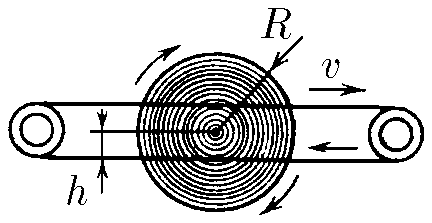
| $2.8.37^*.$ A wheel of radius $R$ can rotate freely around its axis. Drive belts moving at a speed $v$ are pressed against the side surface of the wheel at a distance $h$ from the axis of rotation. Determine the steady-state angular velocity of the wheel if its contact with the drive belt occurs only along the rim. | |||
|  | |||
| @@ -6,7 +6,7 @@Statement | |||
| ### Solution | |||
| − |  Direction of the torque of the rotational force | ||
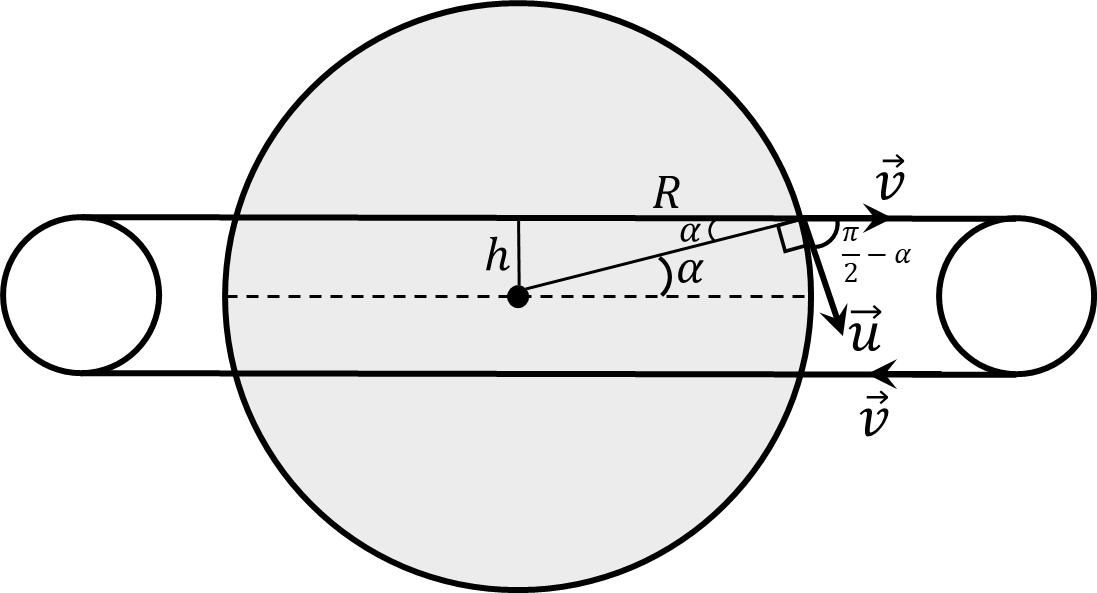
| In order for the wheel to move it is necessary that a moment of force associated with the frictional force from drive belts is transmitted, which is directed along the axis of rotation. | |||
| Thus, the momentum will make an angle with velocity $v$ equal to $\pi -\alpha$ | |||
| Projecting onto the linear rotation speed of the wheel: $$u=v\cos(\frac{\pi}{2}-\alpha )=v\sin\alpha\tag{1}$$ From the drawing $$\sin\alpha = \frac{h}{R}$$ Substituting into $(1)$ $$u=v \frac{h}{R}$$ From where we find the linear velocity, given that the wheel is circular $$\boxed{\omega =\frac{u}{R}=v \frac{h}{R^2}}$$ | |||
| #### Answer | |||
| $$\omega =\frac{hv}{R^2}$$ | |||
| ещё строк без изменений 7 | |||
| ### Statement | ### Statement | ||
| $2.8.37^*.$ A wheel of radius $R$ can rotate freely around its axis. Drive belts moving at a speed $v$ are pressed against the side surface of the wheel at a distance $h$ from the axis of rotation. Determine the steady-state angular velocity of the wheel if its contact with the drive belt occurs only along the rim. | $2.8.37^*.$ A wheel of radius $R$ can rotate freely around its axis. Drive belts moving at a speed $v$ are pressed against the side surface of the wheel at a distance $h$ from the axis of rotation. Determine the steady-state angular velocity of the wheel if its contact with the drive belt occurs only along the rim. | ||
|  |  | ||
| @@ -6,7 +6,7 @@Statement | |||
| ### Solution | ### Solution | ||
|  Direction of the torque of the rotational force | ||
| In order for the wheel to move it is necessary that a moment of force associated with the frictional force from drive belts is transmitted, which is directed along the axis of rotation. | In order for the wheel to move it is necessary that a moment of force associated with the frictional force from drive belts is transmitted, which is directed along the axis of rotation. | ||
| Thus, the momentum will make an angle with velocity $v$ equal to $\pi -\alpha$ | Thus, the momentum will make an angle with velocity $v$ equal to $\pi -\alpha$ | ||
| Projecting onto the linear rotation speed of the wheel: $$u=v\cos(\frac{\pi}{2}-\alpha )=v\sin\alpha\tag{1}$$ From the drawing $$\sin\alpha = \frac{h}{R}$$ Substituting into $(1)$ $$u=v \frac{h}{R}$$ From where we find the linear velocity, given that the wheel is circular $$\boxed{\omega =\frac{u}{R}=v \frac{h}{R^2}}$$ | Projecting onto the linear rotation speed of the wheel: $$u=v\cos(\frac{\pi}{2}-\alpha )=v\sin\alpha\tag{1}$$ From the drawing $$\sin\alpha = \frac{h}{R}$$ Substituting into $(1)$ $$u=v \frac{h}{R}$$ From where we find the linear velocity, given that the wheel is circular $$\boxed{\omega =\frac{u}{R}=v \frac{h}{R^2}}$$ | ||
| #### Answer | #### Answer | ||
| $$\omega =\frac{hv}{R^2}$$ | $$\omega =\frac{hv}{R^2}$$ | ||
| ещё строк без изменений 7 | |||