Правка раздела «Solution»

en/4.1.22.md
+2 −2
| ### Statement | |||
| $4.1.22.$ At what angle to the horizon will the surface of the liquid in the vessel slide on an inclined plane that makes an angle $\alpha$ to the horizon if the friction coefficient is $\mu$? | |||
| ### Solution | |||
|  | |||
| @@ -8,9 +8,9 @@Solution | |||
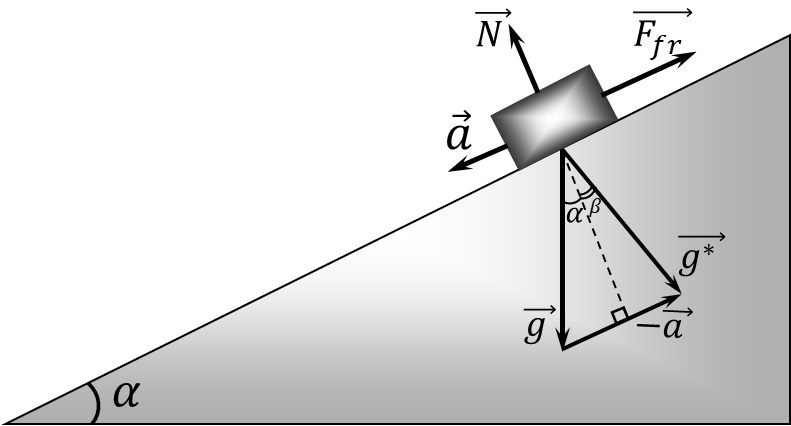
| The vessel with liquid goes downward with acceleration $a$ as shown in the figure | |||
| − | Given the reaction force $N=mg\cos\alpha$, the sliding friction force is found as $$F_\text{fr} = \mu N = \mu mg\cos\alpha$$ Newton's second law for the vessel $$ma = mg\sin\alpha -F_\text{fr}$$ $$\boxed{a=g(\sin\alpha -\mu\cos\alpha )} | ||
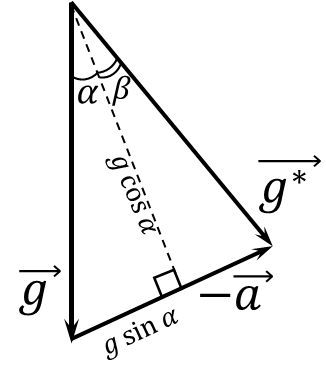
| + | Given the reaction force $N=mg\cos\alpha$, the sliding friction force is found as $$F_\text{fr} = \mu N = \mu mg\cos\alpha$$ Newton's second law for the vessel $$ma = mg\sin\alpha -F_\text{fr}$$ $$\boxed{a=g(\sin\alpha -\mu\cos\alpha )}\tag{1}$$ Let us introduce the effective acceleration of free fall $\vec{g^*}$ in a non-inertial frame of reference associated with the vessel, then vectorially, it is found as $$\vec{g^*}=\vec{g}-\vec{a}$$ | ||
| − |  | ||
| + |  | ||
| From the drawing it could be found that $$\tan\beta = \frac{a - g\sin\alpha}{g\cos\alpha} = -\mu$$ The angle between the water level and the horizon will be $$\boxed{\gamma = \alpha -\operatorname{\arctan }\mu}$$ | |||
| #### Answer | |||
| $$\gamma =\alpha -\operatorname{\arctan }\mu$$ | |||
| ещё строк без изменений 3 | |||
| ### Statement | ### Statement | ||
| $4.1.22.$ At what angle to the horizon will the surface of the liquid in the vessel slide on an inclined plane that makes an angle $\alpha$ to the horizon if the friction coefficient is $\mu$? | $4.1.22.$ At what angle to the horizon will the surface of the liquid in the vessel slide on an inclined plane that makes an angle $\alpha$ to the horizon if the friction coefficient is $\mu$? | ||
| ### Solution | ### Solution | ||
|  |  | ||
| @@ -8,9 +8,9 @@Solution | |||
| The vessel with liquid goes downward with acceleration $a$ as shown in the figure | The vessel with liquid goes downward with acceleration $a$ as shown in the figure | ||
| Given the reaction force $N=mg\cos\alpha$, the sliding friction force is found as $$F_\text{fr} = \mu N = \mu mg\cos\alpha$$ Newton's second law for the vessel $$ma = mg\sin\alpha -F_\text{fr}$$ $$\boxed{a=g(\sin\alpha -\mu\cos\alpha )} |
Given the reaction force $N=mg\cos\alpha$, the sliding friction force is found as $$F_\text{fr} = \mu N = \mu mg\cos\alpha$$ Newton's second law for the vessel $$ma = mg\sin\alpha -F_\text{fr}$$ $$\boxed{a=g(\sin\alpha -\mu\cos\alpha )}\tag{1}$$ Let us introduce the effective acceleration of free fall $\vec{g^*}$ in a non-inertial frame of reference associated with the vessel, then vectorially, it is found as $$\vec{g^*}=\vec{g}-\vec{a}$$ | ||
|  |
 | ||
| From the drawing it could be found that $$\tan\beta = \frac{a - g\sin\alpha}{g\cos\alpha} = -\mu$$ The angle between the water level and the horizon will be $$\boxed{\gamma = \alpha -\operatorname{\arctan }\mu}$$ | From the drawing it could be found that $$\tan\beta = \frac{a - g\sin\alpha}{g\cos\alpha} = -\mu$$ The angle between the water level and the horizon will be $$\boxed{\gamma = \alpha -\operatorname{\arctan }\mu}$$ | ||
| #### Answer | #### Answer | ||
| $$\gamma =\alpha -\operatorname{\arctan }\mu$$ | $$\gamma =\alpha -\operatorname{\arctan }\mu$$ | ||
| ещё строк без изменений 3 | |||