Правка раздела «Solution»

en/2.3.35.md
+5 −1
| ### Statement | |||
| $2.3.35.$ A particle of mass $m$ flies into a region where it is affected by a braking force that depends only on the distance between the particle and the boundary of the region. Find this dependence if the depth of penetration of a particle into the braking region is proportional to its initial momentum: $l = \alpha p$. | |||
| ### Solution | |||
| 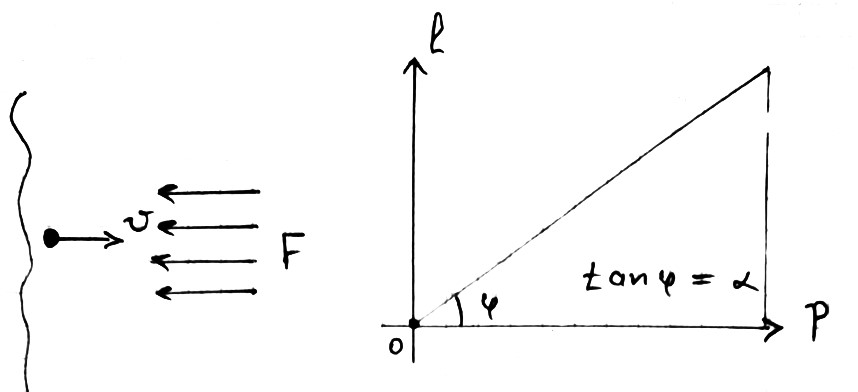 | |||
| The work done by the force $F$ when the particle moves $dl$ | |||
| $$ | |||
| F dl = dA \tag{1} | |||
| $$ | |||
| From the law of conservation of energy | |||
| $$ | |||
| \quad \frac{m u^2}{2} = \frac{p^2}{2m} | |||
| $$ | |||
| @@ -21,7 +21,11 @@Solution | |||
| Considering a small increment of energy | |||
| $$ | |||
| − | dE = \frac{d(p^2)}{2m} = \frac{p dp}{m} \tag{2} | ||
| + | dE = \frac{d(p^2)}{2m} = \frac{p dp}{m} \tag{2} | ||
| + | $$ | ||
| + | |||
| + | $$ | ||
| + | dA = dE \Rightarrow F dl = \frac{p dp}{m} | ||
| $$ | |||
| $$ | |||
| \quad F = \frac{p}{m} \frac{dp}{dl} = \frac{p}{m} \frac{1}{\alpha} = \frac{1}{m} \frac{l}{\alpha} \frac{1}{\alpha} = \frac{l}{m \alpha^2} \quad (*) | |||
| $$ | |||
| From where | |||
| $$ | |||
| \quad \frac{dp}{dl} = \frac{1}{\alpha} , \quad p = \frac{l}{\alpha} \\\ \quad \boxed{F = \frac{l}{m \alpha^2}} | |||
| $$ | |||
| #### Answer | |||
| $$ | |||
| F={l}/{(m \alpha^2)} | |||
| $$ | |||
| ещё строк без изменений 14 | |||
| ### Statement | ### Statement | ||
| $2.3.35.$ A particle of mass $m$ flies into a region where it is affected by a braking force that depends only on the distance between the particle and the boundary of the region. Find this dependence if the depth of penetration of a particle into the braking region is proportional to its initial momentum: $l = \alpha p$. | $2.3.35.$ A particle of mass $m$ flies into a region where it is affected by a braking force that depends only on the distance between the particle and the boundary of the region. Find this dependence if the depth of penetration of a particle into the braking region is proportional to its initial momentum: $l = \alpha p$. | ||
| ### Solution | ### Solution | ||
|  |  | ||
| The work done by the force $F$ when the particle moves $dl$ | The work done by the force $F$ when the particle moves $dl$ | ||
| $$ | $$ | ||
| F dl = dA \tag{1} | F dl = dA \tag{1} | ||
| $$ | $$ | ||
| From the law of conservation of energy | From the law of conservation of energy | ||
| $$ | $$ | ||
| \quad \frac{m u^2}{2} = \frac{p^2}{2m} | \quad \frac{m u^2}{2} = \frac{p^2}{2m} | ||
| $$ | $$ | ||
| @@ -21,7 +21,11 @@Solution | |||
| Considering a small increment of energy | Considering a small increment of energy | ||
| $$ | $$ | ||
| dE = \frac{d(p^2)}{2m} = \frac{p dp}{m} \tag{2} |
dE = \frac{d(p^2)}{2m} = \frac{p dp}{m} \tag{2} | ||
| $$ | |||
| $$ | |||
| dA = dE \Rightarrow F dl = \frac{p dp}{m} | |||
| $$ | $$ | ||
| $$ | $$ | ||
| \quad F = \frac{p}{m} \frac{dp}{dl} = \frac{p}{m} \frac{1}{\alpha} = \frac{1}{m} \frac{l}{\alpha} \frac{1}{\alpha} = \frac{l}{m \alpha^2} \quad (*) | \quad F = \frac{p}{m} \frac{dp}{dl} = \frac{p}{m} \frac{1}{\alpha} = \frac{1}{m} \frac{l}{\alpha} \frac{1}{\alpha} = \frac{l}{m \alpha^2} \quad (*) | ||
| $$ | $$ | ||
| From where | From where | ||
| $$ | $$ | ||
| \quad \frac{dp}{dl} = \frac{1}{\alpha} , \quad p = \frac{l}{\alpha} \\\ \quad \boxed{F = \frac{l}{m \alpha^2}} | \quad \frac{dp}{dl} = \frac{1}{\alpha} , \quad p = \frac{l}{\alpha} \\\ \quad \boxed{F = \frac{l}{m \alpha^2}} | ||
| $$ | $$ | ||
| #### Answer | #### Answer | ||
| $$ | $$ | ||
| F={l}/{(m \alpha^2)} | F={l}/{(m \alpha^2)} | ||
| $$ | $$ | ||
| ещё строк без изменений 14 | |||