| ### Statement | | ### Statement |
| | | |
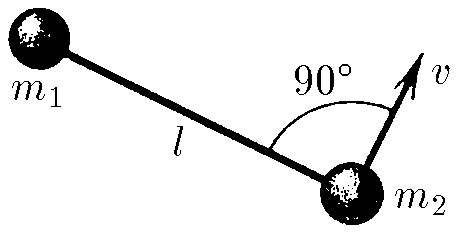
| $2.2.24^*$ Two bodies of mass $m_1$ and $m_2$ are connected by a stretched thread of length $l$ and move along a smooth horizontal surface. At some point in time, it turned out that the first body is stationary, and the velocity of the second body, equal to $v$, is perpendicular to the thread. Determine the tension force of the thread. | | $2.2.24^*$ Two bodies of mass $m_1$ and $m_2$ are connected by a stretched thread of length $l$ and move along a smooth horizontal surface. At some point in time, it turned out that the first body is stationary, and the velocity of the second body, equal to $v$, is perpendicular to the thread. Determine the tension force of the thread. |
| | | |
|  | |  |
| | | |
| ### Solution | | ### Solution |
| | | |
|  | |  |
| | | |
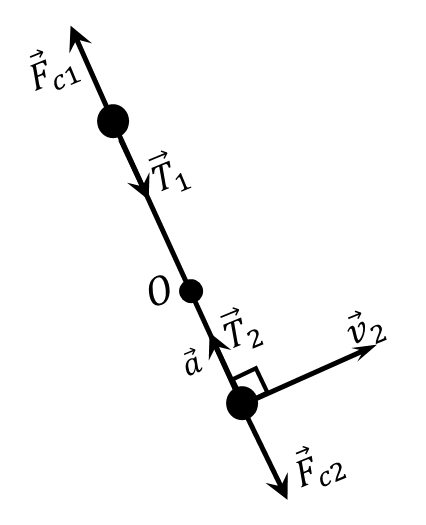
| Since point $1$ is at rest, it follows that the forces acting on it are compensated | | Since point $1$ is at rest, it follows that the forces acting on it are compensated |
| | | |
| $$ | | $$ |
| \vec{F}_{c1}=-\vec{T}_{1} | | \vec{F}_{c1}=-\vec{T}_{1} |
| $$ | | $$ |
| | | |
| $$ | | $$ |
| T_1=m_1\omega^2 x | | T_1=m_1\omega^2 x |
| $$ | | $$ |
| | | |
| Where distance $x$ between point $1$ and center of mass | | Where distance $x$ between point $1$ and center of mass |
| | | |
| $$ | | $$ |
| x=l\frac{m_2}{m_1+m_2} | | x=l\frac{m_2}{m_1+m_2} |
| $$ | | $$ |
| | | |
|  | |  |
| | | |
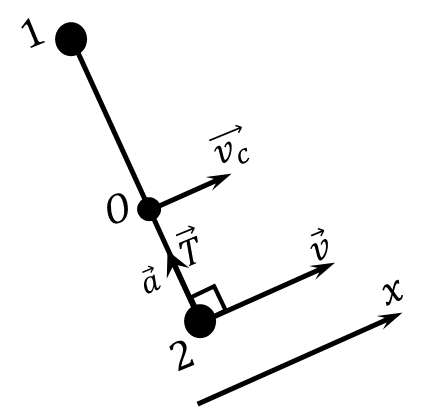
| Since point $1$ is at rest, the motion is around it. Then the angular velocity of rotation is found through the velocity $v$ of the point $2$ | | Since point $1$ is at rest, the motion is around it. Then the angular velocity of rotation is found through the velocity $v$ of the point $2$ |
| | | |
| $$ | | $$ |
| \omega = \frac{v}{l} | | \omega = \frac{v}{l} |
| $$ | | $$ |
| | | |
| Now, substitute all of this into the expression for $T_1$ | | Now, substitute all of this into the expression for $T_1$ |
| | | |
| $$ | | $$ |
| T_1=m_1\frac{v^2}{l^2} \cdot l\frac{m_2}{m_1+m_2} | | T_1=m_1\frac{v^2}{l^2} \cdot l\frac{m_2}{m_1+m_2} |
| $$ | | $$ |
| | | |
| $$ | | $$ |
| T_1=\frac{m_1m_2v^2}{(m_1+m_2)l} | | T_1=\frac{m_1m_2v^2}{(m_1+m_2)l} |
| $$ | | $$ |
| | | |
| According to Newton's third law, since the thread is weightless, the absolute value of tension force of the thread at point $1$ and point $2$ are equal. | | According to Newton's third law, since the thread is weightless, the absolute value of tension force of the thread at point $1$ and point $2$ are equal. |
| | | |
| $$ | | $$ |
| T_1=T_2=T | | T_1=T_2=T |
| $$ | | $$ |
| | | |
| $$ | | $$ |
| \boxed{T=\frac{m_1m_2}{m_1+m_2}\frac{v^2}{l}} | | \boxed{T=\frac{m_1m_2}{m_1+m_2}\frac{v^2}{l}} |
| $$ | | $$ |
| | | |
| #### Answer | | #### Answer |
| | | |
| $$ | | $$ |
| F=\frac{m_1m_2v^2}{(m_1+m_2)l} | | F=\frac{m_1m_2v^2}{(m_1+m_2)l} |
| $$ | | $$ |
| | | |
| ### Alternative solution | | ### Alternative solution |
| | | |
|  | |  |
| | | |
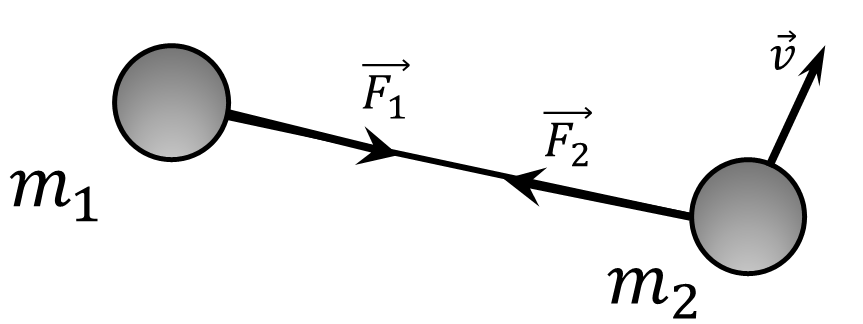
| Let's consider this system as different bodies. Using Newton's Second law of motion, we can get: | | Let's consider this system as different bodies. Using Newton's Second law of motion, we can get: |
| | | |
| $$ | | $$ |
| \begin{cases} \vec{F}_1 = m_1 \vec{a}_1 \\\ \vec{F}_2 = m_2 \vec{a}_2 \end{cases} \Rightarrow \begin{cases} \vec{a}_1 = \frac{\vec{F}_1}{m_1} \\\ \vec{a}_2 = \frac{\vec{F}_2}{m_2} \end{cases} \quad \text{(1)} | | \begin{cases} \vec{F}_1 = m_1 \vec{a}_1 \\\ \vec{F}_2 = m_2 \vec{a}_2 \end{cases} \Rightarrow \begin{cases} \vec{a}_1 = \frac{\vec{F}_1}{m_1} \\\ \vec{a}_2 = \frac{\vec{F}_2}{m_2} \end{cases} \quad \text{(1)} |
| $$ | | $$ |
| | | |
| Let's subtract $\vec{a}_2$ from $\vec{a}_1$: | | Let's subtract $\vec{a}_2$ from $\vec{a}_1$: |
| | | |
| $$ | | $$ |
| \vec{a}_1 - \vec{a}_2 = \frac{\vec{F}_1}{m_1} - \frac{\vec{F}_2}{m_2} \quad \text{(2)} | | \vec{a}_1 - \vec{a}_2 = \frac{\vec{F}_1}{m_1} - \frac{\vec{F}_2}{m_2} \quad \text{(2)} |
| $$ | | $$ |
| | | |
| 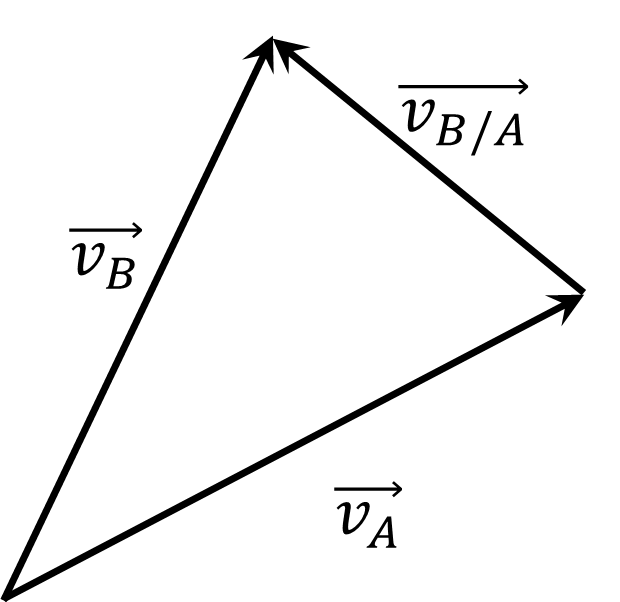 | |  |
| | | |
| As we can see, it looks like the derivative of relative velocity: | | As we can see, it looks like the derivative of relative velocity: |
| | | |
| $$ | | $$ |
| \vec{v}_{B/A} = \vec{v}_B - \vec{v}_A \quad \text{(3)} | | \vec{v}_{B/A} = \vec{v}_B - \vec{v}_A \quad \text{(3)} |
| $$ | | $$ |
| | | |
| Now, let's solve the derivative: | | Now, let's solve the derivative: |
| | | |
| $$ | | $$ |
| \frac{d(\vec{v}_{B/A})}{dt} = \frac{d(\vec{v}_B)}{dt} - \frac{d(\vec{v}_A)}{dt} \Rightarrow \vec{a}_{B/A} = \vec{a}_B - \vec{a}_A \quad \text{(4)} | | \frac{d(\vec{v}_{B/A})}{dt} = \frac{d(\vec{v}_B)}{dt} - \frac{d(\vec{v}_A)}{dt} \Rightarrow \vec{a}_{B/A} = \vec{a}_B - \vec{a}_A \quad \text{(4)} |
| $$ | | $$ |
| | | |
| This is why we can say that: | | This is why we can say that: |
| | | |
| $$ | | $$ |
| \vec{a}_1 - \vec{a}_2 = \vec{a}_{12} = \frac{\vec{F}_1}{m_1} - \frac{\vec{F}_2}{m_2} \quad \text{(5)} | | \vec{a}_1 - \vec{a}_2 = \vec{a}_{12} = \frac{\vec{F}_1}{m_1} - \frac{\vec{F}_2}{m_2} \quad \text{(5)} |
| $$ | | $$ |
| | | |
| Due to the weightlessness of the thread and Newton's Third Law of Motion $\vec{F}_1 = -\vec{F}_2 = \vec{F}$: Eventually: | | Due to the weightlessness of the thread and Newton's Third Law of Motion $\vec{F}_1 = -\vec{F}_2 = \vec{F}$: Eventually: |
| | | |
| $$ | | $$ |
