Правка разделов «Statement», «Solution», «Answer»

en/2.8.44.md
+24 −37
| @@ -1,44 +1,31 @@ | |||
| ### Statement | |||
| − | |||
| + | $2.8.44.$ A homogeneous thin block of mass $m$ lies on a horizontal plane. What is the smallest horizontal force applied to the end of the block along | ||
| + | perpendicular to it, it can be moved if the friction coefficient | ||
| + | between the block and the plane is equal to $µ$. | ||
| − | __Example Statement__: | ||
| − | $1.1.1.$ Determine the coordinate $x(t)$ of a body as a function of time $t$, given that its acceleration is defined as $a(t) = bt$, where $b$ is a constant. | ||
| + | 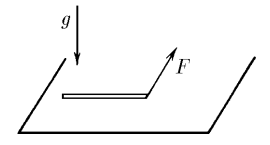 | ||
| − | |||
| ### Solution | |||
| + | Let us write down the statics equation relative to a point that will be stationary at the beginning of the movement. Conventionally, the distance $x$ from the point of application of force $F$. On different sides of this point, there will be different masses of the block. | ||
| + | $$\mu m_1g\frac{x}{2}+\mu m_2\frac{L-x}{2}=Fx$$ | ||
| + | From the homogeneity of the rod it is clear that: | ||
| + | $$m_1=\frac{m}{L}x$$ | ||
| + | $$m_2=\frac{m}{L}(L-x)$$ | ||
| + | Let's substitute: | ||
| + | $$\mu mg\frac{x^2}{2L}+\mu mg\frac{(L-x)^2}{2L}=Fx$$ | ||
| + | Let's open the brackets by dividing both sides of the equation by $x$: | ||
| + | $$\mu mg(\frac{x}{L}+\frac{L}{2x}-1)=F$$ | ||
| + | Let's take the derivative of the force along the shoulder of the applied force, because we need a minimum: | ||
| + | $$\frac{d}{dx}F=\frac{1}{L}-\frac{L}{2x^2}=0$$ | ||
| + | We express the shoulder in units of rod length: | ||
| + | $$x=\frac{L}{\sqrt{2}}$$ | ||
| + | Let's substitute the forces into the equation: | ||
| + | $$\mu mg(\frac{\frac{L}{\sqrt{2}}}{L}+\frac{L}{2\frac{L}{\sqrt{2}}}-1)=F$$ | ||
| + | Let's reduce the length and rationalize the fractions: | ||
| + | $$\mu mg(\frac{\sqrt{2}}{2}+\frac{\sqrt{2}}{2}-1)=F$$ | ||
| + | From here we get the answer: | ||
| + | $$\boxed{F=\mu mg(\sqrt{2}-1)}$$ | ||
| − | [Your solution should be placed here] | ||
| − | |||
| − | __Example Solution__: | ||
| − | The acceleration of the body defined by | ||
| − | |||
| − | $$a(t) = bt$$ | ||
| − | |||
| − | We know that acceleration is the time derivative of velocity: | ||
| − | |||
| − | $$a(t) = \frac{d v(t)}{d t}$$ | ||
| − | |||
| − | To find the velocity $v(t)$, we integrate $a(t)$ with respect to time: | ||
| − | |||
| − | $$v(t) = \int a(t) \, dt = \int b t \, dt$$ | ||
| − | |||
| − | If the initial velocity is $v(0) = 0$, then the velocity becomes: | ||
| − | |||
| − | $$v(t) = \frac{b t^2}{2}$$ | ||
| − | |||
| − | Likewise, integrate $v(t)$ with respect to time: | ||
| − | |||
| − | $$x(t)= \int v(t) \, dt = \frac{b}{2} \int t^2 \, dt$$ | ||
| − | |||
| − | From where the coordinate from time, considering the initial conditions: | ||
| − | |||
| − | $$\boxed{x(t)=\frac{bt^3}{6}}$$ | ||
| − | |||
| #### Answer | |||
| − | |||
| − | [Insert a concise answer or boxed result, like this:] | ||
| − | |||
| − | |||
| − | __Example Answer__: | ||
| − | $$ | ||
| + | $$F=\mu mg(\sqrt{2}-1)$$ | ||
| @@ -1,44 +1,31 @@ | |||
| ### Statement | ### Statement | ||
| $2.8.44.$ A homogeneous thin block of mass $m$ lies on a horizontal plane. What is the smallest horizontal force applied to the end of the block along | |||
| perpendicular to it, it can be moved if the friction coefficient | |||
| between the block and the plane is equal to $µ$. | |||
| __Example Statement__: |  | ||
| $1.1.1.$ Determine the coordinate $x(t)$ of a body as a function of time $t$, given that its acceleration is defined as $a(t) = bt$, where $b$ is a constant. | |||
| ### Solution | ### Solution | ||
| Let us write down the statics equation relative to a point that will be stationary at the beginning of the movement. Conventionally, the distance $x$ from the point of application of force $F$. On different sides of this point, there will be different masses of the block. | |||
| $$\mu m_1g\frac{x}{2}+\mu m_2\frac{L-x}{2}=Fx$$ | |||
| From the homogeneity of the rod it is clear that: | |||
| $$m_1=\frac{m}{L}x$$ | |||
| $$m_2=\frac{m}{L}(L-x)$$ | |||
| Let's substitute: | |||
| $$\mu mg\frac{x^2}{2L}+\mu mg\frac{(L-x)^2}{2L}=Fx$$ | |||
| Let's open the brackets by dividing both sides of the equation by $x$: | |||
| $$\mu mg(\frac{x}{L}+\frac{L}{2x}-1)=F$$ | |||
| Let's take the derivative of the force along the shoulder of the applied force, because we need a minimum: | |||
| $$\frac{d}{dx}F=\frac{1}{L}-\frac{L}{2x^2}=0$$ | |||
| We express the shoulder in units of rod length: | |||
| $$x=\frac{L}{\sqrt{2}}$$ | |||
| Let's substitute the forces into the equation: | |||
| $$\mu mg(\frac{\frac{L}{\sqrt{2}}}{L}+\frac{L}{2\frac{L}{\sqrt{2}}}-1)=F$$ | |||
| Let's reduce the length and rationalize the fractions: | |||
| $$\mu mg(\frac{\sqrt{2}}{2}+\frac{\sqrt{2}}{2}-1)=F$$ | |||
| From here we get the answer: | |||
| $$\boxed{F=\mu mg(\sqrt{2}-1)}$$ | |||
| [Your solution should be placed here] | |||
| __Example Solution__: | |||
| The acceleration of the body defined by | |||
| $$a(t) = bt$$ | |||
| We know that acceleration is the time derivative of velocity: | |||
| $$a(t) = \frac{d v(t)}{d t}$$ | |||
| To find the velocity $v(t)$, we integrate $a(t)$ with respect to time: | |||
| $$v(t) = \int a(t) \, dt = \int b t \, dt$$ | |||
| If the initial velocity is $v(0) = 0$, then the velocity becomes: | |||
| $$v(t) = \frac{b t^2}{2}$$ | |||
| Likewise, integrate $v(t)$ with respect to time: | |||
| $$x(t)= \int v(t) \, dt = \frac{b}{2} \int t^2 \, dt$$ | |||
| From where the coordinate from time, considering the initial conditions: | |||
| $$\boxed{x(t)=\frac{bt^3}{6}}$$ | |||
| #### Answer | #### Answer | ||
| $$F=\mu mg(\sqrt{2}-1)$$ | |||
| [Insert a concise answer or boxed result, like this:] | |||
| __Example Answer__: | |||
| $$ |
|||