Правка разделов «Statement», «Solution», «Answer»

en/7.4.35.md
+5 −33
| ### Statement | |||
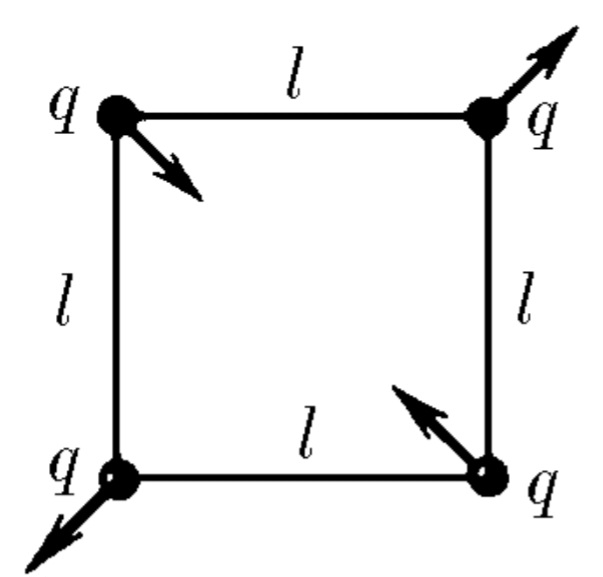
| $7.4.35.$ What is the period of small vibrations of four charged bodies connected by | |||
| @@ -4,44 +4,16 @@Statement | |||
| identical filaments of length l and moving as shown in the figure? Mass and | |||
| charge of the body m and q. | |||
| − |  | ||
| ### Solution | |||
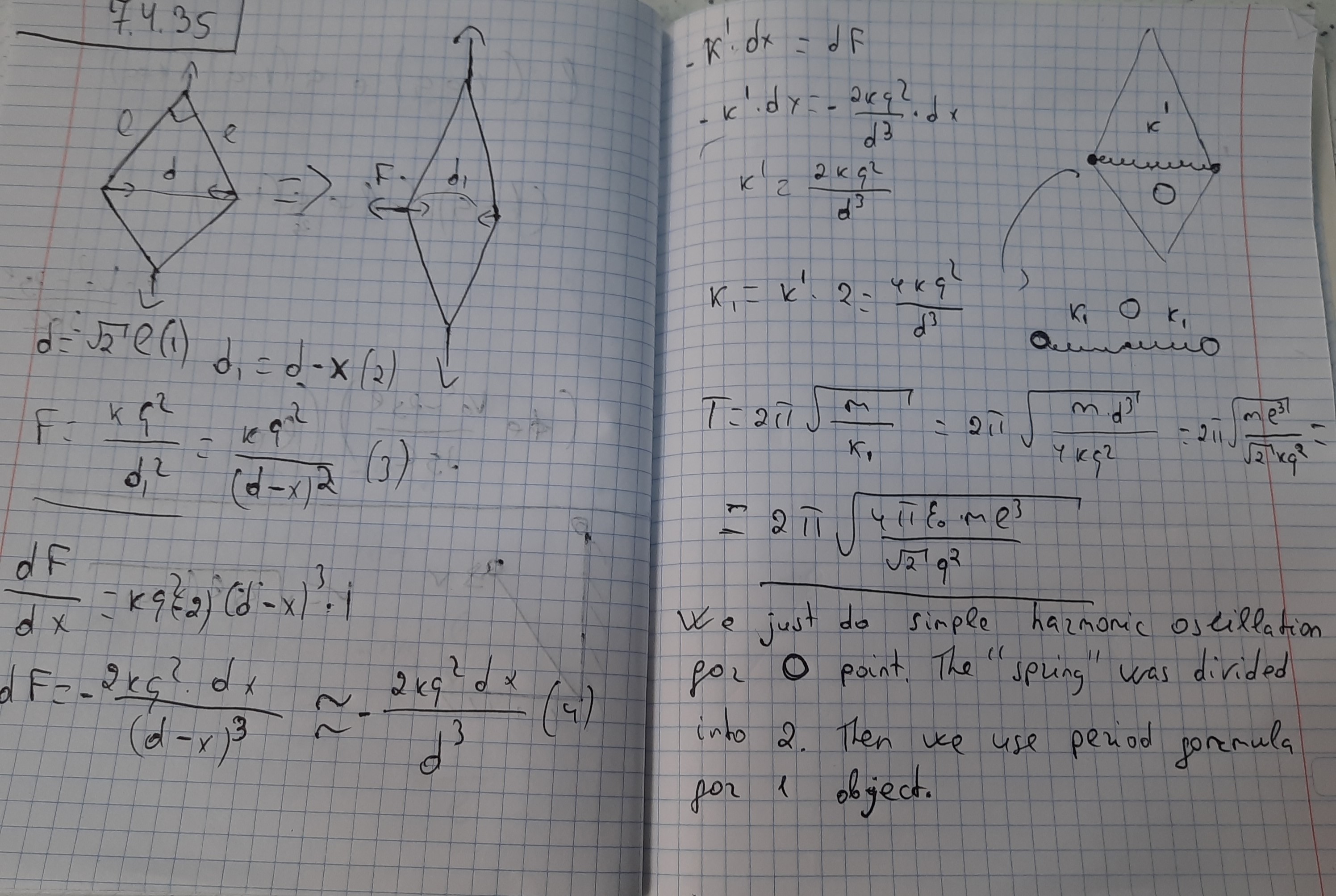
| − | The diagonal | ||
| − | d=l×sqrt(2) | ||
| − | [Your solution should be placed here] | ||
| − | __Example Solution__: | ||
| − | The acceleration of the body defined by | ||
| + |  | ||
| − | $$a(t) = bt$$ | ||
| − | |||
| − | We know that acceleration is the time derivative of velocity: | ||
| − | |||
| − | $$a(t) = \frac{d v(t)}{d t}$$ | ||
| − | |||
| − | To find the velocity $v(t)$, we integrate $a(t)$ with respect to time: | ||
| − | |||
| − | $$v(t) = \int a(t) \, dt = \int b t \, dt$$ | ||
| − | |||
| − | If the initial velocity is $v(0) = 0$, then the velocity becomes: | ||
| − | |||
| − | $$v(t) = \frac{b t^2}{2}$$ | ||
| − | |||
| − | Likewise, integrate $v(t)$ with respect to time: | ||
| − | |||
| − | $$x(t)= \int v(t) \, dt = \frac{b}{2} \int t^2 \, dt$$ | ||
| − | |||
| − | From where the coordinate from time, considering the initial conditions: | ||
| − | |||
| − | $$\boxed{x(t)=\frac{bt^3}{6}}$$ | ||
| − | |||
| #### Answer | |||
| − | [Insert a concise answer or boxed result, like this:] | ||
| − | |||
| − | |||
| − | __Example Answer__: | ||
| − | $$ x(t)=\frac{bt^3}{6} $$ | ||
| + | $$ | ||
| + | T=2\pi\sqrt{4\pi\varepsilon_0ml^3/(\sqrt{2}q^2)}. | ||
| + | $$ | ||
| ### Statement | ### Statement | ||
| $7.4.35.$ What is the period of small vibrations of four charged bodies connected by | $7.4.35.$ What is the period of small vibrations of four charged bodies connected by | ||
| @@ -4,44 +4,16 @@Statement | |||
| identical filaments of length l and moving as shown in the figure? Mass and | identical filaments of length l and moving as shown in the figure? Mass and | ||
| charge of the body m and q. | charge of the body m and q. | ||
|  | ||
| ### Solution | ### Solution | ||
| The diagonal | |||
| d=l×sqrt(2) | |||
| [Your solution should be placed here] | |||
| __Example Solution__: |  | ||
| The acceleration of the body defined by | |||
| $$a(t) = bt$$ | |||
| We know that acceleration is the time derivative of velocity: | |||
| $$a(t) = \frac{d v(t)}{d t}$$ | |||
| To find the velocity $v(t)$, we integrate $a(t)$ with respect to time: | |||
| $$v(t) = \int a(t) \, dt = \int b t \, dt$$ | |||
| If the initial velocity is $v(0) = 0$, then the velocity becomes: | |||
| $$v(t) = \frac{b t^2}{2}$$ | |||
| Likewise, integrate $v(t)$ with respect to time: | |||
| $$x(t)= \int v(t) \, dt = \frac{b}{2} \int t^2 \, dt$$ | |||
| From where the coordinate from time, considering the initial conditions: | |||
| $$\boxed{x(t)=\frac{bt^3}{6}}$$ | |||
| #### Answer | #### Answer | ||
| [Insert a concise answer or boxed result, like this:] | $$ | ||
| T=2\pi\sqrt{4\pi\varepsilon_0ml^3/(\sqrt{2}q^2)}. | |||
| $$ | |||
| __Example Answer__: | |||
| $$ x(t)=\frac{bt^3}{6} $$ | |||