Правка раздела «Solution»
en/2.1.21.md
+1 −1
| ### Statement | |||
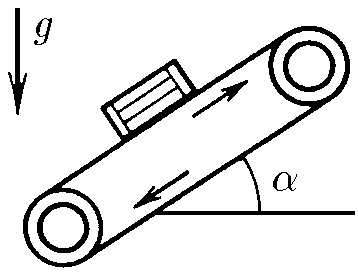
| $2.1.21.$ The belt lift forms an angle $\alpha$ with the horizon. With what maximum acceleration can a box be lifted on such a lift, if the coefficient of friction is equal to $\mu$? The tape doesn't bend. | |||
|  | |||
| ### Solution | |||
| 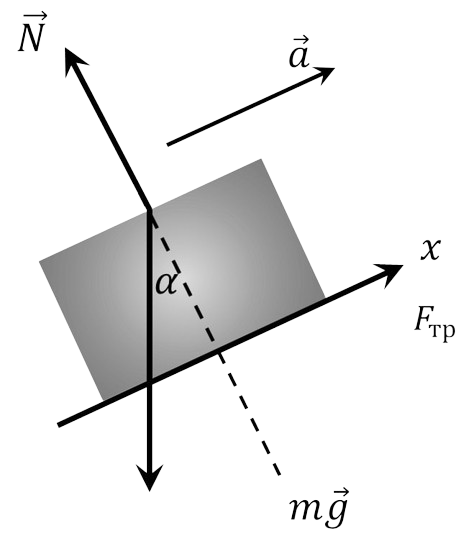 | |||
| 1\. By discarding the constraints imposed on the box and replacing them with reactions, we can consider it as a free body capable of moving along the $OX$ axis. The friction force in this case is directed toward acceleration, i.e. against the possible movement of the box. | |||
| @@ -13,7 +13,7 @@Solution | |||
| 2\. The equation of Newton's second law allows us to determine the maximum value of acceleration | |||
| $$ | |||
| − | \mu mg \cos\alpha -mg | ||
| + | \mu mg \cos\alpha -mg \\alpha\leq ma | ||
| $$ | |||
| $$ | |||
| \boxed{a \leq g (\mu\cos\alpha -\sin\alpha )} | |||
| $$ | |||
| #### Answer | |||
| $$ | |||
| a_{max} = g(\mu\cos\alpha − \sin\alpha ) | |||
| $$ | |||
| ещё строк без изменений 8 | |||
| ### Statement | ### Statement | ||
| $2.1.21.$ The belt lift forms an angle $\alpha$ with the horizon. With what maximum acceleration can a box be lifted on such a lift, if the coefficient of friction is equal to $\mu$? The tape doesn't bend. | $2.1.21.$ The belt lift forms an angle $\alpha$ with the horizon. With what maximum acceleration can a box be lifted on such a lift, if the coefficient of friction is equal to $\mu$? The tape doesn't bend. | ||
|  |  | ||
| ### Solution | ### Solution | ||
|  |  | ||
| 1\. By discarding the constraints imposed on the box and replacing them with reactions, we can consider it as a free body capable of moving along the $OX$ axis. The friction force in this case is directed toward acceleration, i.e. against the possible movement of the box. | 1\. By discarding the constraints imposed on the box and replacing them with reactions, we can consider it as a free body capable of moving along the $OX$ axis. The friction force in this case is directed toward acceleration, i.e. against the possible movement of the box. | ||
| @@ -13,7 +13,7 @@Solution | |||
| 2\. The equation of Newton's second law allows us to determine the maximum value of acceleration | 2\. The equation of Newton's second law allows us to determine the maximum value of acceleration | ||
| $$ | $$ | ||
| \mu mg \cos\alpha -mg |
\mu mg \cos\alpha -mg \\alpha\leq ma | ||
| $$ | $$ | ||
| $$ | $$ | ||
| \boxed{a \leq g (\mu\cos\alpha -\sin\alpha )} | \boxed{a \leq g (\mu\cos\alpha -\sin\alpha )} | ||
| $$ | $$ | ||
| #### Answer | #### Answer | ||
| $$ | $$ | ||
| a_{max} = g(\mu\cos\alpha − \sin\alpha ) | a_{max} = g(\mu\cos\alpha − \sin\alpha ) | ||
| $$ | $$ | ||
| ещё строк без изменений 8 | |||