Правка разделов «Statement», «Solution», «Answer»

en/7.1.27.md
+53 −3
| @@ -1,11 +1,61 @@ | |||
| ### Statement | |||
| − | $7.1.27.$ | ||
| + | $7.1.27.$ | ||
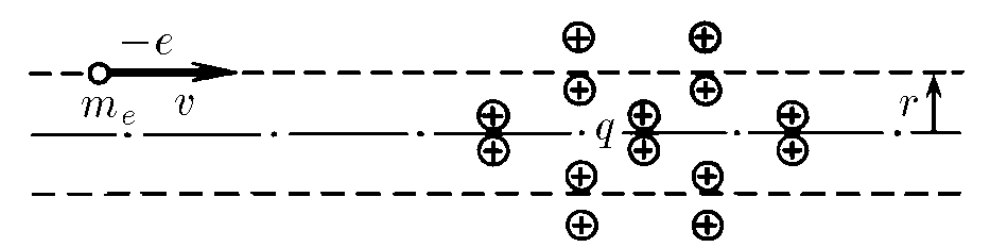
| + | a. The electron enters an axisymmetric electric field created by stationary | ||
| + | charges and initially moves parallel to the field axis at a distance $r$ from it. | ||
| + | Electron velocity $v$. If the velocity of the electron and the distance from it | ||
| + | to the axis change slightly when moving in the field, then the momentum | ||
| + | acquired by the electron can be estimated by the formula $p_⊥$ = $\frac{eq}{2πε0vr}$ | ||
| + | , where | ||
| + | q is the total electric charge inside a cylindrical region of radius r. Use the | ||
| + | Gauss theorem to derive this formula. | ||
| + | |||
| + |  | ||
| + | |||
| + | b. Determine the transverse momentum acquired by charge $q_1$, which flew | ||
| + | past charge $q_2$. The minimum distance between the charges r, the charge | ||
| + | velocity $q_1$ was initially equal to $v$ and changed slightly. | ||
| + | |||
| + | c. Estimate the minimum distance from the nucleus of a nitrogen atom at | ||
| + | which an electron accelerated by a potential difference of $100 \hspace{0.1cm} (kV)$ flew, if it was | ||
| + | deflected by the nucleus by an angle of $10^{\text -3} \hspace{0.1cm} | ||
| + | (rad)$. | ||
| + | |||
| + | |||
| ### Solution | |||
| − | $E$ | ||
| + | (a) | ||
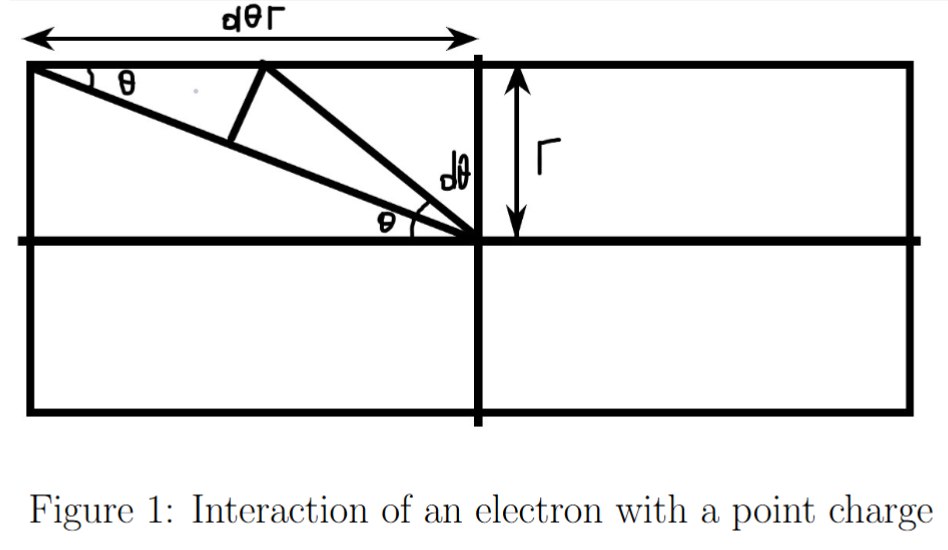
| + | Since the electric field is axisymmetric, we will use superposition, where an electron interacts with a point charge q. | ||
| + | |||
| + | . | ||
| + | |||
| + | $$E(\theta) = \frac{kq}{(r/sin(\theta))^2} $$\ | ||
| + | $$F(\theta)=eE(\theta)=\frac{kq}{(r/sin(\theta))^2}$$ | ||
| + | $$dr=vdt$$\ | ||
| + | $$F_y=Fsin(\theta)$$\ | ||
| + | $$dP_y=F_ydt=\frac{kqe}{vr}sin(\theta)d\theta$$\ | ||
| + | $$P_y=\frac{kqe}{vr}\int_{0}^{\pi}sin(\theta)d\theta = \frac{2kqe}{vr}$$\ | ||
| + | $$P_y = \frac{qe}{2 \pi \epsilon_0vr}$$ | ||
| + | |||
| + | (b) | ||
| + | |||
| + | Let us use the answer of part (a), where instead of electron and particle q, there will be two point charges with the ratings of $q_1,q_2$. | ||
| + | |||
| + | $$P_y=\frac{q_1 q_2}{2 \pi \epsilon_0vr}$$ | ||
| + | |||
| + | (c) | ||
| + | |||
| + | $$tan(\alpha) = \frac{qe}{2 \pi \epsilon_0 m v^2 r}$$\ | ||
| + | $$\frac{m v^2}{2}=e \Delta \phi$$\ | ||
| + | $$tan(\alpha) \approx \alpha$$\ | ||
| + | $$tan(\alpha) = \frac{kq}{\Delta \phi r} \longrightarrow r=\frac{kq}{\alpha \Delta \phi}$$ | ||
| + | |||
| #### Answer | |||
| − | [Insert a concise answer or boxed result] | ||
| + | (a) $$P_y = \frac{qe}{2 \pi \epsilon_0vr}$$ | ||
| + | |||
| + | (b) $$P_y=\frac{q_1 q_2}{2 \pi \epsilon_0vr}$$ | ||
| + | |||
| + | (c) $$r=\frac{kq}{\alpha \Delta \phi}=1 \cdot 10^{\text -10} (m)$$ | ||
| @@ -1,11 +1,61 @@ | |||
| ### Statement | ### Statement | ||
| $7.1.27.$ |
$7.1.27.$ | ||
| a. The electron enters an axisymmetric electric field created by stationary | |||
| charges and initially moves parallel to the field axis at a distance $r$ from it. | |||
| Electron velocity $v$. If the velocity of the electron and the distance from it | |||
| to the axis change slightly when moving in the field, then the momentum | |||
| acquired by the electron can be estimated by the formula $p_⊥$ = $\frac{eq}{2πε0vr}$ | |||
| , where | |||
| q is the total electric charge inside a cylindrical region of radius r. Use the | |||
| Gauss theorem to derive this formula. | |||
|  | |||
| b. Determine the transverse momentum acquired by charge $q_1$, which flew | |||
| past charge $q_2$. The minimum distance between the charges r, the charge | |||
| velocity $q_1$ was initially equal to $v$ and changed slightly. | |||
| c. Estimate the minimum distance from the nucleus of a nitrogen atom at | |||
| which an electron accelerated by a potential difference of $100 \hspace{0.1cm} (kV)$ flew, if it was | |||
| deflected by the nucleus by an angle of $10^{\text -3} \hspace{0.1cm} | |||
| (rad)$. | |||
| ### Solution | ### Solution | ||
| $E$ | (a) | ||
| Since the electric field is axisymmetric, we will use superposition, where an electron interacts with a point charge q. | |||
| . | |||
| $$E(\theta) = \frac{kq}{(r/sin(\theta))^2} $$\ | |||
| $$F(\theta)=eE(\theta)=\frac{kq}{(r/sin(\theta))^2}$$ | |||
| $$dr=vdt$$\ | |||
| $$F_y=Fsin(\theta)$$\ | |||
| $$dP_y=F_ydt=\frac{kqe}{vr}sin(\theta)d\theta$$\ | |||
| $$P_y=\frac{kqe}{vr}\int_{0}^{\pi}sin(\theta)d\theta = \frac{2kqe}{vr}$$\ | |||
| $$P_y = \frac{qe}{2 \pi \epsilon_0vr}$$ | |||
| (b) | |||
| Let us use the answer of part (a), where instead of electron and particle q, there will be two point charges with the ratings of $q_1,q_2$. | |||
| $$P_y=\frac{q_1 q_2}{2 \pi \epsilon_0vr}$$ | |||
| (c) | |||
| $$tan(\alpha) = \frac{qe}{2 \pi \epsilon_0 m v^2 r}$$\ | |||
| $$\frac{m v^2}{2}=e \Delta \phi$$\ | |||
| $$tan(\alpha) \approx \alpha$$\ | |||
| $$tan(\alpha) = \frac{kq}{\Delta \phi r} \longrightarrow r=\frac{kq}{\alpha \Delta \phi}$$ | |||
| #### Answer | #### Answer | ||
| [Insert a concise answer or boxed result] | (a) $$P_y = \frac{qe}{2 \pi \epsilon_0vr}$$ | ||
| (b) $$P_y=\frac{q_1 q_2}{2 \pi \epsilon_0vr}$$ | |||
| (c) $$r=\frac{kq}{\alpha \Delta \phi}=1 \cdot 10^{\text -10} (m)$$ | |||