Правка разделов «Statement», «Solution», «Answer»

en/7.1.28.md
+33 −3
| @@ -1,11 +1,41 @@ | |||
| ### Statement | |||
| − | |||
| + | Electrons fly through the gap to which the potential difference $V$ is applied. | ||
| + | Capacity of the slit length unit $C$. For small values of $V$, the angle of electron deflection by the slit field is proportional to the product of $C$ and $V$ and | ||
| + | inversely proportional to $V_0$ ($e V_0$ is the initial electron energy): $α ≈ | ||
| + | kCV/V_0$. Determine the coefficient k. | ||
| + | 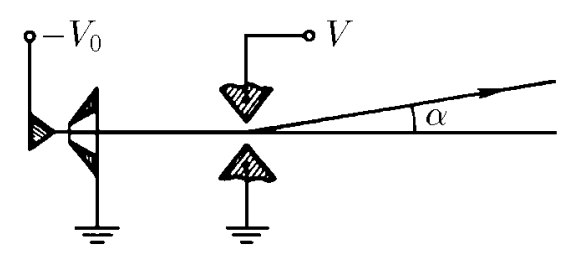 | ||
| + | |||
| ### Solution | |||
| − | Type your LaTeX here... | ||
| + | From the grounding conditions (zero potential), the electron acquires velocity $v_0$, and the energy of the electron does not change. | ||
| + | $$e V_0 = \frac{mv_0^2}{2} $$ | ||
| + | |||
| + | The charge $q$ on the horizontal plates is derived from the capacitor equation, considering that the slit has the shape of a circle.From the grounding conditions (zero potential), the electron acquires velocity $v_0$, while the electron energy does not change. | ||
| + | |||
| + | $$q = 2 \pi R C V$$ | ||
| + | |||
| + | Since the charge distribution has axial symmetry, we consider the interaction of the electron and the total charge of the horizontal plates as the interaction of two point charges. | ||
| + | |||
| + | Since the angle $\alpha$ is small enough under the problem conditions, we assume that the horizontal velocity changes insignificantly.We derive the charge $q$ on the horizontal plates from the capacitor equation, considering that the slit has the shape of a circle.From the grounding conditions (zero potential), the electron acquires velocity $v_0$, and the electron energy does not change. | ||
| + | |||
| + | $$E(\theta) = \frac{kq}{(r/sin(\theta))^2} $$\ | ||
| + | $$F(\theta)=eE(\theta)=\frac{kq}{(r/sin(\theta))^2}$$\ | ||
| + | $$dr=vdt$$\ | ||
| + | $$F_y=Fsin(\theta)$$\ | ||
| + | $$dP_y=F_ydt=\frac{kqe}{vr}sin(\theta)d\theta$$\ | ||
| + | $$P_y=\frac{kqe}{vr}\int_{0}^{\pi}sin(\theta)d\theta = \frac{2kqe}{vr}$$\ | ||
| + | $$P_x = mv$$\ | ||
| + | $$tan(\alpha)=\frac{P_y}{P_x} = \frac{qe}{2 \pi \epsilon_0 m v_0^2 R}$$\ | ||
| + | $$\alpha \approx \frac{qe}{2 \pi \epsilon_0 m v_0^2 R}$$ | ||
| + | |||
| + | Now substitute the value of $q,e$ and compare with the formula from the problem. | ||
| + | |||
| + | $$\alpha \approx \frac{CV}{2 \epsilon_0 V_0}$$\ | ||
| + | $$k=\frac{1}{2 \epsilon_0}$$ | ||
| + | |||
| #### Answer | |||
| − | [Insert a concise answer or boxed result] | ||
| + | $$k=\frac{1}{2 \epsilon_0}$$ | ||
| @@ -1,11 +1,41 @@ | |||
| ### Statement | ### Statement | ||
| Electrons fly through the gap to which the potential difference $V$ is applied. | |||
| Capacity of the slit length unit $C$. For small values of $V$, the angle of electron deflection by the slit field is proportional to the product of $C$ and $V$ and | |||
| inversely proportional to $V_0$ ($e V_0$ is the initial electron energy): $α ≈ | |||
| kCV/V_0$. Determine the coefficient k. | |||
|  | |||
| ### Solution | ### Solution | ||
| Type your LaTeX here... | From the grounding conditions (zero potential), the electron acquires velocity $v_0$, and the energy of the electron does not change. | ||
| $$e V_0 = \frac{mv_0^2}{2} $$ | |||
| The charge $q$ on the horizontal plates is derived from the capacitor equation, considering that the slit has the shape of a circle.From the grounding conditions (zero potential), the electron acquires velocity $v_0$, while the electron energy does not change. | |||
| $$q = 2 \pi R C V$$ | |||
| Since the charge distribution has axial symmetry, we consider the interaction of the electron and the total charge of the horizontal plates as the interaction of two point charges. | |||
| Since the angle $\alpha$ is small enough under the problem conditions, we assume that the horizontal velocity changes insignificantly.We derive the charge $q$ on the horizontal plates from the capacitor equation, considering that the slit has the shape of a circle.From the grounding conditions (zero potential), the electron acquires velocity $v_0$, and the electron energy does not change. | |||
| $$E(\theta) = \frac{kq}{(r/sin(\theta))^2} $$\ | |||
| $$F(\theta)=eE(\theta)=\frac{kq}{(r/sin(\theta))^2}$$\ | |||
| $$dr=vdt$$\ | |||
| $$F_y=Fsin(\theta)$$\ | |||
| $$dP_y=F_ydt=\frac{kqe}{vr}sin(\theta)d\theta$$\ | |||
| $$P_y=\frac{kqe}{vr}\int_{0}^{\pi}sin(\theta)d\theta = \frac{2kqe}{vr}$$\ | |||
| $$P_x = mv$$\ | |||
| $$tan(\alpha)=\frac{P_y}{P_x} = \frac{qe}{2 \pi \epsilon_0 m v_0^2 R}$$\ | |||
| $$\alpha \approx \frac{qe}{2 \pi \epsilon_0 m v_0^2 R}$$ | |||
| Now substitute the value of $q,e$ and compare with the formula from the problem. | |||
| $$\alpha \approx \frac{CV}{2 \epsilon_0 V_0}$$\ | |||
| $$k=\frac{1}{2 \epsilon_0}$$ | |||
| #### Answer | #### Answer | ||
| [Insert a concise answer or boxed result] | $$k=\frac{1}{2 \epsilon_0}$$ | ||