| ### Statement | | ### Statement |
| | | |
| $2.1.27.$ | | $2.1.27.$ |
|  | |  |
| | | |
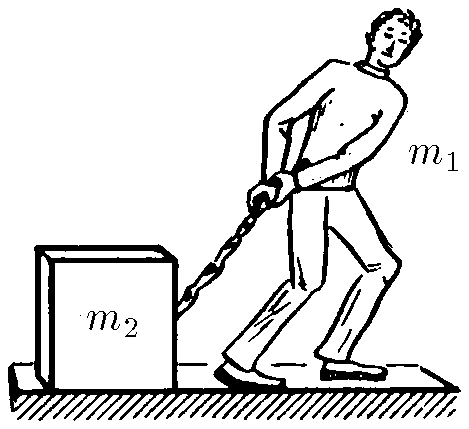
| A person of mass $m_1$, remaining in place, pulls a weight of mass $m_2$ with a rope. The coefficient of friction between the horizontal plane and each object is equal to $\mu$. What is the lowest tension force of the rope, $T$, at which the load will start to move from its place? At what angle to the horizontal plane should the rope be directed? | | A person of mass $m_1$, remaining in place, pulls a weight of mass $m_2$ with a rope. The coefficient of friction between the horizontal plane and each object is equal to $\mu$. What is the lowest tension force of the rope, $T$, at which the load will start to move from its place? At what angle to the horizontal plane should the rope be directed? |
| | | |
| ### Solution | | ### Solution |
| | | |
| For the forces acting on the person, with mass $m_1$, we have: | | For the forces acting on the person, with mass $m_1$, we have: |
| \begin{align*} | | \begin{align*} |
| \sum F_x = f_{1,s} - T \cos \theta = m_1 \, a_{1,x} | | \sum F_x = f_{1,s} - T \cos \theta = m_1 \, a_{1,x} |
| \end{align*} | | \end{align*} |
| \begin{align*} | | \begin{align*} |
| \sum F_y = n_1 - m_1 g - T \sin \theta = m_1 \, a_{1,y} | | \sum F_y = n_1 - m_1 g - T \sin \theta = m_1 \, a_{1,y} |
| \end{align*} | | \end{align*} |
| | | |
| and for the weight (which I'll just call a block going forward), $m_2$, we have: | | and for the weight (which I'll just call a block going forward), $m_2$, we have: |
| \begin{align*} | | \begin{align*} |
| \sum F_x = T \cos \theta - f_{2,s} = m_2 \, a_{2,x} | | \sum F_x = T \cos \theta - f_{2,s} = m_2 \, a_{2,x} |
| \end{align*} | | \end{align*} |
| \begin{align*} | | \begin{align*} |
| \sum F_y = n_2 - m_2 g + T \sin \theta = m_2 \, a_{2,y} | | \sum F_y = n_2 - m_2 g + T \sin \theta = m_2 \, a_{2,y} |
| \end{align*} | | \end{align*} |
| | | |
| We'll need to place some constraints on the expected motion to simplify the problem. First, neither the person nor the block is pulled so hard by the rope that they lift off the ground; i.e., the acceleration in the y-direction for each object is zero. Second, we need to ensure that the person remains in place and does not slip, requiring that the friction force holding the person in place is greater than the x-component of the tension force pulling on the person. Third, we must consider the x-component of the tension in the rope sufficiently large to overcome the static friction force holding the block in place. Noting that $f_{i,s} \leq \mu n_i$ We can then write: | | We'll need to place some constraints on the expected motion to simplify the problem. First, neither the person nor the block is pulled so hard by the rope that they lift off the ground; i.e., the acceleration in the y-direction for each object is zero. Second, we need to ensure that the person remains in place and does not slip, requiring that the friction force holding the person in place is greater than the x-component of the tension force pulling on the person. Third, we must consider the x-component of the tension in the rope sufficiently large to overcome the static friction force holding the block in place. Noting that $f_{i,s} \leq \mu n_i$ We can then write: |
| \begin{align*} | | \begin{align*} |
| \sum F_x = \mu n_1 - T \cos \theta \geq 0 | | \sum F_x = \mu n_1 - T \cos \theta \geq 0 |
| \end{align*} | | \end{align*} |
| \begin{align*} | | \begin{align*} |
| \sum F_y = n_1 - m_1 g - T \sin \theta = 0 | | \sum F_y = n_1 - m_1 g - T \sin \theta = 0 |
| \end{align*} | | \end{align*} |
| | | |
| and for the block, $m_2$, we have: | | and for the block, $m_2$, we have: |
| \begin{align*} | | \begin{align*} |
| \sum F_x = T \cos \theta - \mu n_2 \geq 0 | | \sum F_x = T \cos \theta - \mu n_2 \geq 0 |
| \end{align*} | | \end{align*} |
| \begin{align*} | | \begin{align*} |
| \sum F_y = n_2 - m_2 g + T \sin \theta = 0 | | \sum F_y = n_2 - m_2 g + T \sin \theta = 0 |
| \end{align*} | | \end{align*} |
| | | |
| Substituting the normal forces $n_1$ and $n_2$ into the corresponding $F_x$ equations, we have: | | Substituting the normal forces $n_1$ and $n_2$ into the corresponding $F_x$ equations, we have: |
| \begin{align} | | \begin{align} |
| \mu (m_1 g + T \sin \theta) - T \cos \theta \geq 0 | | \mu (m_1 g + T \sin \theta) - T \cos \theta \geq 0 |
| \end{align} | | \end{align} |
| \begin{align} | | \begin{align} |
| T \cos \theta - \mu (m_2 g - T \sin \theta) \geq 0 | | T \cos \theta - \mu (m_2 g - T \sin \theta) \geq 0 |
| \end{align} | | \end{align} |
| To build intuition, let us first determine the tension force needed to move the block alone, and ignoring the person (for now): | | To build intuition, let us first determine the tension force needed to move the block alone, and ignoring the person (for now): |
| \begin{align} | | \begin{align} |
| T \geq \frac{\mu m_2 g}{\cos \theta + \mu \sin \theta} | | T \geq \frac{\mu m_2 g}{\cos \theta + \mu \sin \theta} |
| \end{align} | | \end{align} |
| It's good to take a minute here and think about what this means physically. If the angle is zero, well you have all of the tension force acting along the direction you want to move it in, which is good. But you'll also have all of the weight is acting on the surface, so the normal force is maximized, and by extension so is the static friction force. So, you can "do" the most with the tension here, but you're also fighting against the most friction, and a large $T$ is required. At the other extreme, as $\theta \to \pi/2$, you can reduce the normal force to nearly zero so there is almost no friction force, but, well, there is so little of the tension acting in the direction you want to move it in that it you need to apply a large tension force to move it all. Somewhere in this range, then, is a "sweet spot". | | It's good to take a minute here and think about what this means physically. If the angle is zero, well you have all of the tension force acting along the direction you want to move it in, which is good. But you'll also have all of the weight is acting on the surface, so the normal force is maximized, and by extension so is the static friction force. So, you can "do" the most with the tension here, but you're also fighting against the most friction, and a large $T$ is required. At the other extreme, as $\theta \to \pi/2$, you can reduce the normal force to nearly zero so there is almost no friction force, but, well, there is so little of the tension acting in the direction you want to move it in that it you need to apply a large tension force to move it all. Somewhere in this range, then, is a "sweet spot". |
| | | |
| Where is that sweet spot? Well, clearly it depends on $\mu$. If $\mu$ is non-zero but small ($\mu \ll 1$), then the friction force is also small, so the sweet spot is likely an angle just above zero. If $\mu$ is large ($\mu \gtrsim 1$), then the friction force is also large, and you'll need to apply the tension at a significant angle to reduce the effect of the friction force. We can make this explicit by noting $\cos \theta + \mu \sin \theta$ can be written as $\sqrt{1+\mu^2} \cos (\theta - \phi)$, where $\phi = \arctan \mu$. We can then write the tension as | | Where is that sweet spot? Well, clearly it depends on $\mu$. If $\mu$ is non-zero but small ($\mu \ll 1$), then the friction force is also small, so the sweet spot is likely an angle just above zero. If $\mu$ is large ($\mu \gtrsim 1$), then the friction force is also large, and you'll need to apply the tension at a significant angle to reduce the effect of the friction force. We can make this explicit by noting $\cos \theta + \mu \sin \theta$ can be written as $\sqrt{1+\mu^2} \cos (\theta - \phi)$, where $\phi = \arctan \mu$. We can then write the tension as |
| \begin{align} | | \begin{align} |
| T \geq \frac{m_2 g}{\sqrt{1+\mu^{-2}}} \sec (\theta - \phi) | | T \geq \frac{m_2 g}{\sqrt{1+\mu^{-2}}} \sec (\theta - \phi) |
| \end{align} | | \end{align} |
| We see immediately that the tension is minimized (our "sweet spot") when $\sec = 1$, so $T$ is a minimum at $\theta = \phi$. Without considering the person, then, the minimum tension and associated angle is given by | | We see immediately that the tension is minimized (our "sweet spot") when $\sec = 1$, so $T$ is a minimum at $\theta = \phi$. Without considering the person, then, the minimum tension and associated angle is given by |
| \begin{align} | | \begin{align} |
| T_{min} = \frac{m_2 g}{\sqrt{1+\mu^{-2}}} \quad , \quad \theta = \phi = \arctan \mu | | T_{min} = \frac{m_2 g}{\sqrt{1+\mu^{-2}}} \quad , \quad \theta = \phi = \arctan \mu |
| \end{align} | | \end{align} |
| where we see that the angle and required minimum tension increases with increasing $\mu$, which makes sense. | | where we see that the angle and required minimum tension increases with increasing $\mu$, which makes sense. |
| | | |
| OK, we know what the minimum tension to move the block is. But can the person support that tension? It seems reasonable to say yes. If the rope is at an angle, then while the block is experiencing an upward force from the rope reducing friction, the person is experiencing a downward force driving them into the ground, increasing friction. So, the bigger the angle, the bigger the difference and the more tension the person can "support" acting on the block. That seems good. | | OK, we know what the minimum tension to move the block is. But can the person support that tension? It seems reasonable to say yes. If the rope is at an angle, then while the block is experiencing an upward force from the rope reducing friction, the person is experiencing a downward force driving them into the ground, increasing friction. So, the bigger the angle, the bigger the difference and the more tension the person can "support" acting on the block. That seems good. |
| | | |
| The question is, how much tilt is necessary? If the person is massive compared to the block ($m_1 > m_2$), then the friction force acting on the person is larger than the friction force acting on the block. But if the block is, as is often the case when moving cargo, larger ($m_2 > m_1$) then the person will need to tilt the rope quite a bit to make sure they can support support moving the block without slipping. Using the same logic as we used in the above steps for the block, we have for the person: | | The question is, how much tilt is necessary? If the person is massive compared to the block ($m_1 > m_2$), then the friction force acting on the person is larger than the friction force acting on the block. But if the block is, as is often the case when moving cargo, larger ($m_2 > m_1$) then the person will need to tilt the rope quite a bit to make sure they can support support moving the block without slipping. Using the same logic as we used in the above steps for the block, we have for the person: |
| | | |
| \begin{align*} | | \begin{align*} |
| T &\leq \frac{\mu m_1 g}{\cos \theta - \mu \sin \theta} | | T &\leq \frac{\mu m_1 g}{\cos \theta - \mu \sin \theta} |
| \end{align*} | | \end{align*} |
| \begin{align*} | | \begin{align*} |
| \implies T &\leq \frac{m_1 g}{\sqrt{1+\mu^{-2}}} \sec (\theta + \phi) | | \implies T &\leq \frac{m_1 g}{\sqrt{1+\mu^{-2}}} \sec (\theta + \phi) |
| \end{align*} | | \end{align*} |
| This puts a clear upper bound on $T$. It also brings the difference between the masses clearly into play; if $m_2\gg m_1$, then even if the tension is minimized for $m_2$, the tension may easily overcome the maximum tension $m_1$ can support before slipping. Put another way, we must impose | | This puts a clear upper bound on $T$. It also brings the difference between the masses clearly into play; if $m_2\gg m_1$, then even if the tension is minimized for $m_2$, the tension may easily overcome the maximum tension $m_1$ can support before slipping. Put another way, we must impose |
| \begin{align*} | | \begin{align*} |
| \frac{\mu m_2 g}{\cos \theta + \mu \sin \theta} \leq T \leq \frac{\mu m_1 g}{\cos \theta - \mu \sin \theta} | | \frac{\mu m_2 g}{\cos \theta + \mu \sin \theta} \leq T \leq \frac{\mu m_1 g}{\cos \theta - \mu \sin \theta} |
| \end{align*} | | \end{align*} |
| For simplicity, I choose to rewrite our masses in terms of the ratio $m_2/m_1 = \alpha$, so we can express the relations above as: | | For simplicity, I choose to rewrite our masses in terms of the ratio $m_2/m_1 = \alpha$, so we can express the relations above as: |
| \begin{align*} | | \begin{align*} |
| \alpha (\cos \theta - \mu \sin \theta) &\leq (\cos \theta + \mu \sin \theta) | | \alpha (\cos \theta - \mu \sin \theta) &\leq (\cos \theta + \mu \sin \theta) |
| \end{align*} | | \end{align*} |
| \begin{align*} | | \begin{align*} |
| \implies \cos \theta (\alpha - 1) &\leq \mu \sin \theta(\alpha + 1) | | \implies \cos \theta (\alpha - 1) &\leq \mu \sin \theta(\alpha + 1) |
| \end{align*} | | \end{align*} |
| \begin{align*} | | \begin{align*} |
| \implies \frac{1}{\mu} \left( \frac{\alpha - 1}{\alpha + 1} \right) &\leq \tan \theta | | \implies \frac{1}{\mu} \left( \frac{\alpha - 1}{\alpha + 1} \right) &\leq \tan \theta |
| \end{align*} | | \end{align*} |
| so the minimum angle needed to prevent the person from slipping is: | | so the minimum angle needed to prevent the person from slipping is: |
| \begin{align} | | \begin{align} |
| \theta = \arctan \left( \frac{1}{\mu} \left( \frac{\alpha - 1}{\alpha + 1} \right) \right) | | \theta = \arctan \left( \frac{1}{\mu} \left( \frac{\alpha - 1}{\alpha + 1} \right) \right) |
| \end{align} | | \end{align} |
| | | |
| We can then slap this into the tension equation above: | | We can then slap this into the tension equation above: |
| \begin{align} | | \begin{align} |
| T &= \frac{\mu m_2 g}{\cos \theta + \mu \sin \theta} \nonumber | | T &= \frac{\mu m_2 g}{\cos \theta + \mu \sin \theta} \nonumber |
| \end{align} | | \end{align} |
| \begin{align} | | \begin{align} |
| T &= \frac{\mu m_2 g}{1 + \left( \frac{\alpha - 1}{\alpha + 1} \right)} \sqrt{1+\frac{1}{\mu^2} \left( \frac{\alpha - 1}{\alpha + 1} \right)^2 } | | T &= \frac{\mu m_2 g}{1 + \left( \frac{\alpha - 1}{\alpha + 1} \right)} \sqrt{1+\frac{1}{\mu^2} \left( \frac{\alpha - 1}{\alpha + 1} \right)^2 } |
| \end{align} | | \end{align} |
| \begin{align} | | \begin{align} |
| T &= \frac{ m_2 g (\alpha +1)}{2 \alpha} \sqrt{\mu^2 +\left( \frac{\alpha - 1}{\alpha + 1} \right)^2 } | | T &= \frac{ m_2 g (\alpha +1)}{2 \alpha} \sqrt{\mu^2 +\left( \frac{\alpha - 1}{\alpha + 1} \right)^2 } |
| \end{align} | | \end{align} |
| \begin{align} | | \begin{align} |
| T &= \frac{ m_2 g}{2} \sqrt{\mu^2 (1+\alpha^{-1})^2 + (1-\alpha^{-1})^2 } | | T &= \frac{ m_2 g}{2} \sqrt{\mu^2 (1+\alpha^{-1})^2 + (1-\alpha^{-1})^2 } |
| \end{align} | | \end{align} |
| | | |
| Excellent, we now know the minimal angle required to ensure the person stays at rest and moves the block. Note that the equation for the minimum supported angle makes physical sense. If $\mu \to 0$, then $\theta \to \pi/2$; as you approach no friction, then the person will need to apply larger and larger angles to be able remain in place. In the limiting case of $0$, an angle of $\pi/2$ is needed, which is hilarious since this will not move the block, but again, that makes sense since there's no friction to hold the person in place. As friction increases, the angle decreases, so in the case of $\mu \to \infty$ you have $\theta \to 0$; this again makes sense, as when the friction is enormous (very sticky), there is little benefit to reducing the friction force acting on the block, and you're better off just pulling horizontally. (I note here that typical "large" values are $\mu \gtrsim 1)$. | | Excellent, we now know the minimal angle required to ensure the person stays at rest and moves the block. Note that the equation for the minimum supported angle makes physical sense. If $\mu \to 0$, then $\theta \to \pi/2$; as you approach no friction, then the person will need to apply larger and larger angles to be able remain in place. In the limiting case of $0$, an angle of $\pi/2$ is needed, which is hilarious since this will not move the block, but again, that makes sense since there's no friction to hold the person in place. As friction increases, the angle decreases, so in the case of $\mu \to \infty$ you have $\theta \to 0$; this again makes sense, as when the friction is enormous (very sticky), there is little benefit to reducing the friction force acting on the block, and you're better off just pulling horizontally. (I note here that typical "large" values are $\mu \gtrsim 1)$. |
| | | |
| Considering $\alpha$, we see that if the masses are the same, then $\alpha=1$ and $\theta = 0$. This again makes sense; if the person and the block have the same mass, they both have the same friction force, so this angle can support both, and any angle above 0 will allow the person to slide the block while remaining fixed. In the case of a block lighter than the person ($\alpha <1$), then you can actually use a negativ} angle if you want; you can increase the friction force on the block and reduce the friction force on the person, and the block will still move while the person stays fixed. In the limit of $\alpha \to 0$, we see that $\theta \to - \arctan \mu^{-1}$ Now, we note that while it is possible to move the block with a negative angle, it does not minimize the tension. In this case, the option that minimizes the angle is $\theta = \phi$, as we found earlier. The interesting point is when $\alpha>1$; in that case, angle must increase so that the person can support moving the block. In the case of $\alpha \to \infty$, we have $\theta \to \arctan \mu^{-1}$. | | Considering $\alpha$, we see that if the masses are the same, then $\alpha=1$ and $\theta = 0$. This again makes sense; if the person and the block have the same mass, they both have the same friction force, so this angle can support both, and any angle above 0 will allow the person to slide the block while remaining fixed. In the case of a block lighter than the person ($\alpha <1$), then you can actually use a negativ} angle if you want; you can increase the friction force on the block and reduce the friction force on the person, and the block will still move while the person stays fixed. In the limit of $\alpha \to 0$, we see that $\theta \to - \arctan \mu^{-1}$ Now, we note that while it is possible to move the block with a negative angle, it does not minimize the tension. In this case, the option that minimizes the angle is $\theta = \phi$, as we found earlier. The interesting point is when $\alpha>1$; in that case, angle must increase so that the person can support moving the block. In the case of $\alpha \to \infty$, we have $\theta \to \arctan \mu^{-1}$. |
| | | |
| This suggests a clear cross-over point: if the minimum required support angle is less than $\phi$, then the we just choose $\phi$. Otherwise, the best we can do is the support angle (since secant increases monotonically, $T$ only gets bigger from there). But when is the required support angle larger than $\phi$? | | This suggests a clear cross-over point: if the minimum required support angle is less than $\phi$, then the we just choose $\phi$. Otherwise, the best we can do is the support angle (since secant increases monotonically, $T$ only gets bigger from there). But when is the required support angle larger than $\phi$? |
| \begin{align} | | \begin{align} |
| \arctan \mu &\leq \arctan \left( \frac{1}{\mu} \left( \frac{\alpha - 1}{\alpha + 1} \right) \right) \nonumber | | \arctan \mu &\leq \arctan \left( \frac{1}{\mu} \left( \frac{\alpha - 1}{\alpha + 1} \right) \right) \nonumber |
| \end{align} | | \end{align} |
